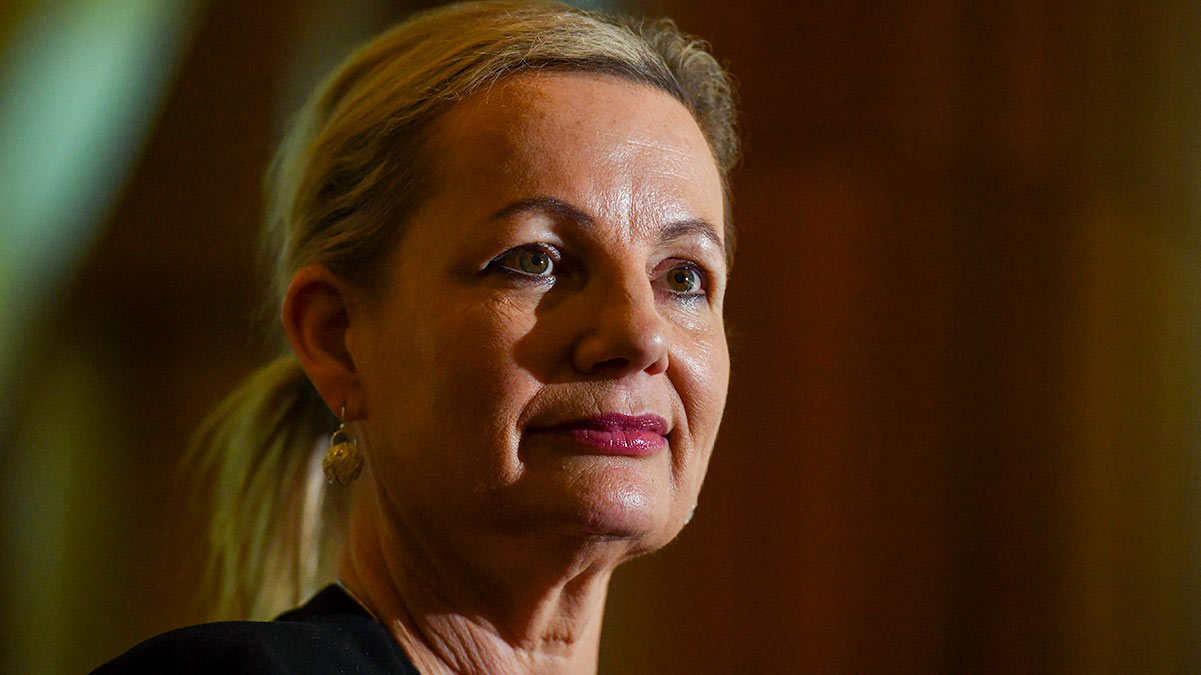
We came pretty close to opposition leader (and potential future prime minister) Angus Taylor – but ultimately, Taylor was not succesful. The Coalitions’ new leader is Sussan Ley, and her successs has generally been presented as a win for the more moderate wing of the Coalition.
Ley’s voting record on climate policies is roughly aligned with the positions of the Liberal party over time. While these records don’t always show an insight into a specific politician, they illustrate what they represent.
Ley generally voted strongly or mostly in favour of:
- – A plebiscite on carbon pricing
- – The Coalition’s ‘Emissions reductions fund’
- – Increasing state and territory environmental approval powers
- – Unconventional gas mining
And generally or strongly voted against:
- – Net zero by 2050
- – Taxing minerals and resources
- – Increasing investment in renewable energy
- – Carbon pricing
- – A transition plan for coal workers
- – Carbon farming
- – Letting environmental groups challenge the legality of certain government decisions
- – Net zero emissions by 2035
- – The Australian Renewable Energy Agency (ARENA)
- – The Carbon Pollution Reduction Scheme
- – The Paris Climate Agreement
- – Vehicle efficiency standards
Sussan Ley was environment minister of Australia for one day short of three full years, covering the term before Tanya Plibersek.
One of the most significant moments during that term was the federal court order that found Ley, as environment minister, has a duty of care to protect young people from greenhouse gas emissions impacts in 2021. The original case was brought in response to the expansion of Whiteaven’s Vickery coal mine (Whitehaven’s CEO Paul Flynn arrogantly dismissed the case as a “nuisance” at the time).
That Ley would appeal an order to display some responsibility for future generations felt like a rare moment of clarity and admission. As one of the group of young students suing the government, Anjali Sharma repsonded at the time:
“As a person in power, her job should be to act for, not against, the young people of Australia. But instead of doing her job of safeguarding our future, she is prepared to spend public money fighting for her right to make climate change worse, harm the environment and risk the injury and death of Australian children”.
But Ley’s appeal was successful, and in 2022 the appeals court ruled that Australia’s environment mininster can operate without a requirement to involve any concern for future generations.
“It does not change the science. It does not put out the fires or drain the flood waters. We will not stop in our fight for climate justice. The world is watching”, Sharma replied at the time. Many of these wounds are still fresh.
Ley’s tenure as environment minister saw the approval of several major coal mining projects, including the massive Adani coal mine. But this doesn’t differ too greatly from Plibersek’s tenure, during which many coal and gas projects were approved. Both Ley and Plibersek also rejected wind farm proposals in Queensland that would have severe impacts on biodiversity (something welcomed by climate and environment groups).
It’s worth noting that Ley was health minister during the years in which the Abbott government used fears of ‘wind turbine syndrome’ to demonise what was very signfiicant and new wind farm development at the time, overseeing several ‘studies‘ of the fears that themselves helped prolong a pseudoscientific trend that has thankfully burnt out.
“Last year the NHMRC concluded further Australian research, which was both of higher quality and conducted locally, was warranted in this area and this is what is now happening…..I’m not going to be lectured by a Labor party who disastrously tried to politicise medical research by slashing funding to cover its budget black hole, leading to marches in the street,” said Ley at the time.
Conversely, Ley spent a good chunk of 2021 and 2022 defending the over-arching goal of ‘net zero’, even on far-right video blogging networks like Sky News Australia. These clips are fascinating.
Even in recent years, Ley opted for a softer approach towards supporting gas in particular – not actively denying or decrying climate policy in general but arguing for a ‘slow’ approach to climate action that mimics the language of Morrison and Taylor in the later years of their government, as they tried to meet the climate moment while still supporting fossil fuels.
It isn’t easy to project what Ley’s tenure will look like, in climate, environment and energy terms. The world is very different to the 2019 – 2022 period of Ley’s time as environment minister.
In the UK, for instance, the tory opposition is becoming increasingly feral every single day, mimicking MAGA and switching to attacking the entire concept of having climate policies and the ‘need’ for net zero.
UK Labour have responded to these attacks not by holding firm but by shifting right. That won’t be mirrored in Australia precisely, but it does raise a contextual threat for both parties, and potentially a pathway for Ley if the opposition decides to exploit, wreck and destabilise.
Ley is capable of nuance, but also has a material track record of actively helping the fossil fuel industry by destroying a landmark legal win, much to the delight of the coal and gas mining industries. The next three years will be a test.