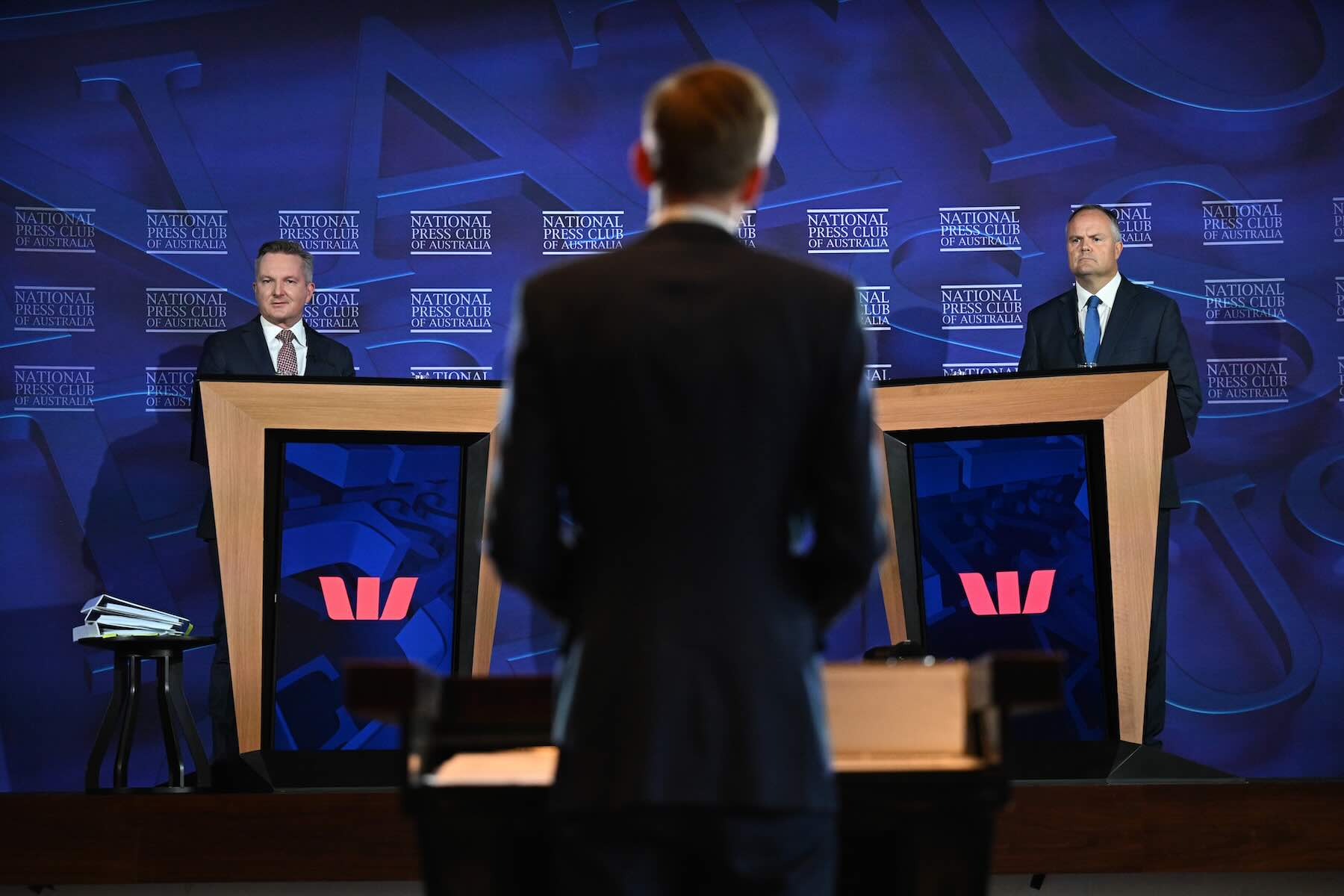
Energy Minister Chris Bowen vs Shadow Energy Minister Ted O’Brien. No, I didn’t want to wake up at 3am Norway time to live-post through it on Bluesky. So here’s a blow-by-blow annotated summary as I watch through the recording.
Opening bell – okay, honestly, is it just me or does the bell look EXACTLY like an old-timey oil drilling rig? Specifically the wooden suspension from There Will Be Blood. Setting the tone, I guess.

The event is sponsored by – and branded prominently with logos for – Westpac, a bank which Market Forces found has been funding fossil fuels pretty much every single year since the signing of the Paris Agreement.


Chris Bowen’s introduction doesn’t introduce much new information, but makes some problematic statements.
Eg, claiming that renewables were “33% the day we came to office, and 46% in the last quarter of last year”. That is sneaky math: renewables fluctuate around the year due to seasonal changes in sun and wind. It makes much more sense to take a 12 month rolling average.
With that, renewables in the NEM went from 33% in May 2022 to 39.8% in March 2025, with a notable stagnation followed by a recent return to a rising trend. I don’t think this is nitpicking: Bowen presents a 13% increase when really it’s more like a 7% increase. As I noted here, the NEM’s renewable proportion is a full 10% lower than what was modelled for Reputex back in 2021 (this becomes important later…).

Bowen makes a great point in his opening statement on reliability: “Just today, we have 4.7 gigawatts of coal-fired power broken down. Today. Not a day in the last two years hasn’t seen a coal fired power station broken down….”[the Coalition] think the way to improve reliability is to lean on the most unreliable part of our system”.
“Their modelling crumbles like a sao in a blender at the slightest scrutiny” – what a metaphor for the Coalitions’ nuclear modelling. It doesn’t make any sense, but it’s visually arresting and needlessly overpowered. 9/10.
Before Ted O’Brien starts his opening statement, a protester from Rising Tide interrupts to criticise the fossil fuel industry’s influence in politics. Amusingly, the NPC didn’t disclose the location until soon before the session, adding “this is a high security event”. Not enough to keep climate activists from speaking out, though. Good on the protesters – a reminder to everyone in that room that climate change is real, and that fossil fuels are the cause, and the reason for all of this is resolving the threat to humanity.
O’Brien centers energy security and ‘independence’ in his opening speech. There are so many things wrong with this, but a nice example is: Who is going to process the fuel for nuclear reactors? Who is going to build them? These questions never really come up in the first half.
“It doesn’t matter whether it’s the the market operator, it doesn’t matter if it’s energy experts there is no credible commentator in this country suggesting that prices will come down under the Albany Labor government”. Er, the AEMC’s latest report shows that power prices will probably come down regardless of who’s in power.
“There is not a country in the world trying to down the path that Labor is trying to go down – a predominantly wind and solar grid. This is unheard of.
Wow. That’s a huge stinker from O’Brien.
Of the 88 countries in Ember’s latest Global Energy Report, 14 have higher shares of wind and solar than Australia for 2024, and 48 have shares above 10%. And of the 14 with higher wind and solar shares, three (Spain, Germany and the UK) have significantly higher annual demand than Australia.
China and the US have shares of 17-18% wind and solar, comfortably the two largest power consuming countries. This isn’t even accounting for future plans – this is just what has been achieved so far. What a terrible falsehood.

“The Coalition’s plan is based on engineering and economics.” I’ve heard this a few times now, and it’s weird. It’s a Turnbull-ism that seems to have made a comeback. It’s a pretense by people who are just as emotional and ideological as the rest of us that they’re somehow granted special access to rationality. It’s very arrogant and I wish they’d stop.
“We do not believe we should be closing our baseload power stations prematurely; unlike Labor which is happy to close one system without having another one ready to go.”
This is a common tactic of setting an impossible standard. Obviously it makes no sense to build an entire system’s worth of wind and solar, but only connect it the instant all the coal is shut down like you’re doing a 1:1 swap. Ultimately this logic leads to never building anything new at all – which is O’Brien’s aim.
“Our plan is to replace retiring coal plants with zero emissions nuclear energy.” This another really bad one. Coal is going to retire from Australia’s grid in years – almost months, to be honest, and then it’s a drumbeat of retirements every few years. In the years before that, they will probably keep exploding.
There is not a single chance a fleet of nuclear reactors would be ready to replace them in time, and it is devastatingly irresponsible and just really bad for a shadow energy minister to claim something so deeply silly at an event like this. If you could somehow use one of those nukes to create a time machine that sends you back to 2015, and you started then – well, maybe.

“In [Bowen’s] own electorate, power bills have gone up by $1,300 more than what Bowen and Albense has promised them. The Treasurer last night couldn’t even bring himself to say a simple word: ‘Sorry.’” That’s another huge lie: analysis from The Australia Institute shows that while there has been a rise, the real number is far, far smaller. That probably deserves an “Australians, we got it wrong – sorry.”
Bowen holds up the Coalition’s gas modelling. “I’ve seen more detailed menus in a Chinese restaurant than this document.” Weird metaphor. Is he saying that menus in Chinese restaurants aren’t detailed? Does any restaurant have detailed menus? It’s also worded strangely to imply the modelling is also a menu, which it isn’t. 3/10, buddy. You started strong with the sao-blender gambit but you played yourself. Never play yourself.
After that, O’Brien shot back. “This is coming from the minister, whose own plan wouldn’t fit in a Chinese fortune cookie. If anything that’s probably where it would belong, because you’d crack it open and all it would be would be a slogan. No numbers, no plan, no modelling. It’s just a slogan.” I hate to admit it, but that’s a decent clap back, at the very least because the metaphor makes sense. Even Bowen found it funny. 7/10.
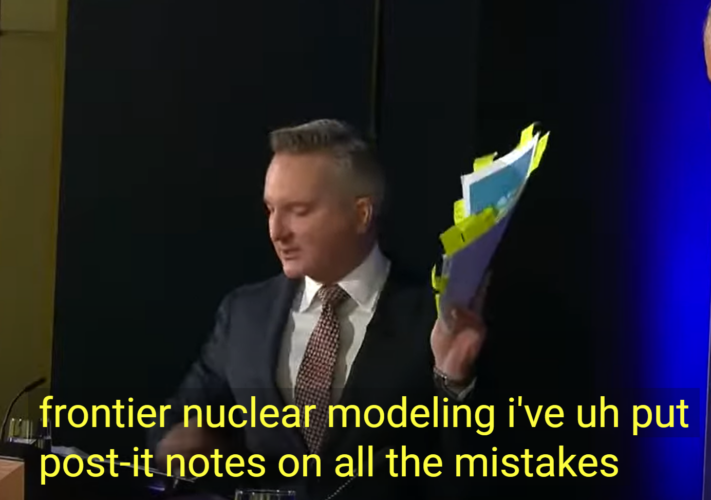
A constant theme through this debate is a fight about modelling, and specifically, Labor somewhat forgiving themselves for the conclusions of the Reputex modelling, that “did not predict the war in Ukraine.” That is true: the document was released on December 2021, and the war began in February 2022.
O’Brien also claims that Bowen is over-relying on the ‘step change’ scenario in the AEMO ISP, when explaining why he is overstating the cost reductions of the Coalition plan. Step Change sees higher power demand in the future than the Coalition’s preferred scenario, ‘progressive’, which is lower.
O’Brien describes it like this:
“Everybody is driving EVs. Like, everyone is driving an EV. Therefore you have to overbuild the grid to accommodate that. They believe that green hydrogen is going to be so big you need to almost double the size of the grid.”
The host, Sky News’ O’Connell, challenges O’Brien: “Like for like, it’s not a 44% reduction, is it?”
O’Brien says: “Yes it is. You know why? Because you’re comparing our plan – our plan, which is not to overbuild the grid, to Labor’s plan to overbuild the grid”
As I wrote here previously, that isn’t a good reflection of the different futures each party is leaning on. The Coalition’s preferred scenario sees a major decline in industrial power consumption – namely, the death of the aluminium smelting industry. The difference between the two scenarios for both EVs and hydrogen production is not particularly dramatic:

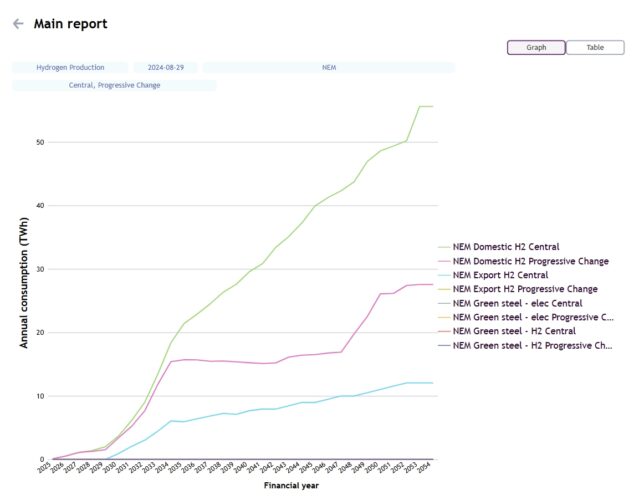
Source – AEMO forecasting portal
No – the core difference between Bowen’s scenario and O’Brien’s scenario is pretty simply a deeper cut to economic growth and business:

There is a long, protracted and pretty pointless spat about the dollar values behind each party’s modelling. What we don’t hear asked about or mentioned is the total cumulative climate impact of each party’s plans.
At least the Climate Change Authority spent some time asking this very question. The greenhouse gas emissions from keeping coal for decades longer will cause more financial harm than any of the numbers either leader mentioned.
At precisely 30:17, there is a really wild crash-zoom camera movement right onto Chris Bowen. I’m not sure why, but I enjoyed it: pointlessly dramatic and seemingly to no real productive or interesting end. That’s a fitting way to end the first half of this not-live-blog (deadblog?) on the debate. I can imagine walking away from this feeling exhausted, but honestly, this first half was pretty fun.
Both leaders were down in the weeds of the modelling assumptions and the numbers they’re relying on. Neither the ministers nor the moderator felt inspired to say anything about climate change, but that isn’t really surprising and won’t be any different in any context for this campaign. My next blog will cover the second half, where journalists asks questions of the pair.