The federal Coalition is not planning to cap renewable generation to make way for its nuclear dreams – despite touting modelling that said exactly that — or so says its energy spokesperson Ted O’Brien.
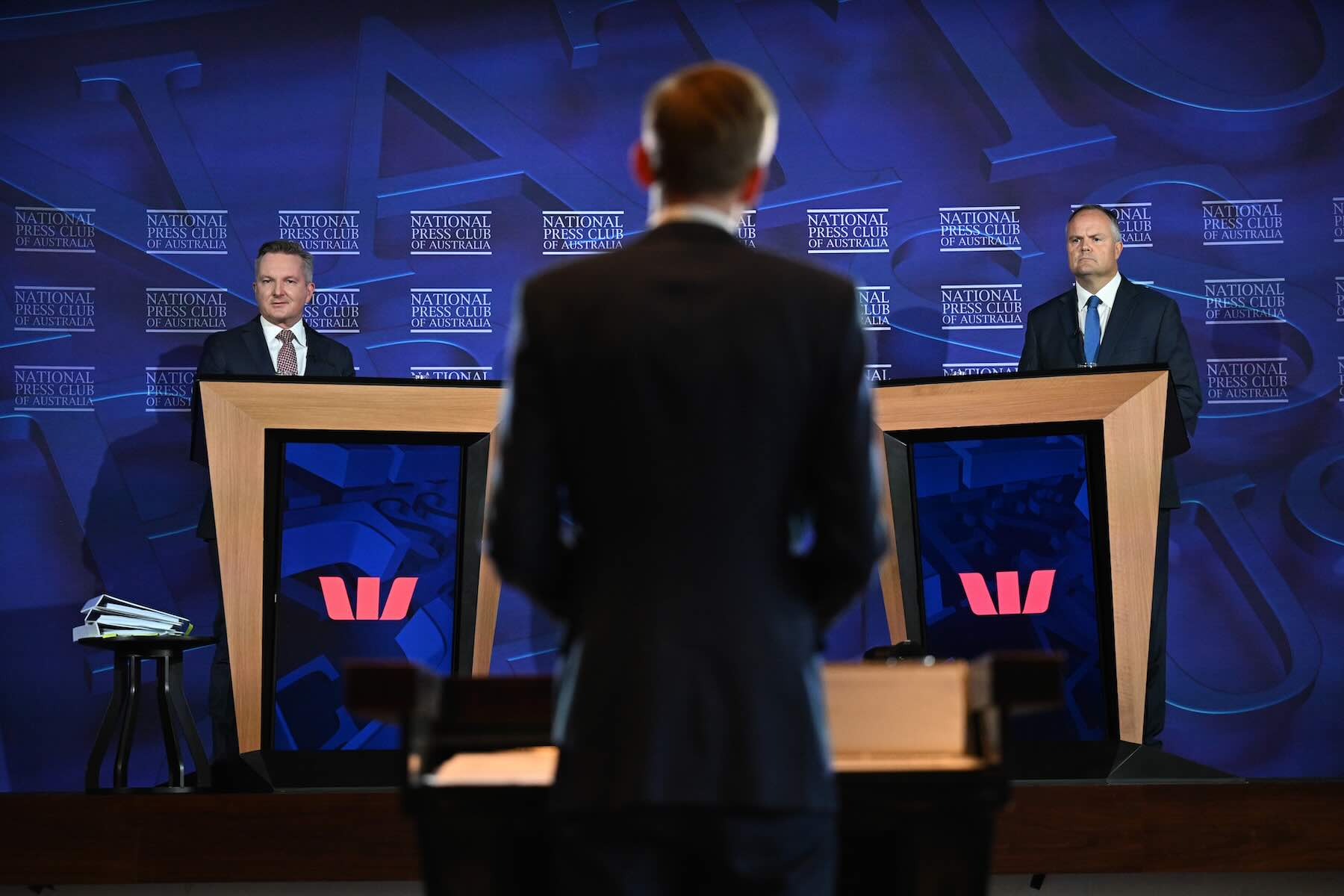
O’Brien appeared to contradict some of the core tenets of the Coalition’s nuclear proposal during a debate today with energy minister Chris Bowen at the National Press Club, with his first comments briefly held up by a heckler.
“There’s no policy that we have, which is capping any technology,” O’Brien insisted, drawing a quip from Bowen that either the nuclear modelling is wrong, or the policy is.
The Coalition is relying on modelling by Frontier Economics that says adding nuclear power to Australia’s energy mix will require wind and solar to be be around 54 per cent of the total energy mix by 2050.
But Australia will reach this level by 2028 – according to most analysis – just with projects that are already under construction or which are financially committed.
And energy sector stakeholders are worried that a Dutton government will cause developers to walk away from some 29 gigawatts of currently proposed projects, causing major job and investment losses in regional areas.
O’Brien also admitted – for the first time – that the Coalition’s mantra that nuclear will be 44 per cent cheaper than renewables-plus-storage isn’t strictly correct.
“If it’s the exact same amount of electricity you want to produce, the modelling looked at two scenarios. In both scenarios, once you put nuclear into the mix, it’s actually 25 per cent cheaper,” he said.
He said the extra 19 per cent came from avoiding the construction of new transmission lines to deliver renewable energy. Most energy analysts suggest even that modified claim is highly questionable, given the high costs of nuclear, and the plunging costs of renewables, particularly storage and solar.
During the debate Bowen point out the Frontier Economics modelling doesn’t take into account costs outlined by CSIRO in delivering a first-of-kind power source to Australia with nuclear, operating costs, and the cost of refurbishing nuclear reactors, nor does it factor in the cost of keeping aged coal power plants running in the interim.
Clear as mud
Opposition leader Peter Dutton also promised to abolish the $19 billion Rewiring the Nation fund during his budget reply speech, but this was another policy quickly followed by an admission, again from O’Brien, that the Coalition would still honour existing contracts.
There are 24 major transmission projects proposed across the east coast and Tasmania, leading the Electrical Trades Union to question which of these the Coalition intends to cancel.
“This raises significant questions of how the Coalition would achieve their projected $20 billion in savings from cancelling the fund,” the union’s briefing note speculates.
“With David Littleproud previously threatening to tear up contracts for wind and solar farm developments if elected, there remains significant uncertainty regarding the Coalition’s plans.”