One of the world’s biggest specialist investors in renewable energy, and a major developer in Australia, says the Trump administration’s tariffs could be good news for Australia’s green energy transition.
Jörn Hammer, the CEO of the Australian operations of Copenhagen Infrastructure Partners, which recently closed a giant $A21 billion green investment fund, says the Trump tariffs announced on Thursday morning (Australian time) could free up capital and the supply chain for the rest of the world.
“The US market doesn’t necessarily impact the rest of the world to the same degree as it would have 10 years ago,” Hammer said in comments made at the Clean Energy Investors Forum in Sydney.
“And I think if there’s more of the supply chain free to look to the rest of the world, it’ll probably mean good things, at least for Australia. I think that if the supply chain is focusing less on a big market like the US, it could probably help us in the short-medium term.”
The comments by Hammer are significant, given CIP is one of the largest investors in Australia’s green energy transition, with a pipeline of more than 40 gigawatts (GW) spread across offshore wind, onshore wind, battery storage and green hydrogen projects.
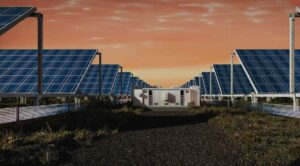
Its projects include the Star of the South, likely to be the first offshore wind project to be built in Australia, the giant Summerfield battery in South Australia, and what could be the first large-scale green hydrogen project, Murchison, which has been the first to land hydrogen head start funding from the federal government.
CIP recently completed a global raising of more than $A20 billion for a new investment fund that will target investments in onshore and offshore wind, solar PV, battery storage – and is looking at low-risk OECD countries in Europe, North America, and the Asia Pacific.
Analysts say that Australia could benefit because if the US tariffs act as a block to capital flowing into that economy, then it will need to find a home elsewhere. Australia could put its hand up.
However, the extent of that will depend on how the rest of the world responds, particularly China given that it also accounts for nearly all its solar modules, and the bulk of its wind turbines and battery storage, particularly as Tesla has now set up a battery manufacturing megafactory in Shanghai.
And the flip-side is the impact on global economic growth. A slowdown in growth means less grid demand as manufacturing load winds down, and that in turn means less need for new energy investment, although in Australia the need is great because of its ageing and increasingly unreliable coal fleet.
Hammer’s position appeared to be supported by the audience – mostly senior executives in the renewable industry, across developers, financiers, suppliers and regulators – with a spot poll showing just under half think Australia’s green energy industry should benefit, about the same number saying it is too early to tell, and just 9 per cent saying it would be bad.