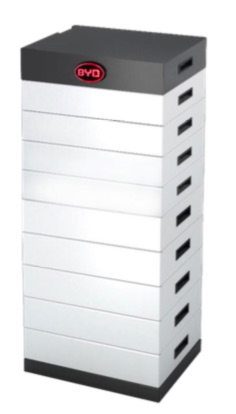
China’s biggest electric vehicle and battery storage company, BYD, is looking to grab a 25 per cent share of Australia’s burgeoning battery storage market, after launching a new B-Box product range aimed at competing with industry leaders LG Chem and Tesla.
In a launch at Sydney’s Museum of Contemporary Art on Wednesday that reflected both the company’s huge asset base and the scale of its ambitions in Australia, BYD (Build Your Dreams) hosted several hundred battery storage installers and distributors as it laid down its challenge.
As we reported on Wednesday, BYD is offering a range of products in low voltage and high voltage arrays, and at both the residential and the commercial and industrial markets.
The basic modular devices start at 2.5kWh and in the most popular array are likely to be stacked to up to 10kWh.
The company is being coy about its pricing, apart from insisting that it will remain “cost competitive” with Tesla, which appears to have become the industry pricing benchmark following the dramatic cost cuts revealed with the Powerwall 2, although this is yet to be available in Australia.
This pricing was confirmed by one of the company’s distributors, who suggested that pricing would range from around $5,000 (for its smallest 2.5kWh model), through to $13,000 for its 10kWh model, fully installed with inverters.
This would put it in within the ball-park of the Tesla Powerwall 2, although there is much industry talk that the Tesla pricing could be higher than forecast, although again this is confused by unconfirmed reports that Tesla will go direct to market, and not through distributors, as it has with its electric vehicles.
Earlier, another of BYD’s distributors, of Solar360’s Richard Smaldino predicted that BYD could grab between 25 per cent and 50 per cent of an Australian battery storage market that is forecast to grow to a possible 50,000 installations in 2017. The compares to a market of around 7,000 in 2017.
BYD marketing director Julia Chen was more circumspect, but still ambitious. “Starting from this year, we are looking to get 20-25 per cent of the market. This needs lot of work. But we are confident we have the best quality battery.”
That level would match its share of the global battery storage market, a level it has reached mostly due to its position as a supplier and manufacturer in the electric vehicle market, including electric buses.
Chen said that the combination of battery storage and rooftop solar was already delivering cheaper electricity than the grid. She expected the “returns on investment” of the technology to fall to around 5 years.
Like other leading international manufacturers, Chen says the Australian market is attractive because of high electricity prices, great solar resources, the presence of rooftop solar on more than 1.5 million homes, and the expiry of premium feed-in tariffs.
The energy security issues, including the blackouts in South Australia, and storm induced outages in other states, was also making back-up power increasingly attractive.

However, she also raised concerns about proposed new standards and installation guidelines that suggested battery storage units should not be placed inside homes or garages, and only in separate fire-proof enclosures.
Chen said this was reaching too far, and suggested that Australia should adopt international standards rather than going out on its own and risking a new industry. BYD says its lithium-iron-phosphate batteries are much safer than lithium-ion chemistries.
“Our suggestions would be to set up minimum requirements, because at the moment there is no minimum retirement. You need to have that. But there are no safety issues for putting our product in the garage.”