Home » Commentary » Where did all the energy demand peaks go?

Where did all the energy demand peaks go?

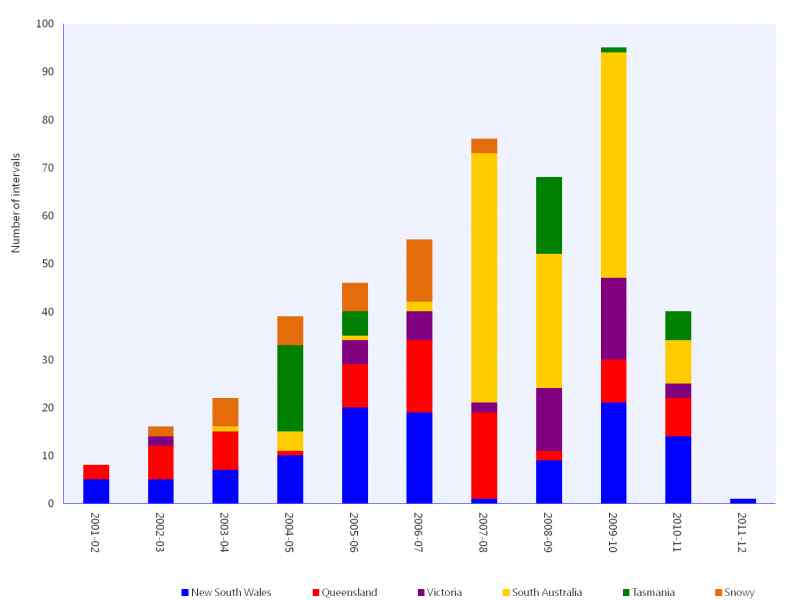
It has been estimated that around one quarter of the revenue earned by Australia’s electricity generators – and nearly all their profits – come from a short period – between 36 and 100 hours – of “super peaks” of demand that push wholesale electricity prices beyond $5,000 per megawatt hour or more. But what if those peaks never came?

We’re about to find out, because this graph below published by the Australian Energy Regulator reveals that there were virtually no peaks above $5,000/MWh in 2011/12. The graph tells the story for previous years.

The returns for Australia’s generators for this period have not yet been announced, but as we saw in the December half with Loy Yang A’s plunge into the red (before its purchase and refinancing by AGL Energy) those generators with high debt levels will be suffering badly. Those generators owned by vertically integrated companies can take it on the chin and offset it with higher earnings from their retailing operations.

Sadly, the record low wholesale costs being recorded this year in the NEM are not passed on to consumers. At least not yet.

And what is the reason for the disappearing peaks? For that we can go to the Australian Energy Market Operator report and find that milder weather (fewer extreme hot days when everyone flicks on their air conditioners at the same time), reduced demand from manufacturers, more efficient and cautious use by commercial and residential users in the face of higher retail prices, and the growing impact of rooftop solar (its deployment trebled in the past year). Welcome to the merit order effect.

Giles Parkinson is founder and editor-in-chief of Renew Economy, and founder and editor of its EV-focused sister site The Driven. He is the co-host of the weekly Energy Insiders Podcast. Giles has been a journalist for more than 40 years and is a former deputy editor of the Australian Financial Review. You can find him on LinkedIn and on Twitter.

Related Topics

Latest posts

S-curve modelling says renewables can kick coal out of Australia by 2032. But is this soon enough?

S-curve modelling says renewables can kick coal out of Australia by 2032. But is this soon enough?

In the race to renewables, the big question is whether “faster than we thought” is the same as “fast enough.” S-curves say we can do the first. Nothing in the modelling tells us we’re on track for the second.
“It’s a commercial system. And it has a customer:” Sodium-ion battery sale hailed as a first for Australia

“It’s a commercial system. And it has a customer:” Sodium-ion battery sale hailed as a first for Australia

The sale of a 100 kilowatt and 200 kilowatt-hour sodium-ion battery system is being claimed as an Australian first – and may herald next generation of storage tech.
Energy Insiders Podcast: Will the green bank save the Tomago deal?

Energy Insiders Podcast: Will the green bank save the Tomago deal?

CEFC boss Ian Learmonth explains why big wind projects may finally get delivered this year. Plus: Tomago aims for 100 pct renewables, and the big utility profits.
Balcony solar or building integrated PV? The emerging options for apartment dwellers and owners

Balcony solar or building integrated PV? The emerging options for apartment dwellers and owners

A Victorian parliamentary inquiry on apartment energy issues has recently reported and identified several issues that require urgent attention to address the failures of energy policy. One interesting issue that relates to both high rise apartments, and plug-in ‘balcony solar’, is where solar fits into apartment occupant energy costs.  High rise apartment buildings have very […]
13 Comments