As winter ends, electricity consumption has eased from its July peak. Coal generation in the NEM usually declines substantially between July and August – by more than 7% based on the average of the last five years.
This year followed the familiar pattern, capped by the final week of August, which saw the NEM’s highest weekly renewable generation on record.
Month-to-month generation can be noisy – monthly wind highs are scattered across June to September over recent years – so looking at a seasonal view can give a clearer picture of the broader trends.
Variable renewable generation over winter 2025 was up about 20% across the NEM, well above the previous high in 2024. Victoria led the way, lifting wind and solar output 28% over last year’s winter levels.
Fossil generation shows no such consistency. Coal use is lower than in 2021 and 2024, but higher than 2022 and 2023. One reason for this is growing demand. After plateauing from 2016–2021, consumption has risen steadily. This winter was almost 3.4% higher than the same period last year.
Greater clean energy additions will be needed to not only replace our fossil fuel generation, but also to meet our growing energy needs.
There were 45 records broken in August. View them all.
Here’s your monthly dispatch from Open Electricity:
Notable Records:
1. Highest battery discharge over a calendar month in Western Australia
Western Australia has some of Australia’s largest batteries, and the WEM has had higher battery discharge as a percentage of consumption than all regions in the NEM (other than South Australia). This has come largely from two 4-hour batteries that were added in September last year, Collie Stage 1 and Kwinana Stage 2.
In August, WEM battery output lifted dramatically, with the monthly total reaching over 67 GWh – about 23% higher than the previous record set last month. As a percentage of consumption, this is much higher than SA, and for now WA is the battery capital of Australia. Daily and instantaneous records broke repeatedly across the month.
This can be attributed to the WEM’s fourth and newest battery unit, Collie Stage 2. At 341 MW/1363 MWh, the Neoen project is the third largest battery in Australia by storage capacity. If we include the 219 MW/877 MWh Stage 1 at Collie, it is currently the largest.
Unlike many NEM facilities with a prolonged commissioning period, Collie completed commissioning in just four months.
Collie 2 contributed massively to the state’s generation. In fact, on 11 August, it discharged a total of 1246 MWh in a day, which was at the time more than any single battery had ever discharged in a day in Australia, though this was soon surpassed. Such is the hyperactive state of battery generation in Australia today.
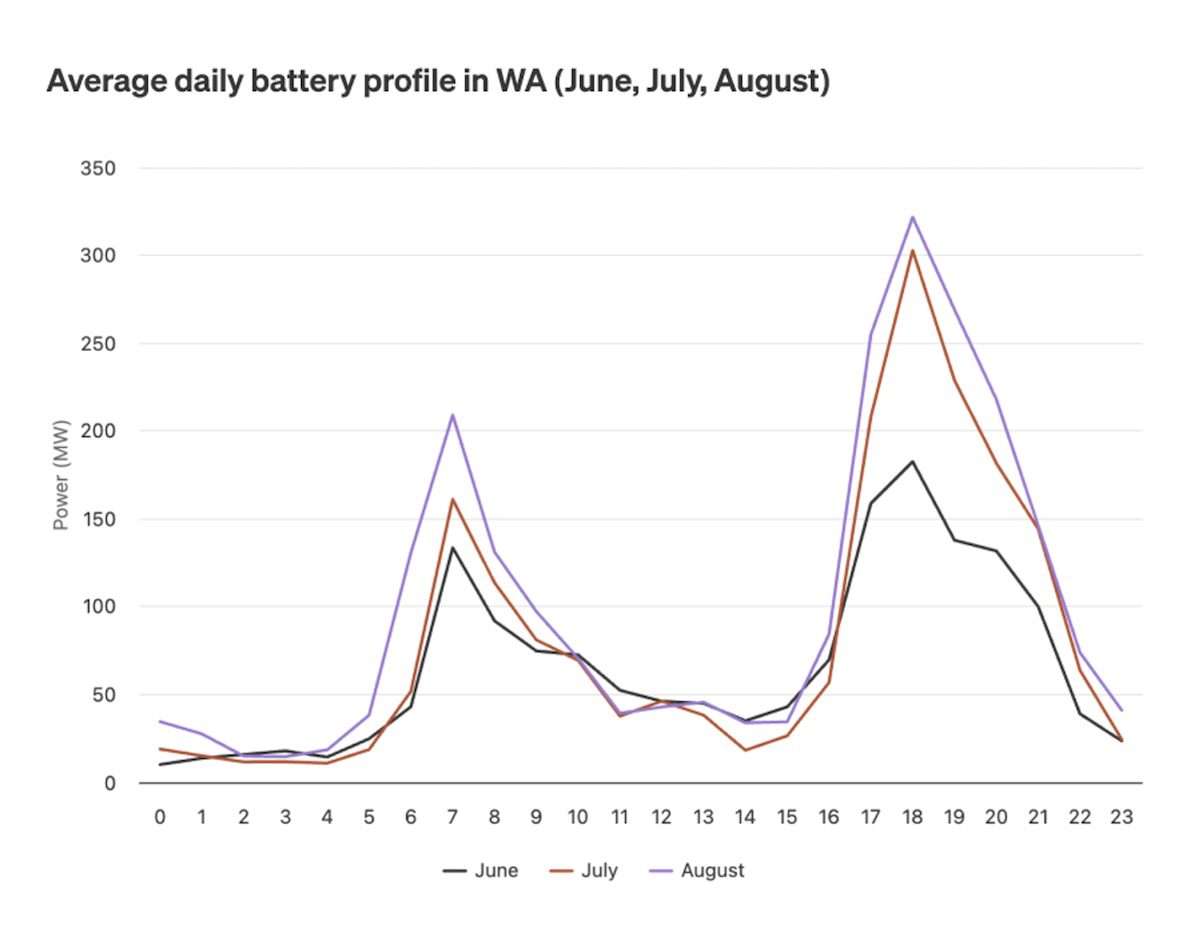
All of this amounts to a striking visual on our tracker page:

2. Highest battery charge over a day in Queensland
Queensland set a new daily charging record on 20 August, soaking up 2164 MWh – edging past the previous high of 2146 MWh set on 6 July.
We often focus on battery discharge, but charging is just as important. Batteries store energy when supply is plentiful and shift it to times of higher demand – often helping to capture renewable output that would otherwise be ‘spilled’. Spillage, also known as curtailment, refers to energy that could have been generated but isn’t delivered to the grid, either because of network congestion or low market prices.
Curtailment received particular attention following the release of AEMO’s Enhanced Locational Information Report, which provided detail on the grid’s ability to accommodate new capacity in different locations. Open Electricity is in the process of adding curtailment data to our site, to give users a better understanding of the phenomenon.
It’s important to note that some amount of curtailment is expected – it doesn’t make sense to build enough wires or storage to use every single watt of renewable generation (as Dylan McConnell explains here). But when levels run high, it signals a missed opportunity.
Increased battery charging in Queensland last month is of particular note as it has especially high curtailment of solar resources:

We can see that – even in August, far from the annual solar peak – we are curtailing a large amount of renewable energy, some of which could be made available for consumption. Over 5000 MWh of batteries currently under construction in Queensland to do just that.
3. Highest battery discharge over a day in New South Wales
On 25 August, New South Wales batteries discharged 2904 MWh across the day – over 28% higher than the previous high of 2,252 MWh set on 11 July. What stood out was the timing: much of the output came during the middle of the day, even at negative prices.
This rarity can be attributed to the commissioning Waratah Super Battery, which alone discharged 2169 MWh – almost enough to set the record by itself. In doing so, it convincingly reclaimed from Collie 2 the title of the largest single battery daily contribution in Australia.

That output equates to about 1.29 cycles over the course of the day – more than most commissioned batteries. As we have touched on in previous Dispatches, a handful of very large batteries continue to dominate new records simply by virtue of their massive scale.
Facilities Update
Bulabul Battery commences construction
The first stage of the Bulabul Battery (formerly Wellington BESS) commenced construction this month. Developer AMPYR Energy expects to energise the battery’s 300 MW/600 MWh first stage in 2026. Construction of a 100 MW/400 MWh second stage is slated to commence in Q2 2026.
The project was renamed by the local Binjang Clan of the Wiradjuri people (“Bulabul” means “two acting together”) and is the NEM’s first equity partnership between a developer and a First Nations community without pre-existing native title rights. The Wambal Bila community-led corporation has secured a 5% equity stake in the project.
Bulabul brings the total number of committed NSW batteries to 14 – the most in the country. Across the state, over 8GWh of battery projects are currently under construction.
Merredin build begins
The 100 MW/400 MWh Merredin BESS commenced construction on 5 August. The facility is expected to be commissioned in October 2026.
The project is being developed by Atmos, a company best known for its wind assets, including the Macarthur Wind Farm, which was Australia’s largest wind facility for almost nine years. Merredin is the company’s first battery project.
Melbourne Renewable Energy Hub powers up
Victoria’s largest battery-in-waiting, the Melbourne Renewable Energy Hub, first generated on 12 August. Stage A contains three units totalling 600 MW/1600 MWh – far larger than the Victoria Big Battery (300 MW/450 MWh), and almost as large as all active batteries in Victoria combined (1706 MWh).
The second stage began generating on 25 August, with the final stage to follow in the near future. The battery is developed by Equis, a Singapore-based company and newcomer to the NEM. The company’s second battery project, the Calala Battery, is currently under construction.
Lynton Hoey is from The Superpower Institute. The original version of this article was published on Open Electricity under Creative Commons Attribution-NoDerivatives 4.0 International (CC BY-ND 4.0). It has been published/amended here with permission from the author.
You can subscribe to the monthly Open Electricity newsletter here.
URL: