Molong Solar Farm. Source: TransGrid
A new report released yesterday by WWF Australia provides a valuable update on the weighting of effort and ambition across a range of different levels of government, in Australia. The most recognisable distinction is between the federal and the state governments; the former confirmed as laggards and the latter picking up the slack.
What WWF’s report highlights is that not all is lost, even as the Australia’s notoriously resistant federal government seems to dig in deeper. A range of state-based initiatives – like renewable energy targets, investments in storage and zero emissions hydrogen, and renewable energy zones – are all directly contributing to injecting momentum into climate action in Australia. Uniquely, the WWF’s report also prioritises benefit sharing and consideration of First Nations people in its judgement of each government’s renewable progress.
As RenewEconomy reported yesterday, “the States and Territories are clearly doing the heavy lifting, with the federal government ranking second last, behind only the Northern Territory, in their efforts to support a switch to renewable energy sources”. However, the report also highlights that there are a range of shortfalls in state governments that, if addressed, could result in many of these regions going even further. Given the urgency of this challenge, it’s worth exploring some of those shortfalls and areas for improvement.
It’s not a bad approximation to hold in your head that aligning Australia with a 1.5°C global temperature target will mean its grid needs to hit near-zero emissions by 2030. That is nine short years to go from 26% to 95-100%, after it took 20 to go from around 7% to 26%. Each state in Australia has its own unique characteristics for electrical power. Tasmania and South Australia both lead in this sector, not just in the existing deployment of zero emissions technologies but in planning for an acceleration and expansion of their capabilities to export that power to other states.
Western Australia is a notable laggard. Primarily because the most recent state election saw some of the weirdest energy policies in recent memory. The opposing Liberal party went into that election with a wildly and genuinely ambitious 100% renewables plan, and almost no chance of winning the actual election. The Labor government, winners of the recent election, have a widely criticised and extremely weak renewable policy. Labor’s leader even went so far as to accuse the Liberals of bringing on blackouts and high power prices due to being too ambitious with their renewable policy. It’s wild.
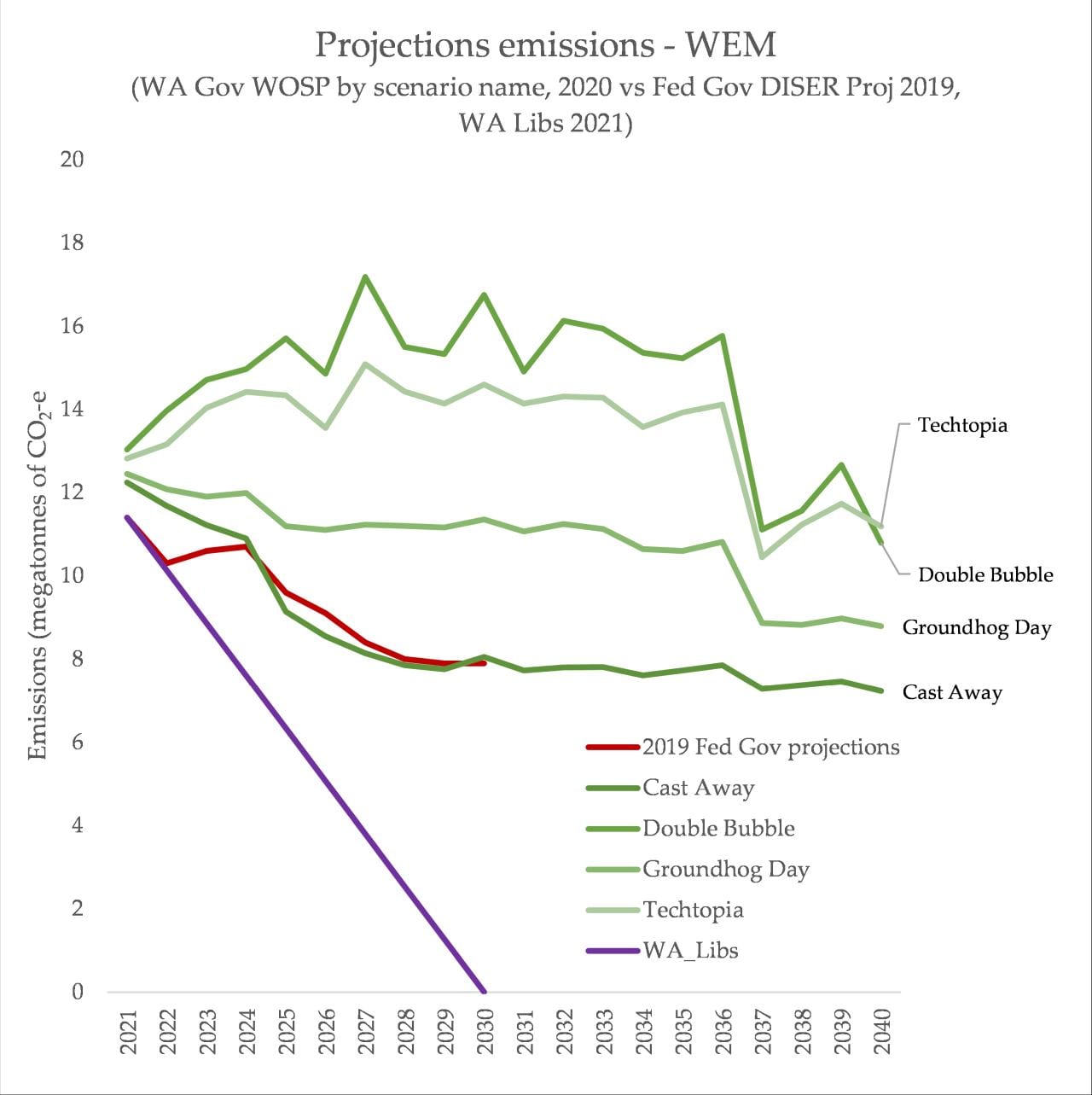
WWF’s report points out the absence of a strong renewable target as a key issue in WA. “This lack of clear direction from the government creates uncertainty, undermining the growth of the renewable energy sector”. In fact, the WA government’s most ambitious projections of emissions from its power sector align with the federal government’s notoriously un-ambitious projections:
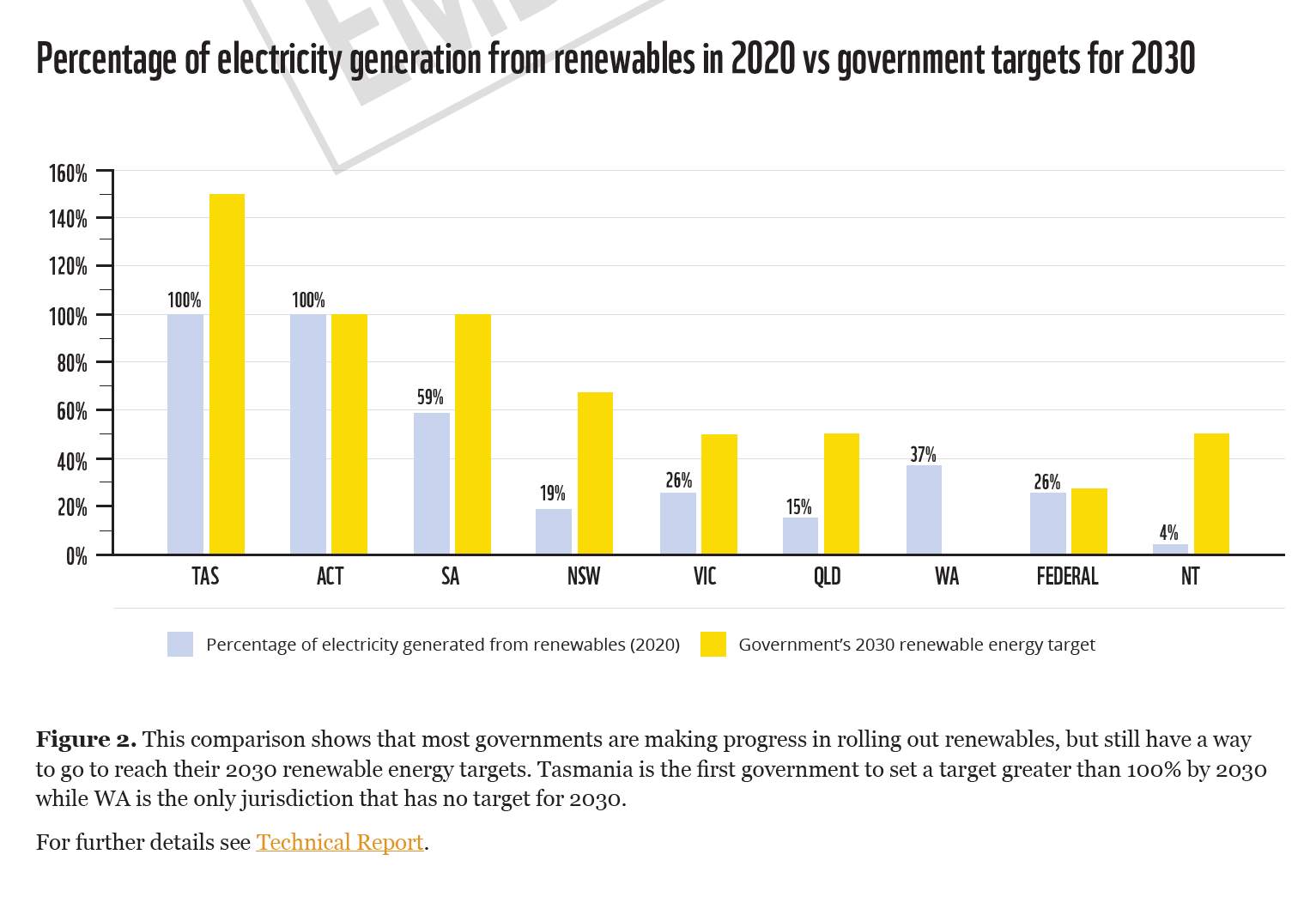
The WWF report shows that WA is in fact completely alone in not having a 2030 renewable energy proportion target:
The export of zero emissions energy products is a key theme in the WWF report, which itself serves as a clear marker of how much the debate has (thankfully) shifted in Australia. While many areas are looking into renewable hydrogen, “The full range of potential renewable export products are not yet receiving government support.” And the long-running issue of a lack of benefit sharing isn’t being addressed anywhere – something extremely vital, if Australia is to ramp up its renewable sector at double or triple the speed of the past two decades.
At the state level, it is tough not to notice some cracks appearing when it comes to making real-world changes that reflect ambitious announcements and net-zero promises. The Victorian government, for instance, seems to have entered into a secret deal with one of the state’s most polluting coal generators to ensure it stays open until 2028, even if it faces economic headwinds from renewable energy growth. And its approach to taxing electric vehicles is enormously retroactive. Queensland’s Labor government is eagerly supporting more coal extraction and Western Australia’s government is going hard on supporting gas.
The existing successes detailed in WWF’s report are a simple reminder that there isn’t much excuse left for any more delay. What’s come, do date, has brought a boom of jobs and benefits to various states. The federal government isn’t likely to change approach any time soon, so the states getting their act together is more important than ever.
BoM chart shows giant El Niño climate pattern in the Pacific is nearing record weekly…
Report suggests focus has shifted from how we can leverage rapidly improving emissions measurement technologies,…
The Australian Greens has named its new leaders, in a move the party says will…
Controversial plan to extend one of Australia's biggest coal mines for almost two decades secures…
CleanCo annual loss comes as it ditches plans to buy large wind farm and convert…
When larger farming machinery and vehicles are fully electric and affordable, Australian farmers will grab…