Western Australia’s Labor government has splurged on green industry, grid upgrades and electrification in its latest state budget, including half a billion dollars towards a transmission project that will “expand renewable generation and shut down coal-fired power stations by 2030.”
The Cook government’s 2025-26 state budget lists a $584 million investment in stage 2 of Western Power’s Clean Energy Link North and Regans Ford terminal projects, which it says will unlock wind generation north of Perth.
The downpayment on the renewables expansing transmission project was billed by the government as part of a $13 billion budget allocation to “significant growth in water and energy infrastructure, delivering on our commitment to become a renewable energy powerhouse.”
Although it’s not entirely clear how much of that $13 billion goes to energy, or where it was all spent. It could be that a decent share is going towards subsidising state power and water costs. According to the budget overview the state had its “sixth consecutive year keeping power and water prices below inflation.”
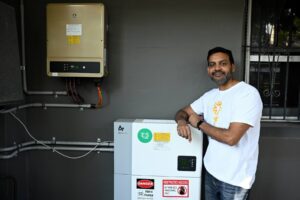
What we do know is that another $337 million was allocated to the state’s Residential Battery Scheme, which was recently “stacked” with the federal Labor Cheaper Home Batteries scheme to extend its reach well beyond the limits of the state’s original funding allocation.
According to a Budget Overview, another $50 million has been put towards supporting local battery manufacturing, for grants and low interest loans to support locally produced residential and industrial batteries.
Further, as Renew Economy reports here, $25 million is being set aside to drive the local manufacture and supply of poles and wires needed to deliver the state’s renewable energy transition.
And $30 million goes towards a further round of funding for new energies industries through the Investment Attraction Fund to support critical minerals, hydrogen and carbon capture and storage projects.
As part of the Made in WA policy, the government has allocated $83 million to produce electric buses and ferries in the state, building – it says – on the success of railcar manufacturing. A further $103 million will go to the state’s transition to a fully electric bus fleet.
The budget announcements follow the release, earlier in the week, of a new strategic roadmap outlining the state’s plans to position the Pilbara as a global hub for clean marine fuel and a leader in the decarbonisation of the global maritime sector.
Released on Tuesday, the ‘Pilbara Clean Fuel Bunkering Hub’ strategic roadmap was published by the WA government and Pilbara Ports, which was established in 2014 by the state government to consolidate seven of the state’s port authorities into four new regional port authorities.
Billed as the first of its type in Australia, the bunkering hub – a port that supplies marine or ‘bunker’ fuel to ships – would enable the use of alternative marine fuels such as ammonia, and would support decarbonisation efforts across the shipping, resource, and maritime sectors.
Over 7,000 bulk carrier vessels visit the Pilbara each year, including 3,865 iron ore vessel arrivals running primarily on the trade route to China. According to Pilbara Ports, in 2023/24, these iron ore vessels consumed over 3.2 million tonnes of heavy fuel oil, resulting in more than 9.9 million tonnes of carbon dioxide equivalent (CO2e) emissions.
Were that same fleet operating on low carbon ammonia produced in the Pilbara, however, Pilbara Ports predicts the fleet would produce less than 560,000 tonnes of CO2e per year, a 94 per cent reduction.
Cook Labor government also announced this week that it will work with industry peak bodies to conduct an intensive consultation process to assess how to position the state’s economy to compete on a global scale as a clean energy powerhouse.
“This work reflects the Cook Labor government’s focus on making more things in WA and diversifying our economy through access to secure, competitively priced clean energy,” said Amber-Jade Sanderson, Western Australia’s minister for energy and decarbonisation.
“I look forward to working closely with industry over the coming months to ensure we can create the right policy settings around energy infrastructure, market rules and the role played by our State-owned energy utilities.”