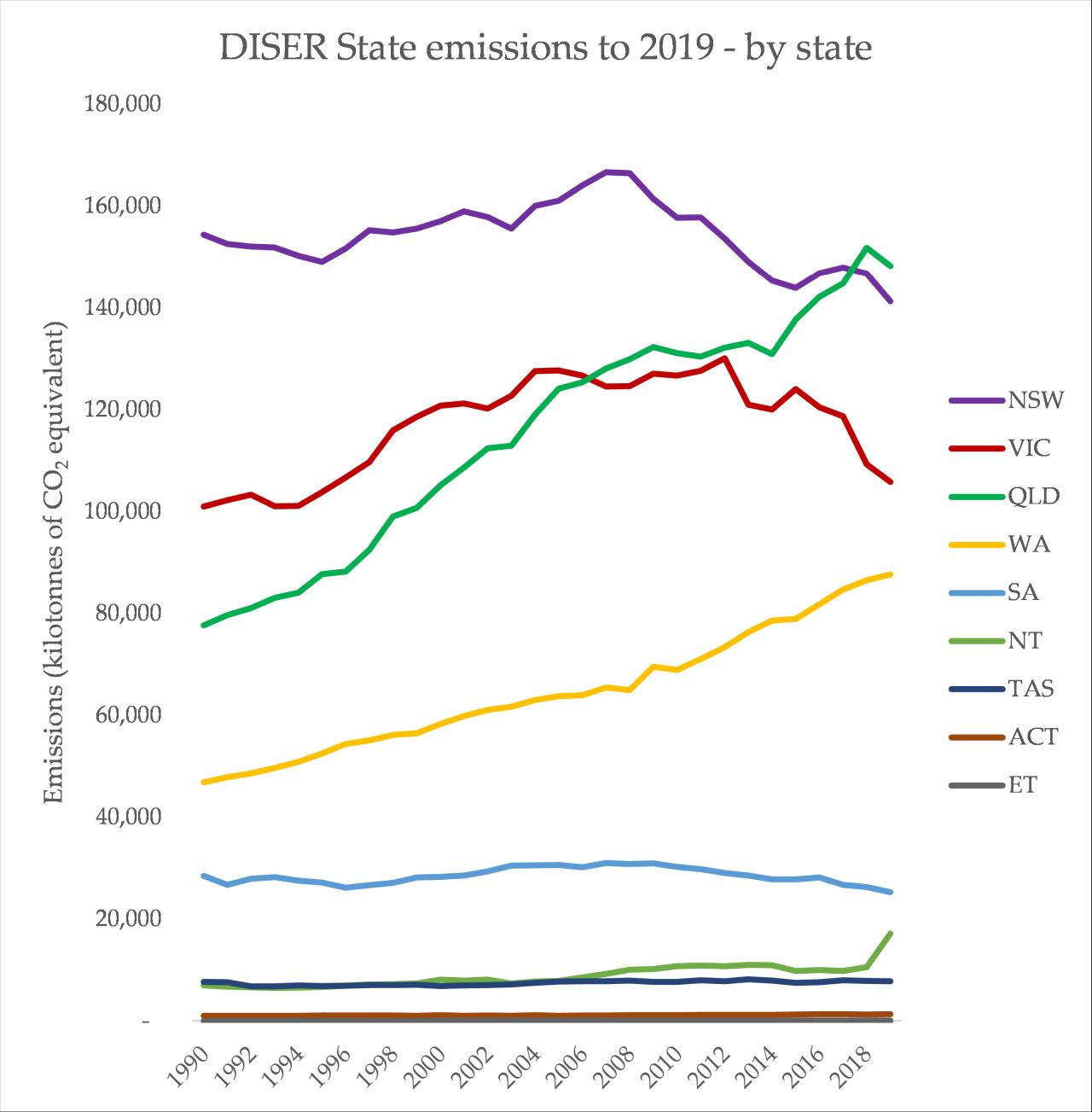
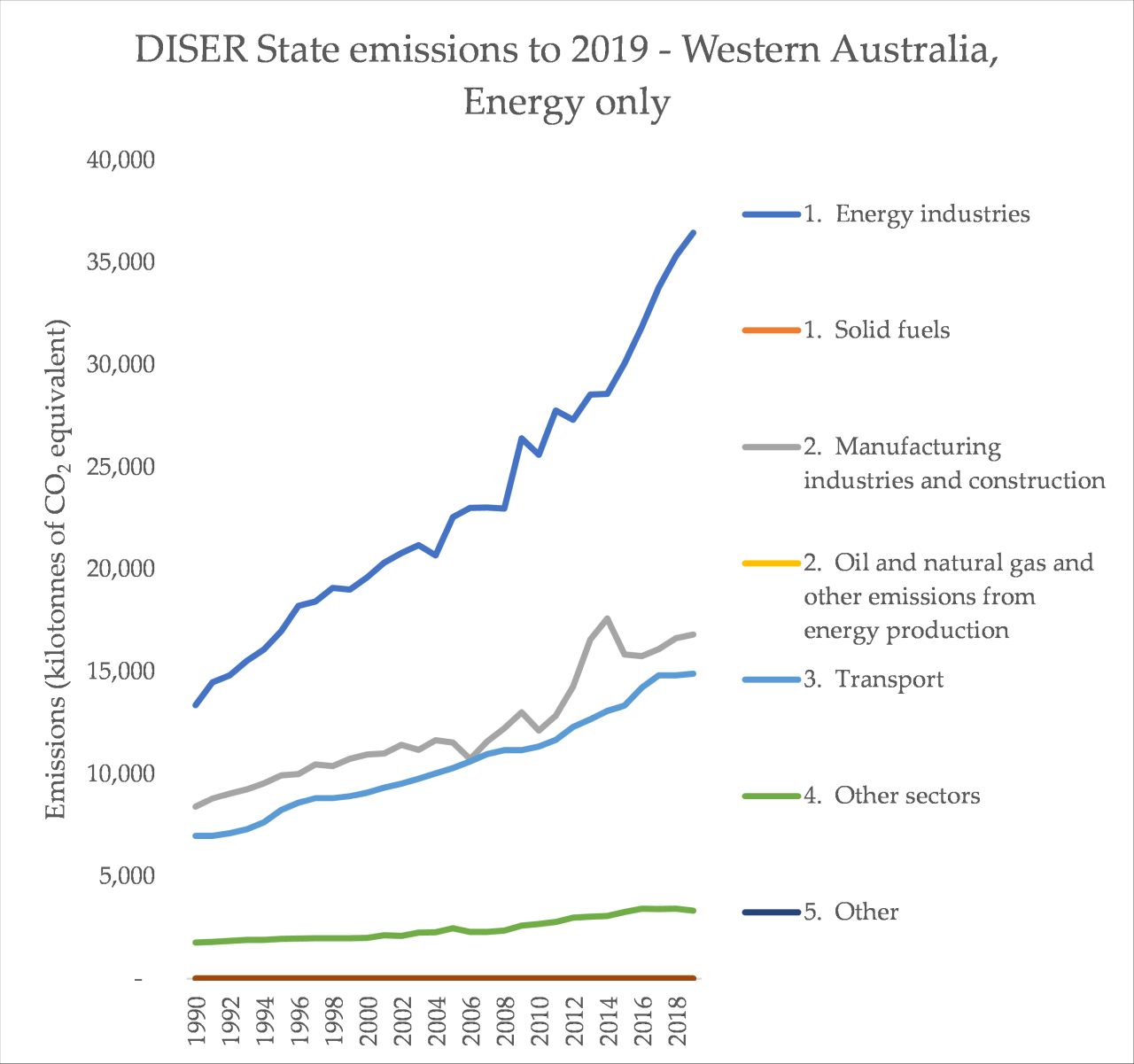
New emissions data relating to state and economic sector emissions in Australia updated to include 2019 reveal the details of shifts in greenhouse gases, and growing problems that threaten Australia’s climate ambitions.
The Department of Industry, Science, Energy and Resources released the data over the weekend, and though more recent national emissions data has been released, these figures provide far more granularity on emissions across both state and territories in Australia, and economic sectors.
They show that a rapidly expanding gas mining sector – the heart of the federal government’s ‘gas fired recovery’ – is responsible for a significant increase in emissions, and rising transport emissions across all states. They also show the notable impact of rapid renewable energy growth, in the year prior to the onset of the COVID19 pandemic.
In Western Australia, emissions have increased nearly 21% since 2005. DISER highlights that this is driven by an explosion in mining and exports, driving “increases in stationary energy and fugitive emissions from fossil fuel extraction”. The Northern Territory also stands out as having seen significant emissions growth due to fossil extraction, as “emissions have increased by 46.5% on 2005 levels”.
Transport stands out as a key source of emissions growth – every single state has seen notable rises in transport emissions, as population growth cancels out any gains in the efficiency of fossil vehicles. Several states have come under scrutiny as they have proposed taxing electric vehicles to make up for the loss of revenue from taxes applied to petroleum products, purportedly to fund road maintenance. Australia’s federal government announced a ‘Future Fuels Strategy’ (FFS), which was also criticised for taking insufficient action to reduce transport emissions.
Using Australian Bureau of Statistics data that show the population in each state, it is possible to determine an estimate of the transport emissions intensity within each region. Queensland, Western Australia and the Northern Territory have all seen significant increases in emissions intensity for transport, likely linked to the use of heavy vehicles in mining and/or larger cars being sold for use by residents.
Other states have seen significant reductions in emissions due to renewable energy growth. In South Australia, “emissions have decreased by 32.9% on 2005 levels, mainly due to reductions in emissions from stationary energy (electricity) and the land sector”, and in Victoria, “emissions have declined 24.8% from 2005 levels” due to the growth of renewable energy.
State-level data organising each region’s emissions by ‘economic sector’ provide more clarity, with mining emissions, for instance, grouped into their own clear category. This category has driven emissions increases significantly over the past three decades, in Australia:
The data also show that only 27 of the 127 MTCO2-e of emissions from mining is associated with the emissions footprint of purchased electricity. Many mine sites utilise on-site generation, in many cases burning the fossil fuels being extracted at the site (such as coal or gas). This means decarbonising the mining sector will be a struggle for many states.
The data show that though several states have established net zero target, many sectors outside the electricity sector will require rapid and significant action, to achieve deep cuts in emissions over the coming decades. Mining and transport in particular are in a state of systemic increase, and this must be reversed for any hope of reducing emissions.
State tips $500,000 into local family-owned electric motor specialist to support delivery of a state-of-the-art…
Energy market operator reinforces need for more flexibility, storage and transmission as electricity demand is…
As the NT marks first gas from the huge Beetaloo "carbon bomb," the Pacific Islands…
Behind the Pacific’s reliance on fossil fuel imports lies an extraordinary economic opportunity. But tapping…
Plans to add batteries to three-quarters of the turbines at a proposed 298 MW wind…
Fossil fuel lobbyists are flooding social media with ads, outgunning the minimal effort of the…