Source: SA Power Networks
As One Nation promises to scrap major grid upgrades and turn the energy policy dial back to baseload power from old and new coal plants, the energy market operator has reported new record lows in electricity demand it says reinforce the need for the exact opposite: more flexibility, storage and transmission.
The first record comes from Australia’s most renewable-powered state, South Australia, where the Australian Energy Market Operator (AEMO) says rooftop solar met 99.9 per cent of total electricity demand on Sunday August 30, slashing demand from grid-scale generation to just 2 megawatts (MW) at 1:30pm (AEST) – a new winter record.
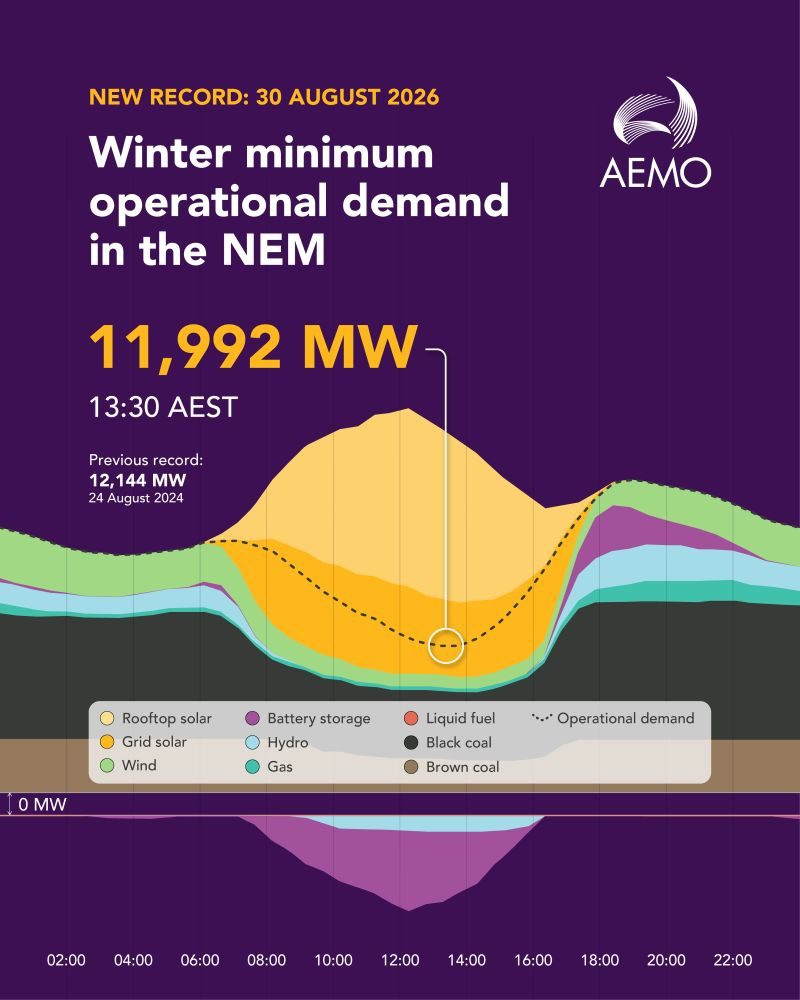
On the broader National Electricity Market (NEM), AEMO says mild temperatures and clear skies across the south-east of the country sent winter minimum operational demand down to 11,992 MW, also at 1:30pm, undercutting the previous winter low of 12,144 MW, set in August 2024.
“High rooftop solar generation and negative wholesale prices also saw batteries charging at above-average rates, absorbing excess renewable electricity for use during the evening peak period,” AEMO said on LinkedIn on Monday.
Image source: AEMO, LinkedIn
AEMO says that at the time of the NEM minimum demand low, rooftop solar was contributing close to 54 per cent of underlying demand, while renewables including rooftop solar, grid-scale solar and wind accounted for 71% of generation.
Battery charging accounted for around 10.5% of total demand, while just over 2% was being used for hydro pumping.
Meanwhile, average wholesale prices sailed into negative territory across every NEM region, ranging from -$7.40/MWh in Queensland to -$8.60/MWh in Tasmania.
“These records demonstrate how rapidly the electricity system is changing, with high renewable generation increasingly being balanced in real time by batteries, hydro and gas, supported by the transmission network,” AEMO said on LinkedIn.
“For AEMO, these conditions reinforce the need to plan for a power system that is increasingly dynamic – with the flexibility, storage, transmission and operational capability needed to maintain a secure and reliable supply as the energy transition accelerates.”
Australia as a whole posted its equal-third warmest winter on record, with mean temperatures coming in at 1.45 degrees above the 1961-90 average, the Bureau of Meteorology reported on Tuesday.
For the states of NSW, Tasmania and Victoria, it was their mildest winters on record, beating previous highs set in 2023. Queensland’s winter that just concluded was its second warmest, trailing only that season in 2023.
Victoria smashed its previous warmest winter by almost a quarter of a degree, at 1.4 degrees above the long-term average. Tasmania’s record winter exceeded the previous high by 0.15 degrees, while NSW’s new high was 0.05 degrees warmer than the previous record.
The ski season has been one of – if not the worst – on record for Australia, with much of the precipitation in recent weeks falling as rain rather than snow.
For minimum temperatures over winter, almost the entire nation recorded above-average readings. The sole exception was a patch of northwestern Western Australia.
The building record El Nino weather pattern in the Pacific has begun to influence global temperatures, with this year on track to one of the hottest and 2027 likely to be warmest on record – potentially by some margin.
For August alone, almost all of the nation reported “very much above average” mean temperatures, according to the Bureau of Meteorology. The month was Australia’s fifth-warmest August by mean readings, with Tasmania posting its warmest ever August.
If you would like to join more than 29,000 others and get the latest clean energy news delivered straight to your inbox, for free, please click here to subscribe to our free daily newsletter.
The "35 by 35" electrification goal has an Australian origin that the government seems to…
If we fail to ensure data centres pay for new renewables and storage to cover…
Home batteries look like resetting the behaviour of households when it comes to responding to…
South Australia energy minister hints that the 100 pct net renewables target may not be…
Australia's first major transmission loop is now operating, and will be at full capacity by…
Former EDO boss and now Greens MLC Sue Higginson on the huge implications of the…