“What’s better than a subsidy-free renewable project?” asks wind farm engineer David Osmond. “How about two subsidy-free wind farms that have returned over $6.5 million to ACT electricity consumers since early 2023!”
Osmond, who works for Windlab, has brought attention to the Goyder South and Berrybank wind farms, two of the newest wind projects in Australia, and the way that they are protecting consumers from higher wholesale electricity prices and soaring bills.
Both wind farms have contracts with the ACT government, agreed and signed in 2020, and according to Osmond, the two wind farms have already returned $6.5 million to ACT consumers. And if wholesale electricity prices remain high, they will deliver even bigger savings.
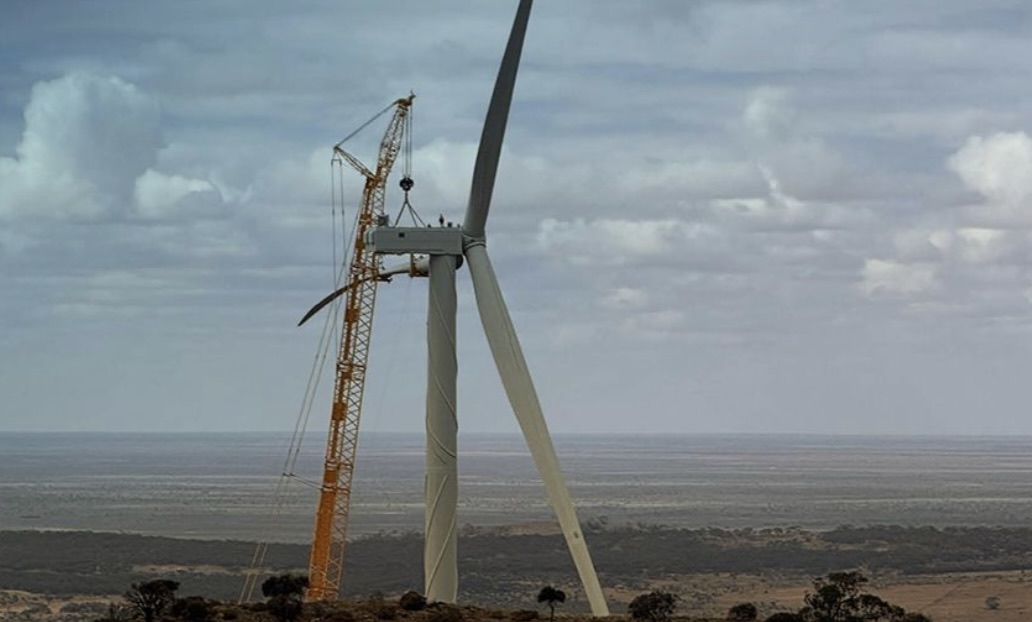
Neoen’s Goyder South wind farm in South Australia, which at 412.5 megawatts will be the biggest in the state when fully commissioned, agreed to supply power to the ACT for part of its output at what likely remains a record low price in Australia – $44.97/MWh, fixed for 14 years,
The agreement with GPG’s Berrybank wind farm, located in western Victoria, is also quite low – $54.48/MWh, and also fixed, in its case for 10 years. Both deals were for 100 MW of capacity.
Like other contracts written by the ACT government for its 100 per cent renewable energy target, these are contracts for difference (CfDs), meaning that if wholesale electricity prices are lower than the CfD price, then consumers will top up the difference. If wholesale prices are higher, as they have been, then the project owners return the excess to consumers.

Berrybank, according to Osmond, has returned $3.7 million to consumers since its contract came into effect in early 2023. Goyder South has returned $2.9 million since its contract – for 100 MW of its capacity – came into effect in late last year. (See graph above).
It should be noted that all the agreements written by the ACT government have required the project owners to surrender the large scale generation (LGC) certificates associated with the contracted output. Which means that those projects are effectively subsidy free for the contracted output.
The ACT held four separate auctions to reach its 100 per cent renewables target – and is holding more to ensure that it has enough contracted renewable supply to account for the growth of electric vehicles and the banning of gas appliances in new homes.
These auctions have proven particularly effective to help shield ACT consumers from the spike in wholesale electricity prices triggered by the Ukraine war and the spike in fossil fuel prices.
These prices remain stubbornly high, particularly in NSW, because of the legacy of ageing and unreliable coal generators, the dependence on expensive gas, and the market power of the dominance utility players in the market.
The federal government is using a broadly similar principal in its Capacity Investment Scheme, which aims to write contracts with 23 gigawatts of new wind and solar, and at least 9 GW (36 GWh) of battery storage capacity.
Unlike the ACT however, the federal government is not releasing the spike prices awarded in its auctions, the first of which agreed terms with 19 different projects. The NSW government is also not releasing the results of its tenders, which use an underwriting mechanism known as LTESA (long term energy supply agreements).
Goyder South consists of two tranches – a 209 MW first stage that includes both the ACT contract and a supply agreement with retailer Flow Power, and a 203 MW second stage that will service – with the help of the new Blyth battery in South Australia – a unique “baseload” renewables contract for BHP’s giant Olympic Dam mine.
As part of their contract wins, both Neoen and GPG agreed to build big batteries in the ACT region, with Neoen building the 100 MW, 200 MWh Capital battery and GPG the smaller 10 MW, 20 MWh Queanbeyan battery.
There were no specific contracts written for the battery projects, but the ACT government wanted the batteries to be built to provide extra grid reliability and security in the case of the failure of large coal fired generators elsewhere in the grid.
The ACT government’s 100 per cent renewables target is a net target, meaning that the total power purchased – mostly from projects in South Australia, Victoria and NSW – is at least equal to the amount consumed within the ACT. Osmond’s analysis showed that it translates into about 80 per cent renewables on a time-matched basis).