At the recent federal election, Australians firmly endorsed ambitious change for a renewable future. The climate wars may not yet be over, but a historic Government majority in the House and the potential for a progressive majority in the Senate should mean strong action on climate and energy.
The Albanese Government’s first term focused on turning the behemoth that is industrial scale energy infrastructure away from coal and towards renewables.
As Luke Menzel from the Energy Efficiency Council aptly argued in RenewEconomy, it made sense to start here. Those reforms are not yet delivered, but the pathway is largely mapped out.
Now, in its second term, the Government must pay closer attention to the role homes and everyday Australians can play in the energy transition – including, but beyond, the easy stuff like installing solar and batteries.
The Justice and Equity Centre, alongside a coalition of over 60 community, climate, industry and built environment organisations, has done the heavy lifting.
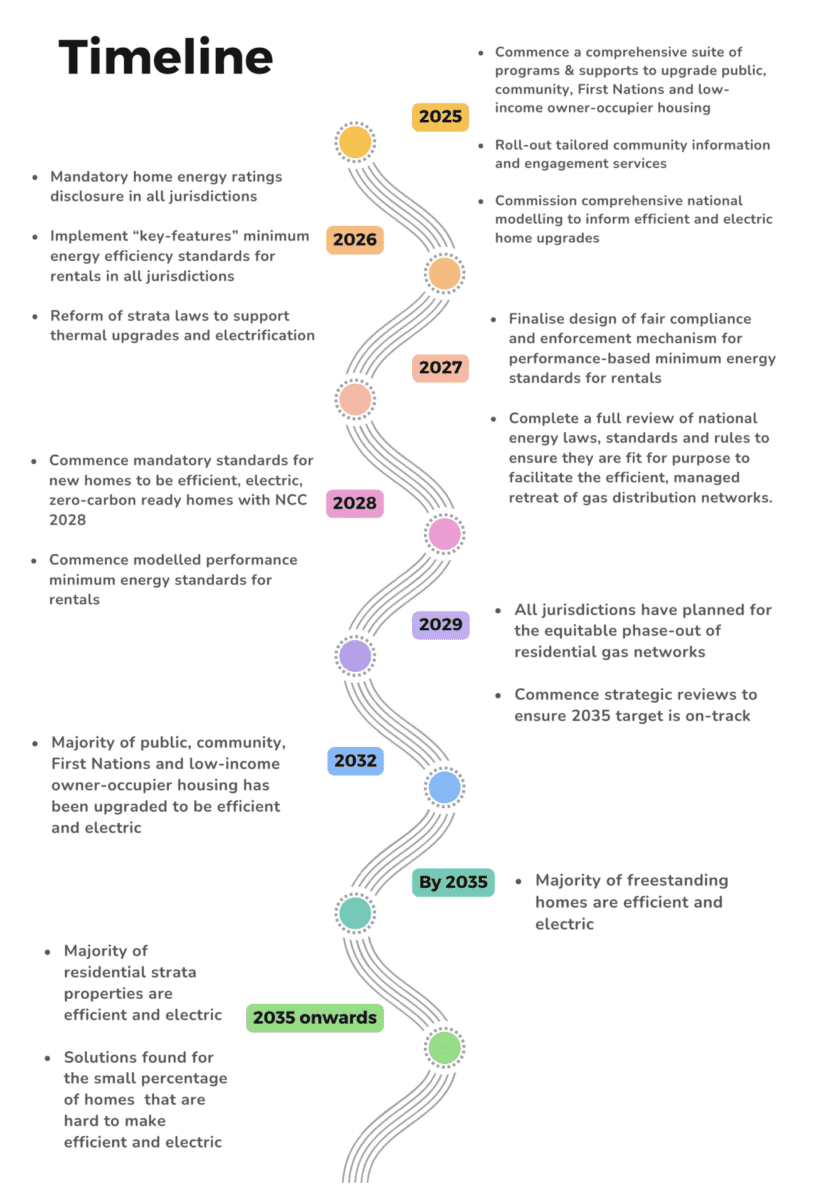
Our detailed roadmap guides the way for Australia to benefit from efficient and electric homes, delivered in time to achieve the emission reductions we need while bringing all Australians along on the journey, not just those who can afford it.
Improving the energy performance of Australian homes should be a critical plank of the productivity agenda the Commonwealth Government has identified for this term. It is also necessary for a fast and fair transition to a zero-carbon-ready society. People are struggling with the rising cost of energy and an acute housing affordability crisis. Electrification and improved home energy efficiency can provide an important part of the solution.
We’ve set out a comprehensive framework for Governments to implement the ambitious, coordinated actions needed. Some of these are already in the works, like mandatory disclosure of home energy ratings and partial funding for social housing upgrades.
But much more is needed, and there are many untapped avenues that can help the Government achieve its 2030 and 2035 emissions reduction targets while making Australian households better off.
Household electrification and improved energy efficiency, effectively implemented, enable substantial, society-wide benefits. They save people money – permanently reducing the cost of their energy and running a home.
And they reduce government spending on healthcare, as less people are made sick by gas stoves and homes that are too hot in summer and too cold in winter. They can also support households and communities to be more resilient in the face of increasingly extreme weather and natural disasters.
There has been some action to upgrade Australian homes to be efficient and electric. But governments and decision-makers are yet to commit to the co-ordinated, long-term, strategic and equitable action needed.
Our roadmap shows how Australian governments at all levels can take decisive steps right now to improve the efficiency of homes, from banning new gas connections and increasing funding for energy upgrades to reforming energy laws, standards and rules.
Other reforms, like introducing and enforcing mandatory minimum efficiency standards for rental properties, offering training to help people exit the gas industry and creating a First Nations home energy performance program, can help secure a more equitable transition.
Transforming Australian homes to be efficient and electric is a mammoth job, but one with rewards that are well worth the effort. It will require governments to work together through the Energy and Climate Change Ministerial Council and similar platforms.
Care must be taken to ensure no one is left behind. Regulations and protections should be made on the basis that energy is essential, and must be easy and affordable to access for everyone. Navigating these challenges is the job of government – and the clear, timely targets we’ve outlined can help marshal the effort required to make it happen.
Governments were right to start this journey with efforts to drive renewables into the energy system, there can be no transition without it. But at the end of the networks of generators, pylons and wires are homes and people who live in them. People who use and need energy for every aspect of their lives. With ambitious reforms, governments can turn obstacles to an efficient future into assets, and ensure everybody benefits from a cleaner energy future.
We’ve provided the roadmap. Now it’s up to governments to be ambitious and get us moving.
One of the world's biggest commodity traders moves into Australia electricity retail business - competition…
Activists have lost their court bid to prevent gas exploration in the Northern Territory after…
EDF has taken nearly 10% of its nuclear power capacity offline this week, to avoid…
South Australia just experienced its worst wind drought in seven years. The fleet of short-duration…
Local government leaders say they were in the dark over state Coalition plans to revise…
Deakin University's Andrea La Nauze on the early findings from an Australia-first trial of technology…