Satellite image of damage after a drone attack to an oil refinery in Saudi Arabia. (Satellite image ©2026 Vantor via AP)
Freshly released Consumer Price Index (CPI) figures show annual inflation dropped to 4% in May from a high of 4.6% in March, but as the Iran conflict has shown, Australia remains highly vulnerable to global oil supply risks.
The latest drop can be fully attributed to a reduction in the increase in transport costs, as oil prices decreased and fuel excise cuts remained in place. This trend could still reverse in the next few months, with the fuel excise relief only partially extended till August, and amid uncertainty over how soon oil flows from the Middle East will recover. Prices for refined oil products, which Australia is mostly reliant on, are particularly hard to predict.
Then there is the question of when the next oil price shock will hit us, and how exposed we will be when it hits.
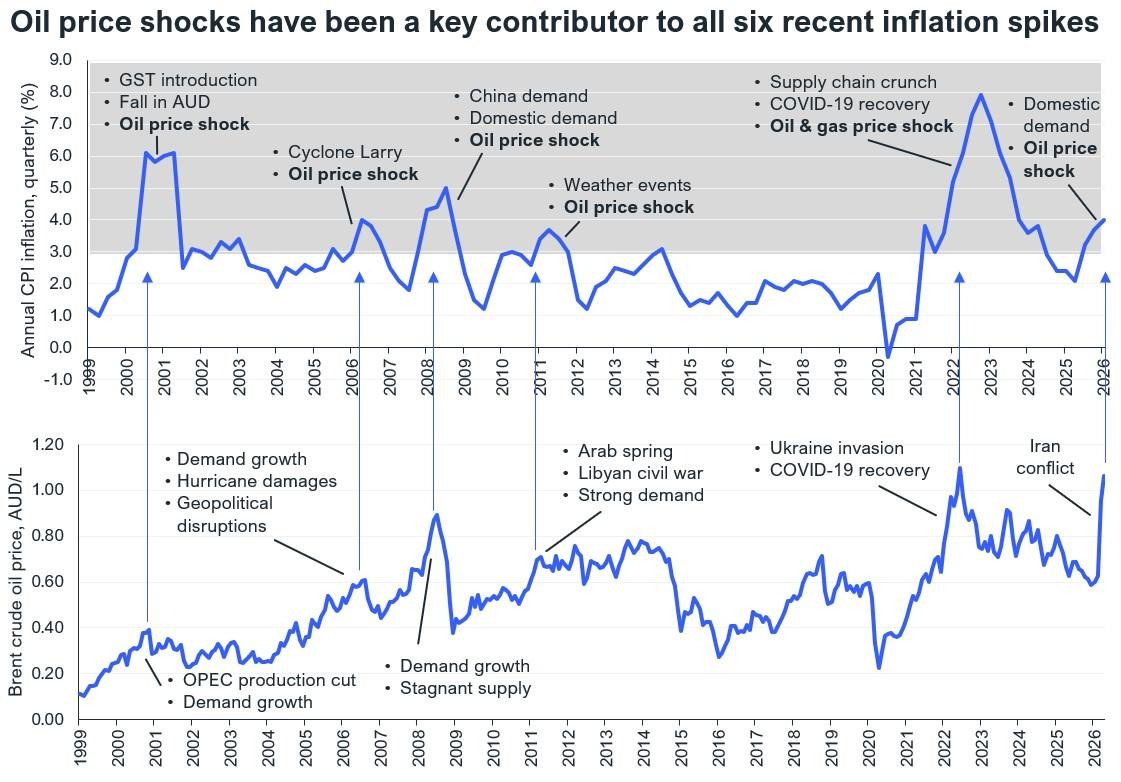
Since 2000, oil prices have become highly volatile, in part due to frequent geopolitical tensions, as well as the low price elasticity of oil demand.
In that period, oil prices increased by about 6.9% a year, well above the annual CPI increase of 2.8%. Oil costs grew even more, by about 8.9% a year, as oil use grew alongside oil prices.
In particular, diesel use increased by a factor of 2.5 to represent the majority of Australia’s oil use, fuelled by road transport and mining. Australia’s growing diesel use is at odds with global trends.
During the same period, Australia also transitioned from being nearly fully self-reliant to mostly import-reliant. In the financial year 2024–25, Australia imported 90% of its diesel, 80% of its jet fuel and 68% of its petrol – the three main oil products it consumes.
It is now the largest importer of seaborne diesel in the world, with its imports representing 10.1% of global net trade in 2025. Australia was also the third-largest importer of seaborne jet fuel and petrol, representing 8.3% and 6.7% of global trade respectively.
This century there have been six main occasions when inflation exceeded the Reserve Bank of Australia (RBA)’s target of 2–3%, with oil price shocks a primary driver for each. Oil affects inflation in three ways.
It has a direct impact through household transport expenditure, which contributed a one percentage point increase to the CPI in March 2026. It has an indirect impact by increasing the cost of goods and services: oil accounts for 2–2.5% of domestic costs, and could account for more through global supply-chain costs. Finally, oil prices make an outsized contribution to inflation expectations, which has flow-on effects.
Traditional monetary policy tools have limitations when dealing with inflation driven by oil price shocks. Central banks focus on countering spillover impacts of high oil prices on broad-based inflation.
For example, the RBA mentioned the risk of second-round effects from oil price increases as part of its decision to increase the cash rate by 0.25% in May 2026. In the case of an initial supply-side shock (as is the case with the Iran conflict), a forceful response can have high economic costs, potentially leading to a recession.
Given the increasing volatility of oil prices, and its recurrent impact on world economies, some central bankers in Europe are calling for a reduced reliance on fossil fuels to protect price and economic stability.
However, monetary action to constrain the spillover of oil price shocks makes it harder and more costly to transition to the very technologies that can protect the economy in the longer term.
Transport is responsible for nearly three quarters of Australia’s oil use, and is the biggest driver of inflation through its direct and indirect impacts on household costs. Electrification of road transport is the most promising opportunity to materially and cost-effectively reduce oil use in the transport sector.
It is possible to more than halve road transport oil use by 2040 and reduce it to near zero by 2050, which would dramatically reduce oil use’s impact on inflation. However, current trends point to more modest reductions. In particular, oil use in heavy transport is expected to increase to 2040.
Continued government incentives are needed to maintain momentum in car electrification, and a ramp-up of support is needed to kick-start heavy vehicle electrification, including funding for early charging networks, financial incentives for heavy EV deployment, and regulatory reforms.
The RBA should also consider introducing a targeted refinancing facility to provide discounted loans to commercial banks for EV financing until they reach cost parity.
Fully electrifying Australia’s road transport would require large volumes of electricity – equivalent to 42% of today’s electricity demand. A large scale-up of electricity generation, storage and transmission will be required. Accelerating transmission grid expansions (or innovative alternatives) is one of the most critical enablers to rapidly increasing electricity supply.
Grid planning and upgrades are also required to deploy EV charging infrastructure, with power needs particularly high for heavy freight charging. Ensuring EV charging is managed effectively will be key to reducing the cost of distribution network upgrades, and will require new data, analytics capabilities and technical standards.
Innovative, cost-reducing solutions should also be investigated, such as co-locating charging stations with renewables and batteries. Bidirectional charging can deliver significant cost benefits to the electricity system and EV owners.
Technologies are now available to shift away from oil, meaning Australia doesn’t need to remain at the mercy of global markets. We now have the option to sever our exposure to oil price shocks – and the inflation that follows.
Amandine Denis-Ryan is the CEO of IEEFA Australia
AEMC commissioner Rainer Korte on what the new rules on reporting and data sharing will…
Developer says it is good to go on early works and construction of the largest…
AEMO says proof that grid forming battery inverters can deliver heartbeat of the grid will…
Days after lodging new plans for a more than 500 MW wind farm, Squadron dumps…
AEMO’S head of systems Nicola Falcon on the 2026 ISP and the importance of grid…
Flagship pilot program to set up 100 sites around the country to collect used solar…