French energy giant Engie has withdrawn an application for a major solar farm, as it considers a new location as part of a rethink of a giant wind, solar and battery hub in south-west of NSW that has so far failed to gain grid access.
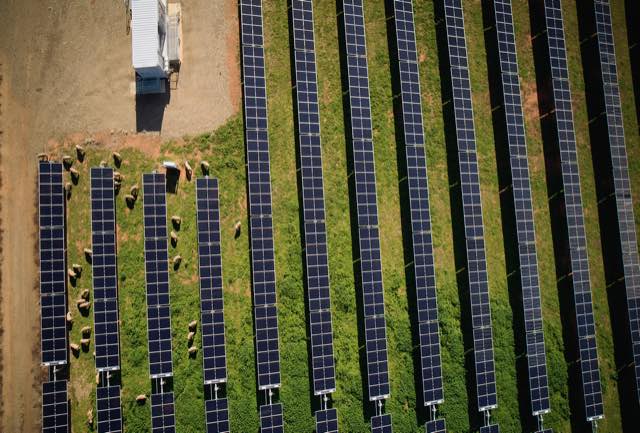
Engie is hoping to develop The Plains renewable energy hub near Hay, with a capacity of up to 1,900 megawatts (MW), and up to 188 turbines and 900,000 solar panels, along with battery storage.
But its plans have been stymied – for the moment – by the low capacity in the newly created south west renewable energy zone, which has allocated access rights to just 3.5 gigawatts (GW) of capacity, a fraction of the near 19 GW that had been proposed in what has emerged as one of the country’s richest wind and solar regions.
Engie this week gave notice that it was withdrawing its EPBC application for federal environmental approval for the proposed 400 MW solar component, and the proposed 400 MW, 1600 MWh battery.
An Engie spokesman told Renew Economy that the solar farm has not been abandoned, but the company is rethinking the layout and the location – still within the hub – and needs to refile its application for environmental approvals.
“Engie identified a more optimised location for the solar farm portion of The Plains Renewable Energy Park project, and the process dictated that the NSW State Significant Development Application and EPBC application be withdrawn, and a new application be submitted for the revised location,” the spokesperson said.
It is part of a broader rethink of the project, which currently has no line of sight for a grid connection, although there is hope that a solution can be found.
Among the ideas being pursued are previously flagged proposals to attract big loads – such as data centres – to the region, which would reduce the need for new transmission capacity, and the creation of a new SIPS (system integrity protection scheme) for the zone.
The SIPS scheme would require the construction of large batteries that would allow the zone to support more capacity – similar to the new Waratah Super Battery, which acts like a giant shock absorber to allow more capacity on the transmission lines feeding the major load centres in Sydney, Newcastle and Wollongong.
“We are continuing to explore alternative grid connection options and still progressing a development application to the Department of Planning, Housing and Infrastructure,” head of development Scott de Keizer said in an emailed statement
“Australia’s grid needs solutions to expand the amount of transmission under construction to get renewables to market. It also needs innovative and market-led solutions to get the most out of the infrastructure we do have, possibly include SIPS battery scheme, and to realise investment and customer appetite.
“Engie is actively engaged in discussing those solutions and aims to bring more development and benefits to Hay and the Riverina region of NSW through our Plains Renewable Energy Park Project, which benefits from strong renewable energy resources and community support.”
It is now generally recognised that the transmission plans for the south west REZ have been seriously undercooked, with some blaming a miscalculation on the potential capacity factors for wind projects in the area.
It meant that the new Project EnergyConnect, with links South Australia and NSW and provides the backbone to the new zone, features only 330 kV lines, when 500 kV could have delivered significantly more capacity.
In the end, only four projects were awarded grid access rights within the REZ. Origin Energy’s 1.45 GW Yanco Delta wind farm received rights for its full capacity, but three other projects – Dinawan, Pottinger and Bullawah – all had to take major haircuts to the their plans because of the grid limits.