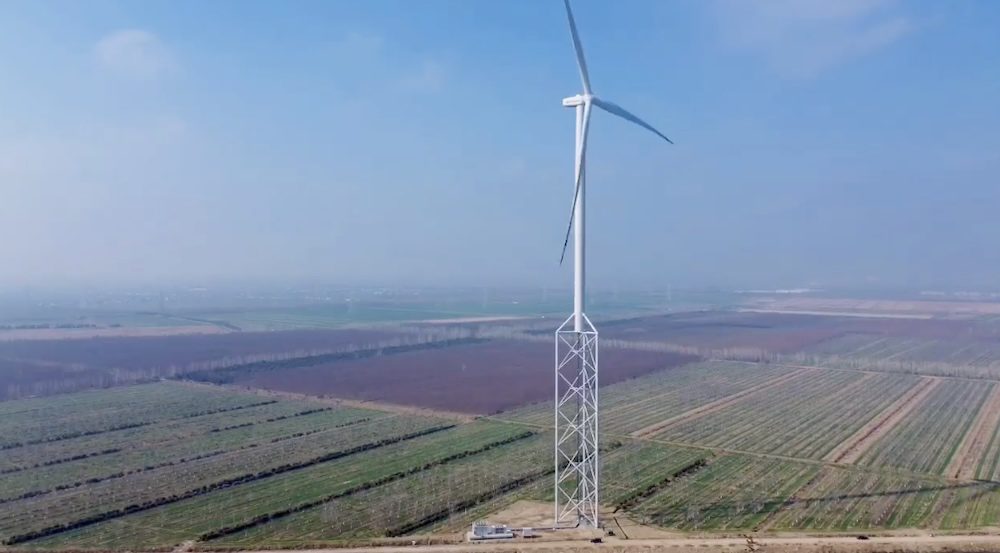
A still from the video posted by Nabrawind on LinkedIn
A prototype wind turbine using “self-erecting” tower technology that will have its global commercial-scale debut at a Fortescue wind farm in Western Australia is now running at full capacity at a testing facility in China, ahead of being relocated to the Pilbara later this year.
The prototype wind turbine combines the cutting edge modular tower technology of Spanish outfit Nabrawind and the 7.8 megawatt (MW) turbines of China-based company Envision Energy.
The plan is for a total of 17 of these hybrid-tech turbines – including the test model – to be installed at Fortescue’s Nullagine Wind farm in the Pilbara, where they will showcase the highest hub height (188 m), highest power rating (7.8 MW), and largest rotor diameter (182 m) yet to be combined in an onshore project.
First, however, a prototype is being put through its paces at an Envision testing site.
A still from a video posted by Nabarwind on LinkedIn
“The first Envision Energy wind turbine with Nabrawind’s self-erecting tower is already running at full capacity – a milestone that proves innovation works in the real world,” Nabrawind said on LinkedIn on Wednesday in a post later shared by Envision.
“17 units will be installed at Nullagine Wind Project in the Pilbara, Australia, powering Fortescue’s journey toward its Real Zero target.”
“Great to see the first turbine up and running,” Envision said in its own post. “Looking forward to delivering the full project and supporting Fortescue’s Real Zero journey.”
In the Pilbara, Fortescue said in January that it had started early works on the 113 MW Nullagine project, just one of a range of renewable energy projects that will underpin Andrew Forrest’s ambitious plans to make his giant iron ore mines fossil fuel free by 2030.
Nabrawind’s self-lifting towers are considered critical by Fortescue for their ability to slash the amount of concrete needed in turbine foundations, to access better wind resources at higher heights, and reduce a number of other logistical challenges.
The turbines are also designed for low-wind environments and are engineered to withstand extreme weather, including cyclones – the latest of which is currently battering the region.
Depending on how the technology performs at the “proof-of concept” Nullagine project, the Nabrawind-Envision turbines could be the technology of choice for the much bigger Bonney Downs wind farm, an up to 2.1 gigawatts (GW) affair proposed for around 9 km south-west of the town of Nullagine, near the company’s Christmas Creek iron ore mine site.
Pilbara Energy, a Fortescue subsidiary, is currently seeking federal environmental approval for Bonney Downs, following a “substantial redesign” of the project, including a halving of the number of turbines being proposed.
The original plans, as Renew Economy reported in October of last year, proposed the installation of up to 200 wind turbines and six substations, with a target installed renewable energy capacity of around 2.1 gigawatts (GW).
If you would like to join more than 29,000 others and get the latest clean energy news delivered straight to your inbox, for free, please click here to subscribe to our free daily newsletter.
Battery component of solar and storage facility joins the grid, part of a boom that…
Germany wants to build the world's first fusion power plant, and scientists say that might…
Government seeks expressions of interest to partner in delivering at least three new synchronous condensers…
Until recently, I had little interest in purchasing a household battery. I am now one…
Senate inquiry uncovers countless instances where misinformation – and often disinformation – is affecting public…
Ratings agency warns of downgrades for Snowy Hydro, saying budget for Snowy 2.0 soon to…