New England solar farm, Image: Acen Australia
The combination of wind, solar and hydro delivered another record output in New South Wales on Thursday, as the country’s biggest state grids sweltered in another autumn heatwave.
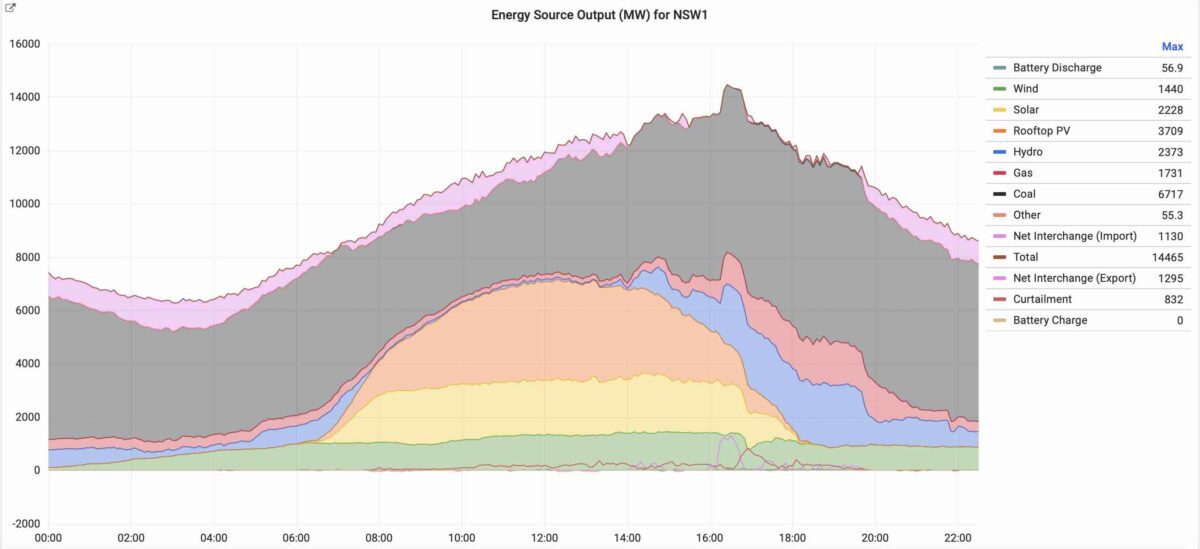
The new maximum instantaneous output of 7,600MW in NSW was reached at 1445 AEST (grid time, or 1545 AEDT), according to data from GPE NemLog 2. That beat the previous record of 7,512MW which was set at 1300 ASET on March 6, in the midst of the last heatwave.
See: Wind and solar output hits new records as heat waves sweep across country
The new record output on Thursday coincided with the temperate peaks of more than 37°C in the main demand centres in Sydney, and above 40°C in the west of the state. Temperatures were up to 12°C above average in parts of the state, according to the Bureau of Meteorology.
The record output was once again led by rooftop solar, which provided nearly 3GW at the time of the combined renewables peak, although up to 3.7GW early in the day.
It was followed by large scale solar and then wind and hydro. At the time of the record, the share of renewables was 57.5 per cent, although it was above 60 per cent earlier in the day when demand was lower.
On Thursday, the day’s grid management was complicated by high temperatures in both NSW and Queensland, constraints on imports from Victoria, and one of the main 330kV lines out of service for maintenance.
Another transmission constraint to manage voltage issues in the west of NSW resulted in some big solar farms in that region – such as Limondale and Sunraysia – being heavily constrained. This coincided with an increase in hydro output to fill in the gaps.
As the sun set and solar trailed off, the grid operator began to encounter issues as people returned home to switch on their air conditioners.
The situation was complicated by a constraint that limited imports from Victoria, and by a heatwave to the north in Queensland, which had little excess power.
And to add to the problem, half the capacity of the coal generators at Mt Piper and Vales Point was offline, as well as a unit at the Bayswater coal generator.
The amount of hydro ramped up in NSW, but the Australian Energy Market Operator had to declare a “Lack of Reserve 2”, which meant that it would struggle to maintain enough supply if a major generator, or transmission line failed without notice.
AEMO prepared to call on its emergency reserves, but didn’t have to call on them in the end. The LOR2 situation – in both NSW and Queensland – lasted for about an hour until just before 7pm grid time, by which time temperatures and demand had begun to ease significantly.
Still, prices jumped to more than $14,000 in some trading intervals as a couple of smaller diesel plants were switched on. Interestingly, NSW was exporting power to Queensland (the reverse is normally true in such situations) as the sunshine state also grappled with a supply squeeze.
Arena says the pursuit of ultra-low cost solar is making "good progress" at the panel…
Gas turbines aren't the only large equipment with long lead times.
All Electric Homes founder Trent Jones warns that a shortage of skilled tradies, fragmented business…
For asset owners, buyers, managers and O&M teams, the webinar will cover performance metrics, service…
Less than two years after starting construction, four-hour big battery energy storage system powers up…
Fascinating chart backs up AEMO chief's observation that people are piling in on the offer…