Colac farmer Peter Mulheron could put his new 105 kilowatt (kW) solar system in a different paddock if he feels like it, or pack it up and sell it if he decides to retire, or just leave it where it is and bask in the glow of the $20,000 he’s about to save on electricity costs.
The new system is one of the first to be installed commercially in Australia by Melbourne-based Phnxx, a set up that arrives in a container and unfolds concertina-like to replace either diesel generators or, as in Mulheron’s case, grid power.
“We had the pilot program installed and that ran part of the farm for four months, so we’ve done our calculations on that and we think it’ll provide 80 per cent of our power over the 12 month period,” Mulheron told Renew Economy.
“In the summer we’ll have excess that we’ll feed back into the grid [during the day].”
The 105 kW solar and 240 kilowatt hour (kWh) battery project, in Victoria, is to power Mulheron’s early morning and late night 220-cow dairy operation, and uses Phnxx’s new portable micro-grid concept.

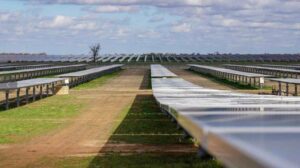
105 kW PHNXX solar system at Peter Mulheron’s dairy farm. Image: Phnxx
The idea, developed three years ago, is designed to be set up within hours and be easily moved to a new paddock, a new construction site, or a new owner, says Phnxx COO Wei-Chi Lee.
“If you were to do that the normal way, mounting panels on roofs and installing a battery in a shed, it would probably take about two weeks. We set up the system on Peter’s farm in a day,” he told Renew Economy.
“If we were putting it on a roof, the first stage is ensuring the roof is structurally sound to hold panels, then all the equipment you need to install equipment at height, and mounting frames.
Instead, at Mulheron’s farm, they simply pulled it out of the container and plugged it in, albeit with a 50m-long buried extension cord.
The Swan Marsh farm is Phnxx’s first Australian installation, although Lee says they have other clients, but the other ‘first’ better highlights how useful having a big portable solar system can be.
Phnxx’s other installation is in a port in Singapore and powers a vertical farm.
Lee says a pair of systems power 40-foot grow containers set up with hydroponics, UV lighting, irrigation and ventilation, that are packed up and moved periodically as the space needs of the port change.
In Australia, the company is selling its solar-, battery-, and grid-in-a-box products as a replacement for diesel generators on small mine sites, short-term construction sites, and farms, say for powering bore pumps
“It’s about the same cost as putting the same system on a roof,” Lee says, as the higher cost of the container outweighs the installation of a rooftop system.
“If you’re replacing diesel generators it’s even more attractive. It’s three to four times cheaper than running a diesel generator.”
While at this stage Mulheron’s system will likely be sitting in the same spot for the next 30-35 years, it’s now a sellable asset.
If he retires, he could sell it, unlike some former dairies he sees in the area with massive rooftop solar systems that are no longer needed.
But it was protection against blackouts that sold it to him.
“We are lucky we live in western Victoria, whenever the power goes off it is usually only for three to five hours at a time for us. We had about 10 minor disruptions in the past year,” he said.
“We can have up to 10,000 litres of milk stored, and if the power fails that would cost us about $8000 plus disposal and sterilisation costs.”
Phnxx has almost come out of nowhere, landing its first pilot in July 2023 and closing a $1.8 million seed round in March last year, with new investors Synertec, ENGIE Factory, deep-tech VC Pacific Channel, LaunchVic happy to be publicly named as its backers.