The New South Wales government has revealed big delays and blowouts in the cost of some its newly created renewable energy zones, raising new questions about the timing of the planned closure of Australia’s biggest coal generator at Eraring and the pace of the state’s green energy transition.
The revelations come in a newly released Network Infrastructure Strategy, and include a five fold increase in the original cost of the Central West Orana zone to $3.2 billion and a potential three year delay to its completion.
The cost increase and delays are being blamed on a decision to provide more capacity in the CWO REZ and because of route changes to respond to community concerns. They are also likely to represent increases in labour and supply costs.
Completion of the New England REZ, which is the biggest of the planned five zones, is also likely to be delayed from 2027 to 2029, although its estimated costs have fallen significantly – by $3 billion. There are small cost increases in other projects such as the Hunter Transmission project. See table below.
The big concern from the new revelations is about the delays, because it strikes at the ability of the state to build enough wind, solar and storage to replace the accelerating closure of ageing and dirty coal generators.
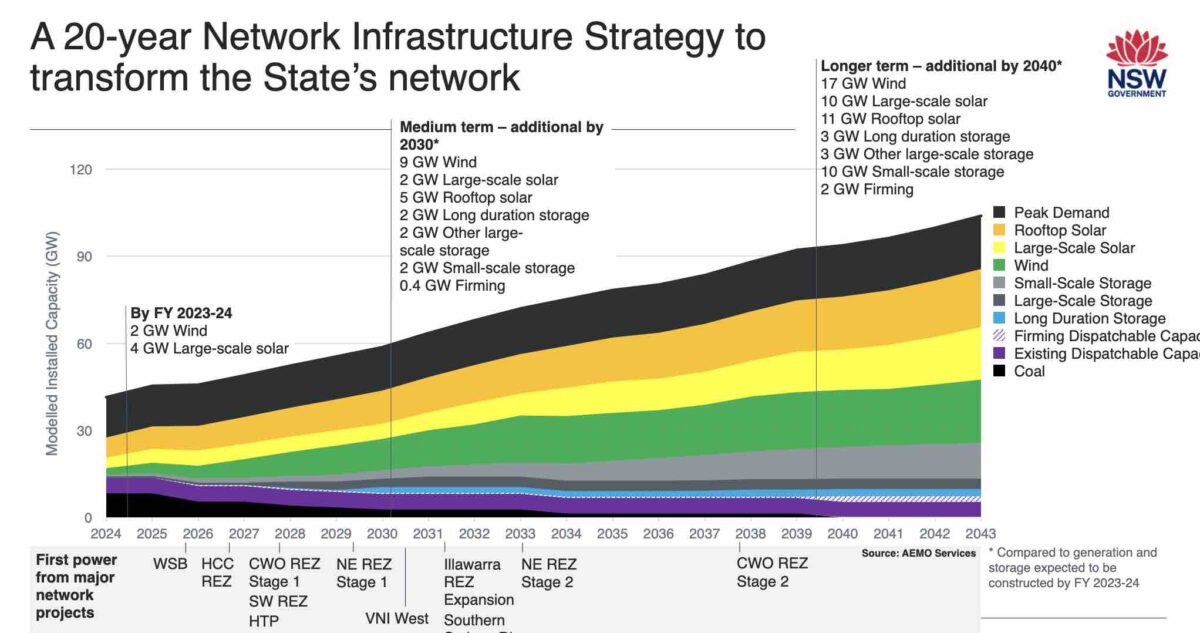
NSW needs to deliver 12GW of new wind and solar generation and at least 2GW of long duration storage capacity by 2030 to deal with the planned coal closures (Eraring in 2025 and Vales Point in 2029).
It will also require a total of 38GW of new wind and solar and 18GW of storage by 2040 to cope with the closure of the remaining coal plants at Bayswater and Mt Piper.
However, its new graph shows that some coal will still be in the grid as late as 2039, although it later emerged that this indicates only the “central” scenario of the new roadmap, and not a “close coal by 2030” scenario that is also presented as one of the options.
See also: NSW now has roadmap to close coal by 2030. But will Labor run with it?
The state is now expected to try and fast track new wind and solar auctions and projects outside the REZs, and it has this week opened its second auction for 1GW of new generation capacity, and 550MW of storage capacity (at least eight hours).
That represents something of a backflip for the state, whose roadmap has been widely admired but has nevertheless been subject to complaints that the “centralised” control over the rollout has delayed some projects.
More importantly, it raises questions about Labor’s plans for Eraring.
Labor’s energy and climate minister Penny Sharpe says she does not want to keep any coal plants open “for a minute longer” than needed, but her government has openly canvassed buying back Eraring from Origin, and is still in talks with both Origin and that company’s proposed new owner Brookfield over the issue.
Sharpe, who has questioned the Eraring closure timing, on Thursday criticised the previous government’s lack of clarity over the costings of the roadmap and the privatisation of many of the states energy utilities.
She said this had led to cost rises and had hamstrung the project because it had reduced the number of levers it could pull.
“I am concerned that costs and timeframes have grown since they were first proposed in 2020,” Sharpe said in a statement.
“The previous government was asked about costs and timeframes and never provided an answer. The addiction to privatisation in the energy sector has also made all aspects of these projects more difficult.”
The NSW EnergyCo has created five REZs, in the Central West, New England, South West, and in the Hunter and Illawarra, where offshore wind could also play a role.
It has also committed to a number of other grid upgrades, and the $900 million Waratah Super Battery, which will be the largest of its type in the world and is designed to act as a shock absorber and increase the amount of electricity that can be transmitted over the lines.
All the five REZs have attracted vastly more project proposals than their capacity, in some cases 10 times that much. Those projects will have to bid for access to network capacity in those zones, but in the meantime the government will have to offer contracts to other wind and solar and storage projects in other parts of the grid.
It is thought that some minor augmentations can be done relatively quickly, and this could allow the state to increase the size and number of auctions to be held in coming years to ensure enough capacity is in the grid.
The first auction delivered 1.4GW of new wind and solar capacity, although some of the solar was already built, and a small eight hour battery. A second auction will also seek another 1GW of capacity and up to 550MW of storage.
However, it is thought that the structure of the auctions for storage favour batteries, and any deep duration projects, such as pumped hydro, will have to be supported through the newly created Energy Security Commission, which will be seeded with $1 billion and will act as a kind of green bank.
The latest capital costs of the REZs and other infrastructure have been put at $9.7 billion. This is made up of
However, the government says the overall benefits of the infrastructure roadmap remain at more than $10 billion, with access fees from the new wind, solar and storage projects making up some of the costs.
See also: NSW now has roadmap to close coal by 2030. But will Labor run with it?
And: Grid has untapped capacity that could be used by renewables. But networks can’t see it
Arena says the pursuit of ultra-low cost solar is making "good progress" at the panel…
Gas turbines aren't the only large equipment with long lead times.
All Electric Homes founder Trent Jones warns that a shortage of skilled tradies, fragmented business…
For asset owners, buyers, managers and O&M teams, the webinar will cover performance metrics, service…
Less than two years after starting construction, four-hour big battery energy storage system powers up…
Fascinating chart backs up AEMO chief's observation that people are piling in on the offer…