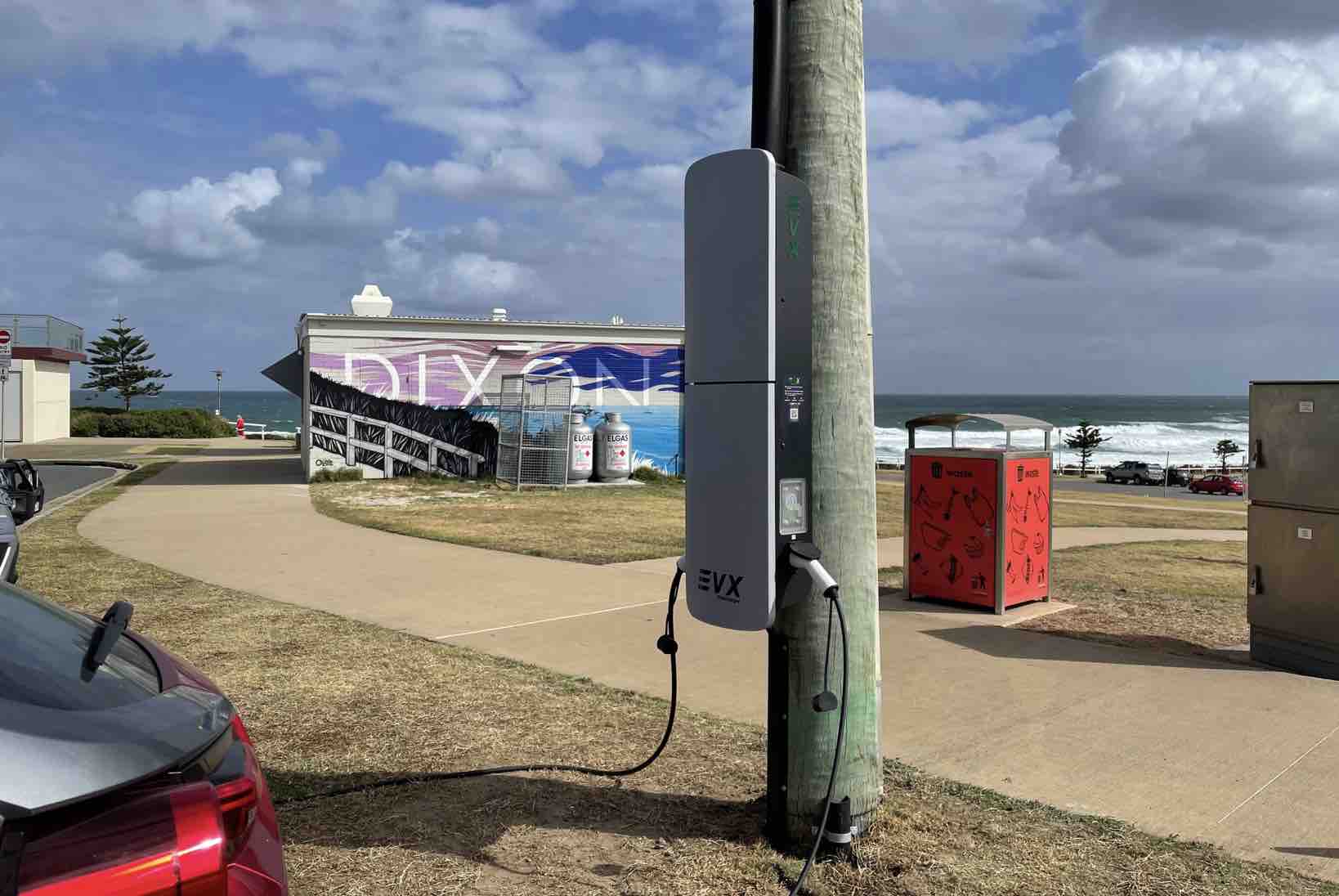
A Victorian network operator will need to charge itself the same fees it levies others to access power poles when it launches a highly-contested kerbside electric vehicle (EV) charging trial in the coming weeks.
The condition is one of nine designed to mollify fears that the CitiPower, Powercor and United Energy (CPU) trial will damage commercial operators and set another precedent for networks to own chargers in the new sector.
The Australian Energy Regulator (AER) on Thursday gave CPU a waiver from ring-fencing rules to install, own and maintain 100 pole-mounted 22 kilowatt (kW) EV chargers across its Melbourne network over the next five years.
The company says the first 10 trial sites will be operating before the end of 2025 and the remaining 90 delivered in 2026. It will lease access to the chargers to retailers who will be the public-facing operators.
Conveniently, CPU is creating a new low pole access fee for the trial specially for kerbside charger owners – one that it and third parties will both be able to access.
Ring-fencing rules prevent monopoly network owners from using their market power in competitive sectors of the energy market.
CPU’s ring-fencing waiver proposal was vigorously fought by companies already trying to get a foothold in the kerbside charger space, who said in submissions to the AER that allowing the monopoly operator to compete in the commercial charging industry would distort the emerging private market.
The AER’s decision to approve another charging waiver is disappointing and “risks undermining the core regulatory framework which protects consumers and competition”, says Evie Networks CEO Chris Mills.
“Allowing monopoly networks to compete with their own customers creates insurmountable structural advantages that no private operator can match,” he said in a statement.
“Victoria needs faster EV charging deployment, but not through expanding network monopolies. The real barriers are connection delays, prohibitive connection costs, and incompatible tariffs, none of which are solved by this trial.
“International experience shows that centrally-planned monopoly rollouts resulted in overspending with large numbers of stranded chargers and low utilisation.
“Markets that succeeded, like the Netherlands and UK, relied on competitive private-public partnerships that rapidly scaled their networks without offloading costs onto consumers.”
But CPU head of customer connections Dan Bye says the need for EV charging options near homes is too great to wait.
“We can deliver faster, more reliable pole-mounted EV infrastructure while potentially avoiding network upgrades by dynamically controlling the chargers,” he said in a statement.
“Drivers are desperate for more chargers and pole-mounted technology is available, so we will install these chargers and help more Victorians switch to an electric vehicle.”
At issue are the rising number of EV owners who live in suburbs without off-street parking, and the lack of ideas, or willingness to let residents run an extension cord across a footpath, is becoming a problem.
Boom-mounted chargers are being trialed in one Melbourne suburb, but the Port Philip council cancelled this trial last year, claiming concerns about flood, the use of public space, and cost despite the chargers being paid for by residents.
Data dump on the way
The conditions attached to the CPU waiver address some of the competition fears, but also include some future proofing – one requires that at least five are vehicle-to-grid chargers.
Interestingly, the waiver forces CPU to publicly reveal the fees that it charges to third parties for pole access, and which it will be paying itself, and the terms of access.
CPU must also share a range of data every year, from how the chargers are used and the way that affects the network in terms of power quality or voltage deviations, to outage frequency and the types of faults the chargers are incurring.
It’s data the AER says private companies are unlikely to make public, industry stakeholders say is already available via trials in New South Wales, and that networks should be providing as of right, according to Nexa Advisory director Stephanie Bashir.
“CPU should already be doing these conditions, especially around transparency, cost to connect, and enabling competitive markets,” she told Renew Economy.
“The good news is the AER has listened to the multiple stakeholders pushing back on the ringfencing waiver. They said the trial isn’t needed, but if this one does go ahead at least it should come with conditions.”
Bashir also raised questions around who will ultimately be paying for the trial, and whether it’s worth running at all given at the end of the five years the chargers will either need to be pulled out, sold, or another waiver granted.
The trial is conditional on the $1.2 million cost having “no bill impacts on customers in the CPU networks”, the AER said today.
But Bashir questions how the AER plans to monitor this when “every dollar that CPU spends is regulated and the public pays for that.”
Competition risks versus need to know more
The AER is live to the risks posed by letting the regulated monopoly set up a rival kerbside charging network, even if it’s only 100 strong.
There’s the risk CPU reserves the best spots for itself, based on what it already knows about its own network and also uses that information to disadvantage commercial competitors.
Submissions by other stakeholders said CPU’s pole access fees are “unreasonably high” compared with other distribution network service providers (DNSPs), and make third party access financially unviable.
Concerns expressed to Renew Economy and its EV-focused sister site The Driven are that once the trial is over the low access fee will reset to the original rates.
And the AER noted fears that and that allowing the network owner to compete with fledgling commercial operators will deter commercial investors.
CPU’s proposed e-MSP model, where it leases access to the charger to a range of charger retailers, and reclassifying pole access to give it greater oversight over fees and terms, as a negotiated distribution service places, would mitigate the competition risks, the AER said in its reasons for giving the waiver.
But the regulator also noted the benefits of CPU’s proposal, namely how to manage EV charging demand as the fleet of privately-owned cars rises, without spending more on network improvements.
“As demand for energy grows, it is beneficial to explore how kerbside electric vehicle charging infrastructure can be used to manage electricity networks more efficiently,” AER chair Claire Savage said in a statement.
“This could help to reduce the need for new investment in networks that is paid for by all consumers.”
The AER is also interested in CPU’s tests of demand management via its chargers such as through price signals or reducing energy supplied to chargers at peak periods.