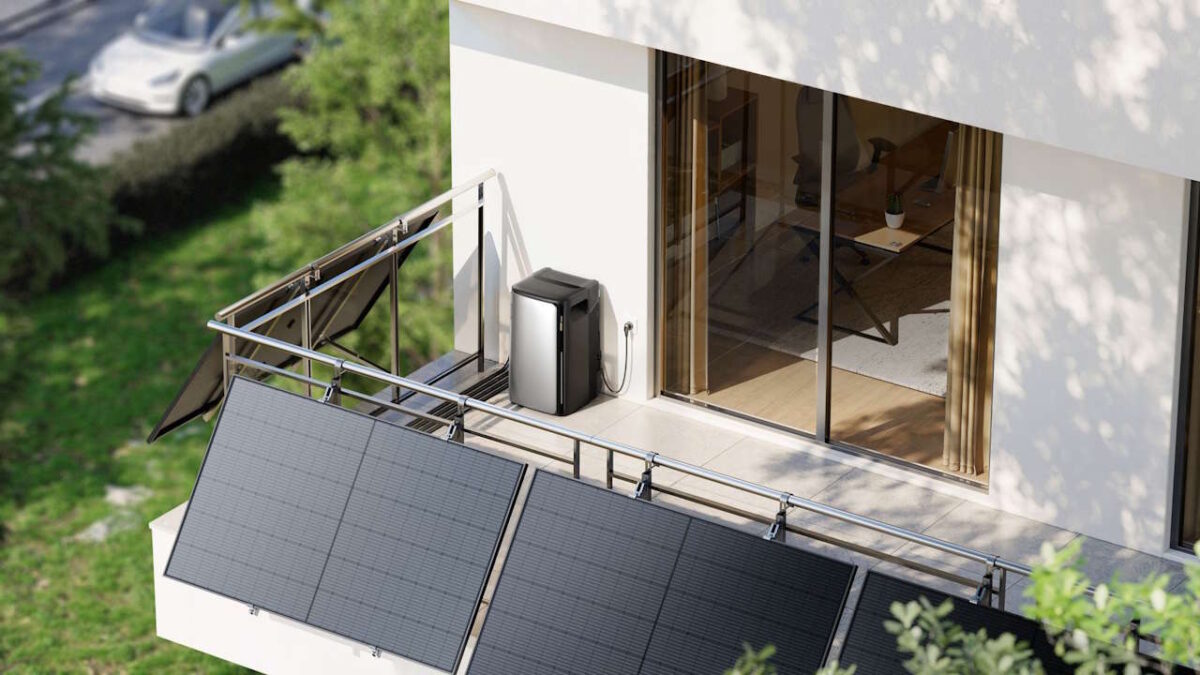

Soon the one third of Australian renters and apartment dwellers may be able to do what people in Europe, India, South Korea and, oddly enough, Utah, already can: pop a solar and battery system onto their balconies and help power their homes.
The obstacles, as reported by Renew Economy last week, are not small. See: Balcony solar is powering apartments from Berlin to Barcelona. So why not in Australia?
But moves are afoot to correct what is seen by many as a market failure and bring power to the rest of the Australian people.
The technology on offer elsewhere in the world can work in Australia – it’s already being tested here for safety – but changing the rules needed to make regulators, networks and, crucially, conservative strata committees, feel it’s safe will take some effort.
“The main component is that Australia and New Zealand have slightly different electrical standards than the rest of the world, in terms of the configuration of our networks and things like weathering systems and safety requirements for RCDs,” says Smart Energy Lab general manager Glenn Morris.
“So long as we can prove that none of this is being compromised, [plug in solar and batteries] shouldn’t be a problem.”
Morris is currently testing a 1.4 kilowatt hour (kWh) balcony battery from Anker Solix, a Chinese company keen to prepare for the currently non-existent plug-in opportunity in Australia.

The Anker balcony battery Morris’ lab is currently testing. Image: Glenn Morris
His lab confirmed the maximum power injected into the circuit is less than 800 watts, or two panels, the maximum that German law allows and which could be a useful guide for Australia.
Morris says it also only works with extra-low voltage solar panels, and the system de-energises within milliseconds so if anyone touches the plug after pulling it out they can’t get shocked.
Crucially, the battery can also provide 1.2 kWh of backup if the power goes out.
Going in to bat for renters, apartment denizens
Morris’ work shows the units available overseas can technically work safely here, but others are beginning to push the concept forward from a legal and regulatory perspective.
Race for 2030 is launching a project to investigate the legal, technical and regulatory barriers to plug-in balcony solar and batteries, and what it will take to change these.
Interestingly, the Victoria government is keen on the project — and it’s not the only government quietly interested in making plug-in energy devices possible.
Anker Solix sales manager Phil Krok says he’s talking to everyone about the concept, to the point where energy minister Chris Bowen knows him as “the balcony guy”.
“I took a piece of kit down to Canberra in December last year and showed them the physical hardware and walked them through the unboxing, what it does, how it does it, and I talked them through some of the challenges,” he told Renew Economy.
“If the rules changed, I think demand would shoot through the roof, so we would just need to fix this… I bet in New South Wales (NSW) alone there would be appetite for thousands of them straight off the bat.”
Krok is pushing hard for those rules changes and says there is a working group in the federal Department of Climate Change, Energy, the Environment and Water (DCCEEW) looking at this issue.
He’s not the only one it’s talking to.
Davood Dehestani, the founder of 3.5 kWh battery-for-renters company Smartizer, says he also had some chats with people from DCCEEW who were keen to understand what regulatory changes might be needed to make plug-in solar-batteries feasible.
A DCCEEW spokesperson declined to admit the department has any work on plug-in solar products underway, saying instead the federal government is “already” delivering other consumer energy equity initiatives.
Dehestani says the UK is looking to have plug-in consumer energy devices approved and available by the end of this year, and like Krok, hopes a similar outcome could happen for Australians soon.
With Anker Solix pushing for change and homegrown companies emerging, when Australia throws the doors open to balcony solar there will be no shortage of competition or innovation.
Just this week, Chinese company Growatt released its own balcony battery, a 5 kWh unit designed specifically to plug into a max 2.5 kilowatt (kW) solar system.
It can run critical devices during a power cut, can work in temperatures as low as -30ºC, and comes with software that will tap into dynamic tariff pricing by exporting when prices are high and importing when low.
“Energy systems must evolve with how people live today,” Growatt CEO David Ding said in a statement.
Us, too, please?
Ding’s comment is one that has many Australians – including people spoken to by Renew Economy this week who work at the entities that make this country’s energy system function – baffled as to why they’re locked out of solar and batteries just because they live in an apartment or rent.
Energy consultant Gabrielle Kuiper points out that if Australia had a distributed energy resources (DER) technical standards regulator running now, as has been on the federal drawing board for years, it could have been working through the issues preventing plug-in devices.
“They could have been working through the challenges and opportunities for balcony solar from a technical perspective, and ensuring that we had the standards in place so millions of Australian households could have access to this incredibly affordable technology without requiring an electrician to wire it in which makes the payback a lot longer,” she told Renew Economy.
Indeed, one distribution network service provider (DNSPs) even told Renew Economy they’re happy for people to plug in, so long as the devices are legal.
“We will approve CER products of any kind to connect to our networks, so long as they comply with the relevant Australian standards (AS/NZS 4777) and are approved for use by the Clean Energy Regulator,” says Powercor’s head of customer connections Dan Bye.
“Once that happens, we will approve those products to connect in our network areas.”
But there are reasons why the dream is yet to be realised, as Renew Economy reported this week.
Letting people in Australia plug in where and when they wish is not simple: there are myriad versions of ancient technology still used to measure and manage electricity flows into apartment buildings in this country.
And then, despite NSW’s ban on anti-green bylaws, conservative body corporate committees in the rest of the country tend to take a ‘no’ route out of fire fears.
Another DNSP told Renew Economy that, quite aside from any regulatory challenges, Australian Standards for electrical wiring in a residential home and battery installation rules would need to change.
Australian Standards, the technical specs for goods sold here, would also need to change to include plug in solar and batteries.
But there is another way: a motivated government could override these by making new regulations, Morris points out.
“The normal approach is that any electrical appliance that generates electricity has to meet an Australian Standard,” he says.
“But there are other means to get approvals such as by government regulation. I have heard it mooted that this [plug in solar and batteries] could be a case where the government steps in to override the standards.”
So while it feels like the world is moving onto the next generation so solar and batteries without us, perhaps Australia won’t be left behind for much longer.
You can find out more about balcony solar in this interview with Brent Clark, the CEO of apartment-focused energy consultancy Wattblock, on this episode of the SwitchedOn Australia podcast.
If you would like to join more than 29,000 others and get the latest clean energy news delivered straight to your inbox, for free, please click here to subscribe to our free daily newsletter.