Please read an update here: Battery supplier to Australia’s giant “shock absorber” blames Trump tariffs for financial woes
The US-based Powin, the main supplier to the Waratah Super Battery in New South Wales, the most powerful big battery to be built in the country, has warned that it may go out of business and be forced to lay off all its staff within weeks.
Powin has filed a letter with regulatory authorities in the US state of Oregon, where it is based, warning that it may be forced to shut down by July 28, or earlier, if business conditions do not improve.
In a letter dated May 29, Powin warns that “due to unforeseen business circumstances, Powin LLC’s situation, as well as the economy generally, remain dynamic and fluid.”
The letter, signed by Powin’s VP for human resources, Scott Getman, says. “If Powin LLC’s present business circumstances do not improve, it is currently anticipated that a layoff will occur on or before 28 July 2025.
“If such cessation of business operations occurs, it is presently contemplated that the affected employees will be permanently terminated.” The letter lists affected job descriptions for more than 250 employees, including the CEO and COO.
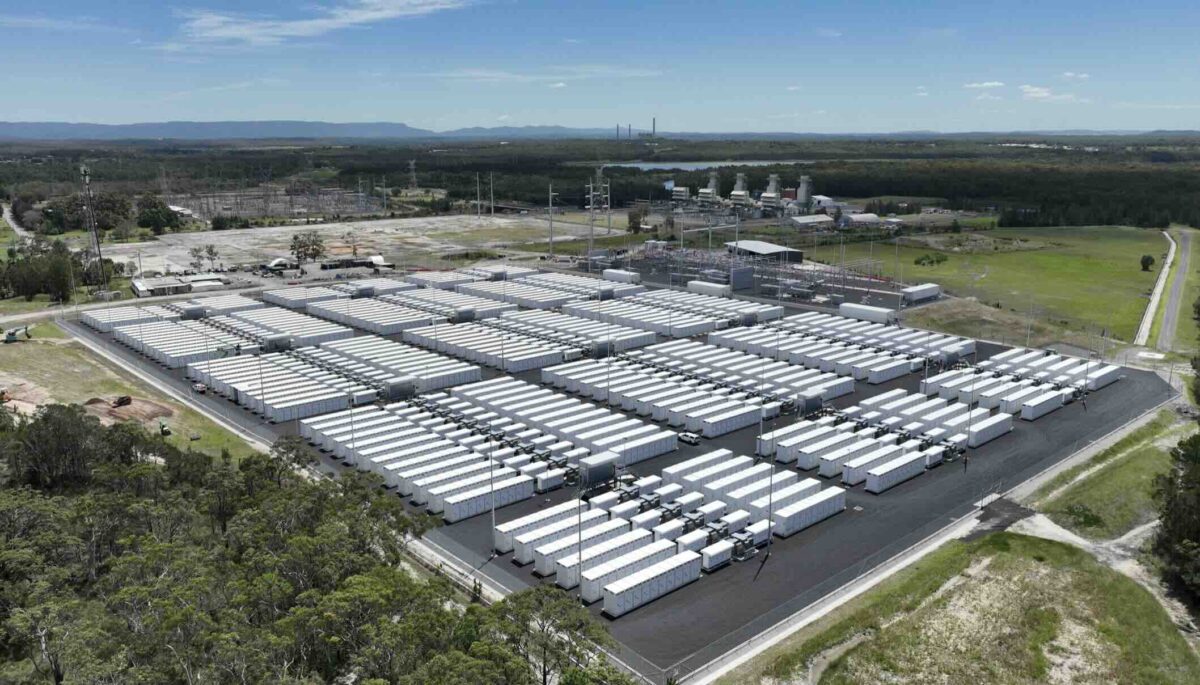
The Waratah Super Battery, sized at 850 megawatts (MW) and 1680 megawatt hours (1680 MWh), is the most powerful battery to be built in Australia, and one of the most powerful in the world. At 850 MW, it is the biggest single unit of any type to be connected to the Australian grid.
The battery is being built at the site of the decommissioned Munmorah coal generator and is owned by the BlackRock-backed Akaysha Energy, which also contracted Powin to supply batteries to the 150 MW, 300 MWh Ulinda Park battery that is currently under construction in Queensland.
Akaysha has since chosen Tesla Megapack battery technology for its two most recent project starts, the 400 MW, 1660 MWh Orana battery in NSW, and the 205 MW, 410 MWh Brendale battery in Queensland.
It is not immediately clear what the source of Powin’s problems are, but as a US-based battery supplier, and using cells from Chinese manufacturers, it is likely to be badly affected by the proposed tariffs, and multiple tariff changes, announced by President Donald Trump and his administration.
The Waratah battery is designed to act as a kind of giant “shock absorber” to the grid, allowing extra capacity to be carried on the main transmission lines feeding the state’s biggest load centres in Sydney, Newcastle and Wollongong.
It was specifically contracted to help fill the gap created by the anticipated closure of the country’s biggest coal generator, Eraring, in August this year, and was supposed to be up and running by then.
The urgency of that deadline was reduced after the NSW state government announced a deal to delay the closure of the 2.88 GW Eraring facility until at least August, 2027, but the timelines for Waratah have clearly slipped.
Despite early success in securing a connection agreement, and being surprisingly co-opted by the Australian Energy Market Operator last November to help respond to a potential supply shortage, the project has struggled to work through its commissioning process.
That is not uncommon in Australia – least of all for a new supplier, Powin, doing its first major project in the country, but it has meant that its planned completion date has slipped from the original target of March this year, then to late August, and more recently to the end of calendar 2025.
There has been speculation in the market that the delays in the commissioning could trigger the payment of liquidated damages – often imposed on suppliers and contractors in the event of a project delay.
But there has been little clarity on the process at Waratah. The details of the contracted revenues agreed by EnergyCo, the state body responsible for overseeing the developments, and approved by the Australian Energy Regulator are completely redacted, but reveal that some payments were due in the current quarter.
Waratah owner Akaysha sought a number of exemptions last year from NSW authorities seeking extension to work hours to make up for lost time it said had been caused by heavy rains and bad weather.
Its latest advice was that “hold point 3” testing was supposed to begin in late January. Renew Economy understands that the battery has now passed “hold point 3a” and is progressing through “hold point 3b”. It still needs to negotiate hold point 4 and hold point 5 testing points before being fully commissioned.
In a statement emailed to Renew Economy, Akaysha Energy said it is aware of Powin’s financial difficulties but has a contingency plan in place in “order to deliver minimal disruption and sustained project momentum.”
It said: “Both Waratah Super Battery and Ulinda Park are well advanced, with 100% of Powin battery packs installed and commissioning activities progressing. Waratah Super Battery currently has around 240 MW available and is progressing through hold point testing.
“Akaysha has mobilised its deep in-house engineering, delivery, asset management, and market operations teams to mitigate any risks to seamless project delivery.
“Our priority remains the uninterrupted and successful progression of these projects through to operations. We are actively engaged with all relevant parties and are confident in our ability to see these projects through to commercial operations as planned.”
In a separate statement , EnergyCo also said it is aware of “recent developments regarding the financial challenges of Powin,” but noted that construction of the Waratah Super Battery was finished on schedule in October 2024.
“With 100% of battery packs installed, the BESS portion of the project is progressing through hold point testing in the lead-up to the start of its operation. Testing and commissioning is ongoing,” it said in a statement.
The filing by Powin to authorities in Oregon is mandated by the state’s Worker Adjustment and Retraining Notification (WARN) Act, which requires employers to give a 60-day notice to the affected employees and to both state and local representatives prior to a plant closing or mass layoff.
Powin had big plans for its Australian business, with senior vice president Danny Lu telling Renew Economy in late 2023 that achieving its first connection approval for Ulinda Park was significant milestone in tackling the Australian market, which he says is one of the fastest-growing in the Asia-Pacific Region.
“Connecting energy projects to the Australian grid poses unique challenges due to stringent interconnection standards resulting from a combination of an inherently weak electrical grid, strict performance requirements and high renewable energy penetration,” he said.
Lu said at the time the company was pursuing up to 4GWh of potential battery storage project opportunities in Australia.