The developers of one of the largest wind and battery projects in NSW is still hoping it can deliver the project at or near its proposed capacity, as long as the state can find a way to augment the grid in the newly created South West renewable energy zone.
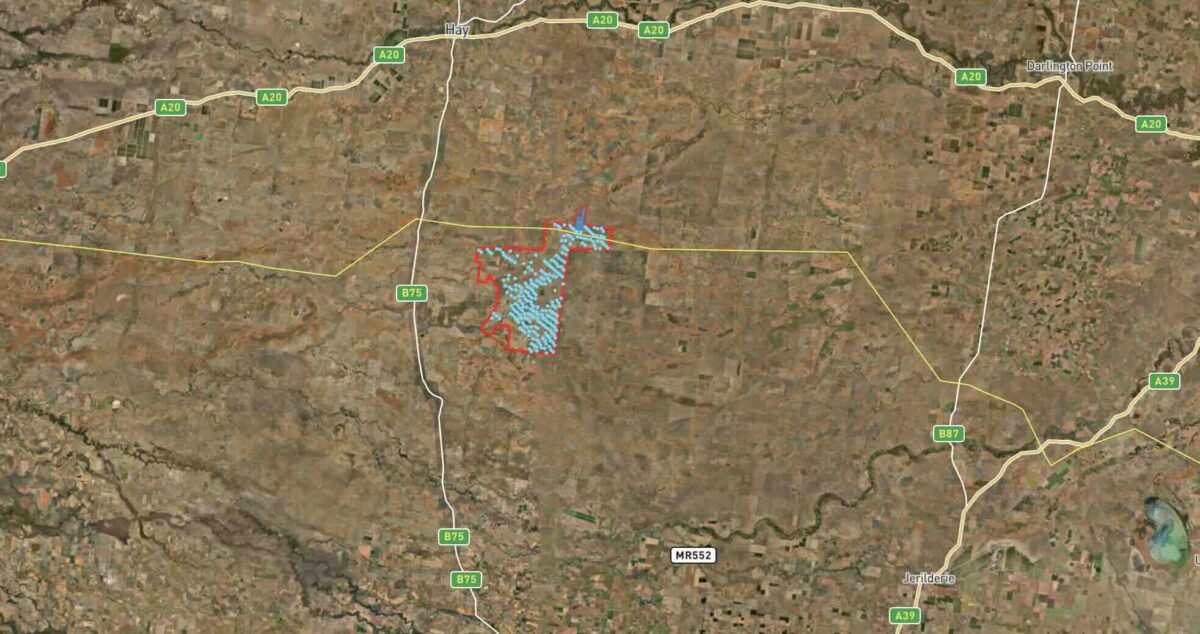
The Pottinger renewable energy hub was pitched as a 1.3 gigawatt (GW) wind project near the town of Hay, backed by a 400 MW, 1600 MWh battery at the same connection point.
But it, and other projects, will be heavily constrained because of the lack of capacity in the new REZ, and Pottinger was only allowed grid access for 831 MW of capacity following the recent landmark auction of grid access rights held by the NSW infrastructure agency EnergyCo.
The lack of capacity in the south-west REZ has long been a frustration for renewable energy developers, with some 19 GW of projects put forward for an REZ that could only support 4 GW, and even that allocation was reduced to just over 3.5 GW after a review by the market operator.
The blame is being put on a decision to build a 330 kV transmission line from NSW to South Australia, the backbone of the new REZ, rather than a 500 kV line that could have supported more capacity.
Someva Renewables, which is developing the Pottinger project along with AGL Energy, is hoping that EnergyCo can find a way to boost the capacity of the zone, the company’s development director Tim Mead told a hearing in Deniliquin in early June.
“From our perspective … there are many opportunities for increased capacity in the future,” Mead told day one of the Independent Planning Commission’s (IPC) local hearings into the project.
Other developers have cited the potential use of big batteries as “visual transmission”, allowing the grid to carry more capacity. Others have suggested creating local demand, such as data centres.
“Our target to get to financial close and start of construction for the end of next year for the 831[MW] is certain, because that is the outcome of the current tender,” Mead said.
The connection limit issue was canvassed during day one of the IPC hearing, which was triggered after the state government received more than 50 submissions from objectors, the vast majority of them from far afield.
Mead says the current connection cap means either reducing the number of turbines, or using smaller turbines.
“[Turbine numbers would] most likely be a range of 110 to 140, and that’s really in response to that 6 to 8-megawatt capacity of turbines that are more commonly sold into this market,” he said.
“There is [sic] still 4.5-megawatt turbine capacities, but I’d say more likely we’ll be in the 6 to 8 megawatts.
“From our perspective it’s important to still seek the 247 turbines.”
Decommissioning top of mind for IPC
The two-day hearing was dominated by opponents of the project, both local and from afar, with three speakers against the proposal on day one and 24 on day two.
Just one was in favour on day one, a landowner called Will Hooke. Hay mayor Carol Oataway was also generally looking forward to the economic benefits major projects will bring to her town, but asks that developers build their own water sources rather than leaning on the region’s. Edward River Council CEO Jack Bond noted they were concerned about road upgrades.
IPC chair Richard Pearson summed up day two as conveying distrust in the renewables rollout, the direction of energy policy, and a skepticism about wind energy and climate change in particular.
But the issues that resonated with the IPC were around the areas it could set conditions on the project.
“A reasonable amount of criticism of the planning process, what was seen as inadequate community consultation, lack of clarity regarding network access rights and transparency, inconsistent government messaging, calls for greater transparency,” Pearson said.
“The social licence issue was raised, which is an incredibly important issue to all industries, but particularly a new emerging industry. And the lack of binding commitments around decommissioning and waste management came through clearly.”
A day earlier Pearson said the commission has a “stronger view on decommissioning” than the Department of Planning’s recommendations.
“We take a stronger approach to ensuring that at the end of the project life, decommissioning does occur and we don’t, in 30 years’ time, end up with ghost wind farms. We don’t want that,” he said.
“We want turbines either to continue longer term or for them to be removed from site and the natural landscape to be returned following the completion of the project.”
Former National Party MP Noel Hicks, representing Save Our Surroundings Murrumbidgee, noted the Codrington wind farm is being decommissioned after 25 years of service and hoped the cost of doing so for the Pottinger wind farm would be born by developers and not the local governments and ratepayers.
“Asbestos of the future”
Some of the feedback was less useful, with one person on the first day unsuccessfully attempting to play the IPC audio from a video by controversial Canadian psychologist Jordan Peterson.
On day two, Riverina farmer Lynette LaBlack repeated claims she made about the Muswellbrook solar farm and battery in February, claiming the “Pottinger swindle factory is an unethical storm of neglect and abuse” of nature.
“Energy poverty renewables are the asbestos of the future,” she said.
“Predatory Transgrid and parasitic Pottinger Wind are not acting in Australia’s best interests at all with their pathetically fragile, unreliable, weather dependent, bankruptingly [sic] costly, insecure, ecocidal infrastructure that doesn’t work most of the time, designed to make Australia weak, and our most hostile enemy increasingly stronger.
“Australia cannot possibly remain a democratic sovereign nation when Pottinger’s unethical, insecure camera surveillance turbine monstrosities and battery bomb include remotely disabling and overheating fire-creating, sabotaging spyware, cyberware, and the ElectroNet/Transgrid combo are given free rein to experiment on the public, just like Transgrid’s Broken Hill blackout future with their sabotaging project EnergyConnect, now enabled without any engineering facts, scientific rigour, integrity or ethics by the non-independent, rotten regulator to be a law unto itself, plundering our precious countryside for no Australian benefit whatsoever, when project EnergyConnect is 46.56% controlled by the State Grid Corporation of China, the Chinese Communist Party.”
Another was from the Riverina State Group, an organisation that wanted to see the region become an independent state of Australia, and which is opposed to the visual impact. It claims the project will make electricity more expensive, and tried to cast doubt on coal as a climate change forcer.