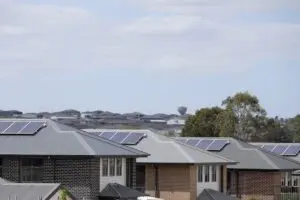
Federal Labor has unveiled a $2.3 billion plan to dramatically boost home battery uptake in Australia, through a national scheme that would cut the up-front cost of installation by an average of around 30 per cent – potentially, thousands of dollars.
The Cheaper Home Batteries Program, officially announced by the Albanese government on Sunday morning, caps off a week of growing speculation over what has become one of the most hotly anticipated policies in years.
The battery discount scheme, which would kick in on July 01 if federal Labor is re-elected in May, would mean households could buy a “typical” battery – “typical” in this case is said to be 11.5 kWh – with a 30 per cent discount on current installed costs, or a saving of about $4000.
The discount would be applied upon the installation of “virtual power plant (VPP) ready battery systems” alongside new or existing rooftop solar until 2030. The batteries do not have to be connected to a VPP, they just need to have the technical capability to do so.
Small businesses and community facilities would also be able to access the subsidy, with support for batteries sized between 50-100 kWh.
To avoid bringing the industry to a sudden halt while consumers wait for the subsidy to take effect, and presuming Labor is re-elected, the scheme has been designed to allow batteries already ordered and installed between now and July 01 to access the subsidy, as long as the systems are not switched on before July 01.
The government says the $2.3 billion program is costed into the 2025-26 federal budget and would be delivered through the existing Small-scale Renewable Energy Scheme (SRES) – the same rooftop solar subsidy program that has helped Australia to lead the world in household PV uptake.
As it does for solar, the size of the battery discount on offer through the SRES will reduce over time in line with expected battery costs.
The expansion of the SRES to take in home batteries has long been on the wish-list of renewable and consumer energy lobby groups, who argue that using an existing scheme – and one that is well understood by the industry – will cause the least disruption to the market.
For consumers, the proposed battery rebate holds significant potential to ease cost-of-living pressure, by maximising rooftop solar self-consumption and minimising exposure to volatile grid electricity prices.
According to energy department analysis, a household with existing rooftop solar could cut a further $1,100 from its annual power bill by adding a battery, while a home adding solar and a battery in one go could save as much as $2,300 a year – up to 90 per cent of a typical family electricity bill.
Many state and territory governments have introduced their own version of a home battery rebate or incentive, but still uptake has remained relatively slow. Currently around one in 40 households has a home battery, compared to one in three with rooftop solar.
A federal subsidy – which in many cases could be bundled with a state discount offer – promises to drive down costs enough to get the market moving in a way that it did with rooftop solar, driving greater uptake and driving down costs.
Boosting the number of batteries installed in homes around the country would also deliver benefits to the broader grid, by soaking up some of the excess solar that floods supply during the middle of the day and shifting it further into the evening peaks.
The smoothing out of rooftop solar on the grid would also reduce the need to upgrade network infrastructure and, it would follow, put downward pressure on network costs, which make up a large part of the retail energy bill that is paid by consumers.
“The sun doesn’t always shine – but households and businesses having batteries means we can keep solar energy on tap and keep energy bills down consistently,” federal energy minister Chris Bowen said in a statement.
“Labor’s number one priority is delivering cost of living relief,” added prime minister Anthony Albanese. “That’s why we want to make sure Australians have access to cheaper, cleaner energy.
“This is good for power bills and good for the environment.”
“A huge win”
The announcement from Labor has been highly anticipated, and much speculated over, as one of the missing pieces of the consumer energy policy puzzle that can make a big dint in the cost of living and take Australia’s world-leading rooftop solar success to the next level.
As one of few energy issues with bipartisan support, the Coalition is expected to announce its own version of a home battery discount policy – but will now do so in the shadow of the Labor proposition.
The Australian Greens unveiled their own home battery policy last month, promising households access grants of up to $5,000 – or 50 per cent of the total cost – and low-interest loans of up to $10,000, making a major dent in the average cost of installing behind-the-meter storage of between $9,000 and $17,000.
For industry, it has been a long time coming – the Smart Energy Council’s Wayne Smith told the Solar Insiders Podcast last week that the SEC has been involved in “a lot of discussions with a lot of governments over a long period of time,” lobbying for an up front discount on the cost of home batteries.
“We’ve particularly [been] talking to the federal government about this and they’ve been good listeners, I’ve got to say,” Smith said.
“If there is an announcement around a national battery booster program it will be an extraordinarily profound announcement, I would expect – a really significant program,” Smith told Solar Insiders.
“It could be the most significant announcement in decades, really.
“This is a big deal, and so industry should see this, if it happens, as a huge win.”
“Literally gives power back”
In a statement on Sunday, SEC chief John Grimes said federal Labor’s Cheaper Home Batteries Program was “the most important development in consumer energy” since the launch of the original SRES scheme, discounting solar panels.
“Australians can take control of their power bills and when and how they produce and use electricity. This literally gives power back to Australians,” Grimes said.
“It’s important to understand that this policy will help reduce the power bills of everyone, not just those who can get solar and a battery.
“Less demand on the energy grid means fewer price peaks, a win win for all.”
The SEC also said it was is pleased to see that the Albanese government had “listened closely to industry” on the design of the policy.
“A range of between 5-15 kWh for home batteries is an appropriate model for Australian households, and $372 per kWh will make a massive difference in bridging the gap between people who couldn’t previously contemplate getting a solar battery,” a statement said.
According to the SEC, there are currently 77 home batteries on the Australian market, starting at around $4,000 for a 5kWh battery.