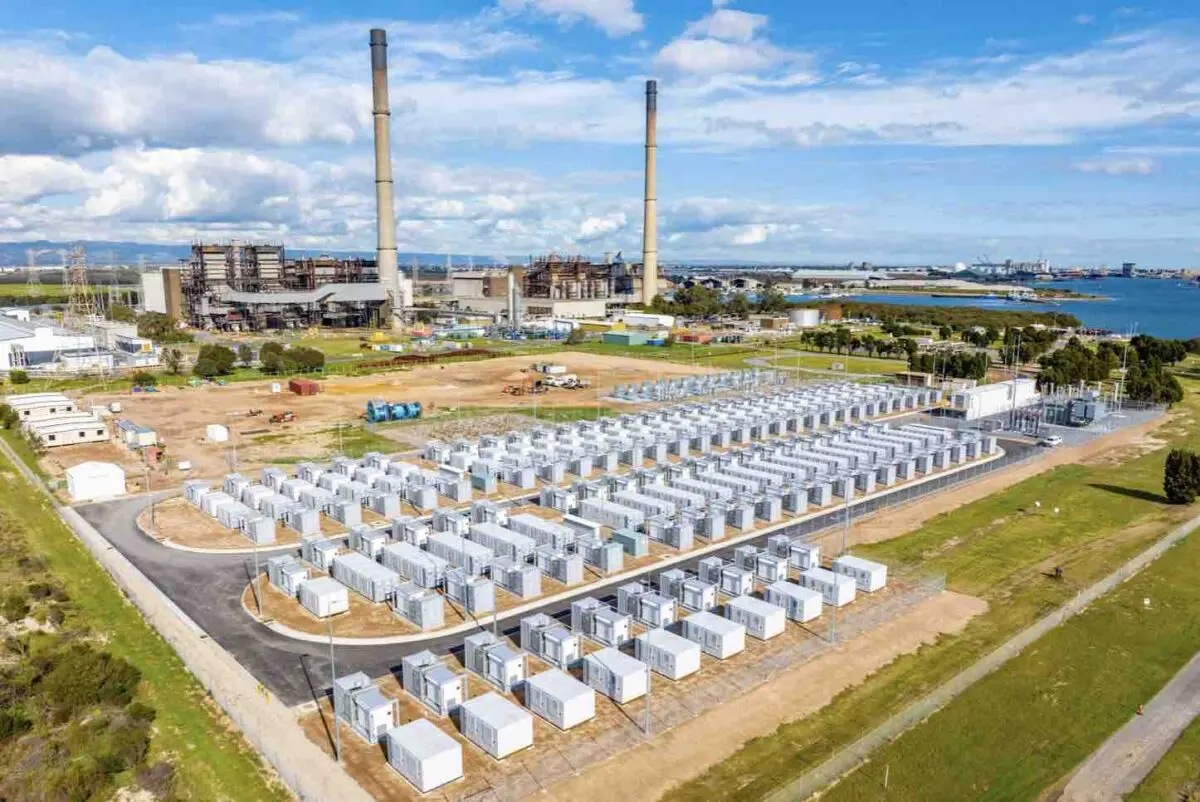
The success and growth of battery storage and other inverter based technologies has led to another major advance in the thinking around grid security needs in South Australia, the most advanced renewable grid in the country and arguably the world.
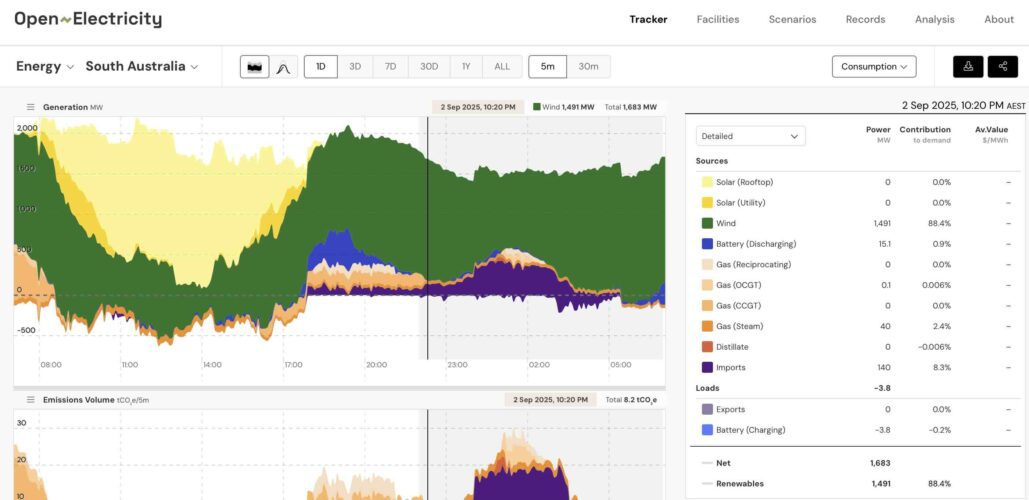
On Tuesday evening, at around 10.20pm (see graph below), the state’s grid was operating – for the first time – with one single synchronous generator, the Torrens B3 gas unit near Adelaide that was injecting around 40 MW of power into the grid at the time.
The Torrens unit was not needed for its power supply, but because of its ability to provide critical grid security needs, such as system strength.
Previously, the market operator had required at least two such machines, but soon it reckons it can keep the grid stable with none at all, a telling signal of the massive rethink that is going about the transition of grids based around traditional spinning machines to ones reliant on inverter-based technologies.
It has been a rapid transition, at least in engineering terms. Go back a decade, and some influential people within the Australian Energy Market Operator and other parts of the industry were not expecting any sort of battery storage above 1 MW to grace Australia’s grid.
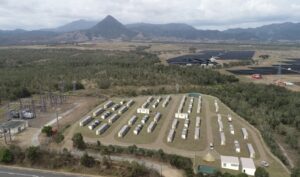
Then in late 2017, the Hornsdale battery was delivered, at 100 MW and 129 MWh, by far the biggest in the world, and then came the rollout of grid forming inverters, which its developers insist can provide all of the grid services, including system strength, traditionally provided by spinning machines.
Batteries are now being sized at up to 850 MW, and more than 3,000 MWh, and there will soon be more than 50 of them scattered around Australia’s main grids, and off grid, playing a key role in the balancing of wind and solar, and providing those essential grid services such as frequency control, inertia and system strength.
In a newly released report, entitled Reduction of Minimum Synchronous Generators in South Australia, AEMO says the reduced need of just one synchronous generator follows studies after the installation of four synchronous generators, or syncons, which are spinning machines that provide those grid services without burning fuel.
South Australia has four of these machines, which has reduced its reliance for such services on the traditional gas generators (coal having already shut down in 2016).
Battery developers, such as Tesla and Fluence, argue that they can provide all of these services and insist they are a lower cost alternative than syncons.
But AEMO and the main transmission companies responsible for maintaining system strength are not convinced that is the case in all circumstances – so many of the country’s renewable energy zones are being populated with these giant spinning machines.
In South Australia, the need for just one gas generator, operating at a minimum level of just 40 MW, means that more wind and solar can be supplied to the grid, rather than curtailed to make space for an extra fossil fuel machine.
There are some caveats, however. On Tuesday night, wind was providing nearly 90 per cent of state demand, but during the day, if the amount of rooftop solar brings “operational demand” down below 600 MW – than at least two synchronous generators will be required.
Rooftop solar, now on the rooftops of 50 per cent of households in the state, can bring operational demand down below zero, highlighting the need for curtailment and more battery storage.
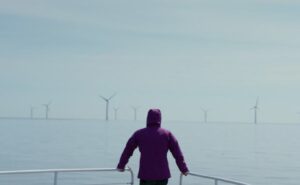
South Australia currently operates at an annual average of 75 per cent wind and solar – the highest in Australia and the world for a grid of its size – and has an official target of reaching 100 per cent “net” renewables by the end of 2027.
The “net” means that it will export surplus wind and solar when required, and import from other states at other times when needed. The completion of the new link to NSW, Project EnergyConnect, will help in that regard and also boost grid security.
Until that new link is completed, South Australia has a maximum allowable output of 2,500 MW of wind and solar, and 2,200 MW if one of the syncons is out of action for some reason.
Interestingly, the AEMO report found that – even if islanded – the state’s growing number of big batteries and its four syncons can, in theory at least, maintain “grid reference”, even without a synchronous generator.
“This assessment for grid reference was carried out based on desktop modelling and simulations as proof of concept,” it says. “A staged physical test is necessary to verify the findings from this assessment.”
That, however, relates to some situations and some applications, and one shouldn’t downplay the complexity of what’s required. There are other situations where AEMO deems that at least two synchronous generators are required.
But what is clear is that the syncons, and the battery inverters, means that AEMO have a rapidly increasing number of options at their disposal.
It means that at some stage, they will be comfortable enough with the technology to manage a major state grid – at least on a system security basis – with no fossil fuels needed at all, powering homes and industry. Who’d ever have thought that was possible?