Queensland’s flagship green hydrogen project Central Queensland Hydrogen Project (CQ-H2) is over after the lead partner, government-owned Stanwell Corporation, pulled out over the weekend.
In a two sentence statement issued on Sunday morning, the coal power plant owner said it had cancelled all of its hydrogen projects.
“Stanwell has discontinued its involvement in the Central Queensland Hydrogen Project (CQ-H2) project and other hydrogen development activities,” the statement said.
“The CQ-H2 project has been a valuable international collaboration that has provided important technical and commercial knowledge to support the future large-scale commercialisation of renewable hydrogen.”
Stanwell’s exit follows that of Kansai Electric Power in November last year. The Japanese company was supposed to be a key offtake partner but pulled out citing higher costs of production than were expected in the 2021 feasibility study.
Iwatani Corporation also left quietly in March, following the Queensland state government’s refusal to match $1.4 billion in federal funding for CQ-H2.
In February, energy minister and treasurer David Janetzki cancelled the state’s involvement, saying the project didn’t align with its priorities to sweat existing coal stations and he believed it would have needed much more than $1 billion in government funding.
With Stanwell leading CQ-H2, it’s unlikely the remaining partners in the consortium will continue pushing it forward. Yet to reveal their position on CQ-H2 are Marubeni Corp and Singaporean infrastructure company Keppel.
Fertiliser maker Dyno Nobel, which until April was known as Incitec Pivot, signed a memorandum of understanding in September last year as it was interested in possible green ammonia production further down the track, but never came into the consortium.
This is the second green hydrogen project to exit Gladstone in the last six months.
Fortescue scrapped its electrolyser project in the town in May, citing global headwinds for a pullback into R&D and away from commercialisation.
Squandering opportunities
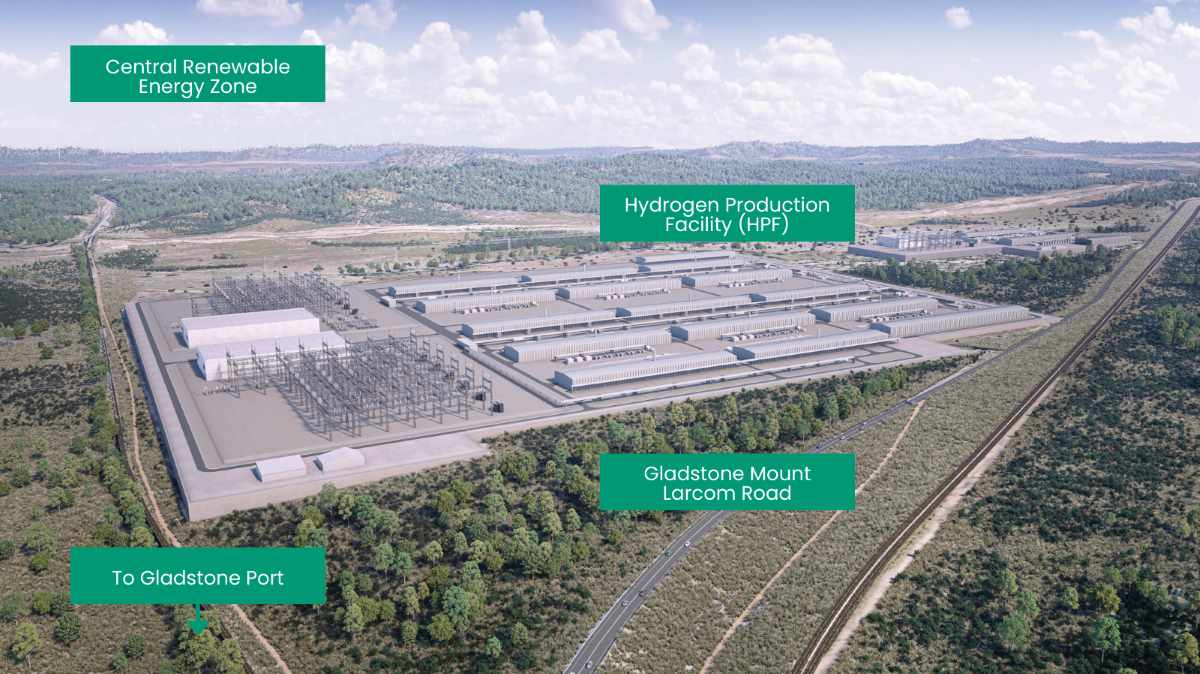
The $12.5 billion CQ-H2 project was supposed to see a hydrogen production facility built at Aldoga, a hydrogen gas pipeline to the Gladstone Port, a hydrogen liquefaction facility and ship loading facilities at the Gladstone Port, and the supply of hydrogen to an ammonia production facility also at Gladstone Port.
The first customers were to have been in Singapore and Japan, with first production of 200 tonnes a day from a 720 megawatt (MW) electrolyser, with electricity sourced from Acciona Energía’s 420MW Aldoga solar farm.
Acciona says the PPA with Stanwell, which has contracted for all of the electricity from the massive solar farm, is still on safe ground despite the hydrogen project being off the table.
Future plans included expanding electrolyser capacity to 2,880 MW to support production of 2,880 tonnes a day.
The exits will hurt Gladstone most, which has been working hard to to shift its fossil fuel economy to renewables and had hoped to become a green iron hub.
Gladstone regional mayor Matt Burnett was initially hopeful in February that CQ-H2 could still go ahead with just private and federal funding, and planned to emphasise its importance to the future of the town.
The regional council has been contacted for comment.
Stanwell’s exit has dismayed Queensland Conservation Council’s Emma Smith, who says the state is squandering opportunities that regional centres want, such as green iron.
“The state government supported the development of the industries that currently keep Gladstone alive, particularly aluminium smelting through subsidised electricity and the gas industry through a range of incentives and tax breaks,” she said in a statement.
“Now they need to provide that certainty to new industries so Gladstone can be set up for the future. But the continued attacks on renewable energy and clean industry are jeopardising regional jobs and derailing new industries setting up shop in Central Queensland.”