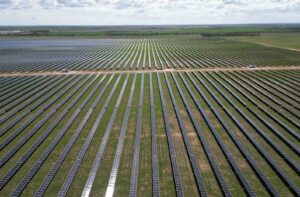
Australia’s richest person Gina Rinehart has made it clear she is no fan of net zero policies, but her mining executives have managed to make some important economic savings by installing solar and battery storage systems at some of their mining operations.
Hancock Iron Ore, the newly created “mega miner” and the owner of the prized mines that are the source of much of Rinehart’s wealth, has revealed it has installed three solar and battery hybrid systems for the company’s dewatering operations in the Pilbara.
The installations are small-scale – combining 750 kW of solar PV, using the rapid deployment Maverick technology developed by Australian solar innovator 5B, and 1.68 MWh of battery storage – but they are effective.
According to Pacific Energy, which installed the systems for Hancock Iron ore, they are designed to achieve 55 per cent renewable energy penetration at these off-grid sites, and save up to 250,000 litres of diesel annually.
“This was our first time deploying the 5B Maverick Solar Array for bore pump applications. The rapid-deploy, transportable design made it perfect for this remote mining environment,” Pacific Energy said in a LinkedIn post.
“We also integrated Variable Speed Drives to optimise pump efficiency and connected everything into Hancock Iron Ore’s existing SCADA platform for seamless monitoring.
“The project shows how hybrid systems can deliver real operational benefits in challenging mining applications – reducing maintenance requirements while cutting fuel consumption.”
Pacific Energy says it is working on yet more such systems for Hancock Iron Ore this year.
Hancock also posted about the success of the solar and battery installations.
“The solar power system’s design will offset up to 55% of the required energy, with the excess generation stored in battery systems for later use,” it noted in its own post on LinkedIn.
“The project will increase productivity and organisational efficiency by reducing the hours required for inspection and maintenance, as well as lowering diesel generator hours, with an expected annual saving of up to 250,000 litres of diesel.
“Our use of technology and innovative thinking have become defining features of our world class iron ore operation.”
In truth, the installations are tiny compared to the scale of solar and battery projects being undertaken by Hancock’s iron ore peers such as Fortescue Metals, BHP and Rio Tinto.
These companies have already built solar farms of more than 100 MW (100,000 kW) and big battery systems, and are now starting the planning work on gigawatt scale projects.
Fortescue has a target of reaching “real zero” by 2030, which would mean not burning any fossil fuels for mining or land based transport or machines by the end of the decade.
Rinehart, on the other hand, has campaigned against even longer term net zero targets, which she has described as a “magic pudding” and unobtainable. She has previously described solar panels as an “eyesore”,
“The truth hiders are not telling us, manufacturing often requires 24-hour reliable electricity, such as dairy and aluminium, steel and AI, they ignore the consequences,” she said in reports of a speech that was posted on the Hancock website.
“The truth avoiders are not telling us, that given the increasing introduction of renewables, businesses, even small ones, are being called up by bureaucrats demanding they stop using mains at times, so that thousands of homes in the cities don’t lose power at peak times,” Rinehart was quoted as saying.
“The truth twisters are not telling us of the trillion plus of taxpayers’ dollars net zero will cost, or the further trillion businesses will have to pay for net zero.”
But it seems clear that, at least for some applications, Hancock is discovering that renewables and storage can deliver savings. As we reported last year, Rinehart’s companies applied for permission to build a 40 MW solar facility at another of its mine sites at Mulga Downs.
Hancock’s post on LinkedIn last month was met with congratulations and offers by other companies that they can provide even better systems.
“AFB has a better off grid solution at 90% diesel reduction,” wrote Mark Reynolds, the chairman of AFB which provides hybrid systems based around flow battery technology.
“Was suggested 9 years ago when I built that place,” wrote Benjamin Greig, whose LinkedIn profile says he was a senior construction manager at Rinehart’s Roy Hill Mines until late 2016, and who is now head of major projects at Australian EV charging company Jet Charge.
Many of Hancock’s peers, and other industries including aluminium smelter owner Rio Tinto, know that those savings can be delivered at much large scale.