There’s not a whole lot that Australia’s two major political parties agree on in energy policy right now, but both seem to be in lock-step on the belief that gas will continue to play a major role supporting the nation’s increasingly renewable grid for the foreseeable future.
The argument goes that renewable energy technologies need gas to work. Or, put another way, solar and wind simply cannot supply power reliably and affordably without gas. And therefore, any and all policies to shore up the national supply of gas are justifiable, even in a climate crisis.
As Ketan Joshi writes here, on LinkedIn, it’s a particularly troubling take from the Albanese government, “because in saying that renewables ‘need’ gas, [federal energy minister Chris] Bowen is also downplaying one of Labor’s greatest and most material successes, which is the way battery storage is absolutely destroying the case for gas in Australia’s energy grid.”
But a new report from the Climate Council has demonstrated this week that it’s also a troubling take for any political party that claims to be focused on bringing down power prices for households and business – because increasingly expensive gas “plays an outsized role” in setting the price of power.
The report – co-authored by associate professor Joel Gilmore and reviewed by Climate Councillor and one-time oil industry exective with BP, Greg Bourne – pinpoints gas as the main driver of rising electricity prices over the past decade, and chief eroder of the “bill-busting benefits” of cheap solar and wind.
“Many Australians will remember a time when fossil gas was an abundant, low-cost source of energy,” the report says. “But this all changed in 2015, when the east coast gas market opened and we started shipping huge amounts (more than 80%) of our gas overseas.”
That local market shift, along with the global reverberations of Russia’s ongoing invasion of Ukraine, means electricity generated using gas has become extremely expensive.
In Australia, this means that despite providing only about 5 per cent of total demand of the National Electricity Market (NEM), gas is setting the price of electricity up to 90% of the time, the Climate Council report says.
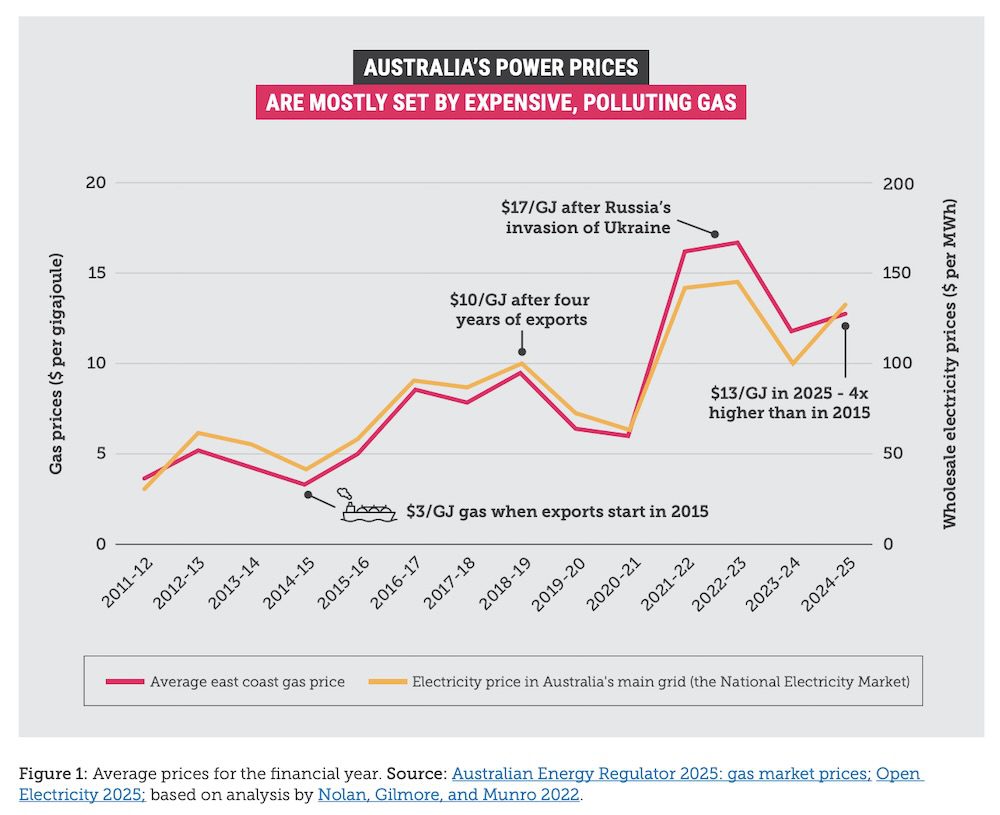
“Gas is the stealthy price setter, tethering our household budgets to volatile and high-cost global markets,” says Bourne.
“[Gas corporations] have made close to $100 billion in extra revenue since the invasion of Ukraine in 2022, and the current uncertain international environment could well expose us to further turbulence.
“That’s why bills are high. If we delay the roll-out of renewable energy and storage, our household and business power bills will only get higher.”

The worse news, which the Climate Council report draws from recent analysis by Nexa Advisory, is that an over reliance on gas generation – which could result from any further delays to the build out of firmed renewables and supporting transmission – could increase wholesale electricity costs by almost $116 billion (more than 20%) by 2050.
The good news – harking back to Ketan Joshi’s analysis, here and here – is that the continued rapid rollout of solar, wind and battery storage can limit gas to a small residual ‘firming’ role in our grid, and therefore limit its impact on consumer bills.
“Already, batteries are providing more of our power and reducing the role of gas. In the last three months of 2025, batteries provided around 1% of our
power (nearly triple as much as the previous year), while the share of gas in the grid has dropped to 3% – compared to more than 4% last summer,” the report says.
“Over the same period, batteries helped put downward pressure on prices and reduce sharp price spikes in the evening peaks: overall, wholesale prices were 44% lower than the same time last year.
“By next year, big batteries are set to make up a greater share of our main grid than gas,” the report concludes. “We need to prioritise reducing our gas use as much as possible, so we deliver energy bill savings for households and businesses while cutting climate pollution.”
Climate Councillor and report co-author, Joel Gilmore says gas is not the only offender in driving up power prices. Australia’s ageing fleet of coal plants is another major source of pressure.
“Those who would advocate for keeping coal power stations open are essentially arguing for higher household bills because of the role these clunkers play in pushing up power prices,” he said on Wednesday.
“Rusty old coal power stations are literally falling apart around us – they’ve become so unreliable that even the operators agree it’s no longer economically viable to keep patching them up.
“The only thing you can count on when it comes to a coal-fired power station is that it will keep breaking down, and causing electricity price spikes.
“We are lucky enough to have abundant natural resources in our solar and wind, and we should make the most of them,” Gilmore says.
“Expanding renewable energy, storage and the necessary poles and wires to deliver more of this low-cost fuel will drive down prices over the long-term, and protect households and businesses against volatile international markets.”
If you would like to join more than 29,000 others and get the latest clean energy news delivered straight to your inbox, for free, please click here to subscribe to our free daily newsletter.