Fortescue is moving its hydrogen free electrochemical iron process out of the lab and into the Pilbara. For a decade, the dominant narrative around green steel has been green hydrogen feeding direct reduced iron (DRI).
Fortescue itself was once one of the loudest voices promoting hydrogen exports from Western Australia. Now it is testing a low temperature electrochemical route that reduces iron ore directly with electricity.
That shift is not about chemistry alone. It is about reading policy signals and preparing for a carbon priced world where exporting metallic iron from the Pilbara may be more competitive than exporting 60% iron ore.
Fortescue’s green iron process, described in its Arena-funded Low Temperature Direct Electrochemical Reduction program, uses electricity and a caustic liquid solution to turn iron ore directly into metallic iron.
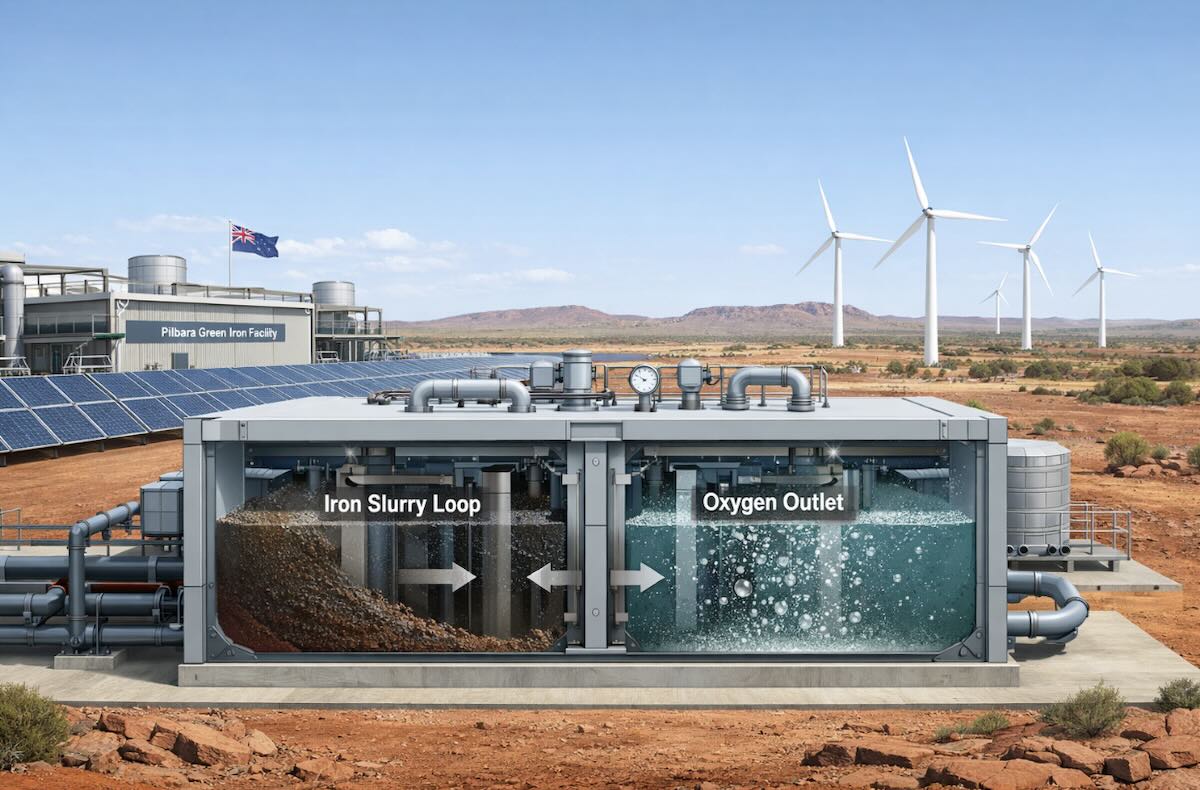
Instead of first making hydrogen and then using that hydrogen to reduce the ore, the process applies electricity inside an electrochemical cell that contains a circulating slurry of finely ground ore mixed with an alkaline solution.
The Arena interim and final reports describe the system operating below about 130°C, with a solution that is roughly 50% sodium hydroxide by weight. The electrolyser has two chambers separated by a membrane that lets charged particles pass while keeping gases and solids apart.
When power is applied, oxygen is released at the anode and metallic iron forms on the cathode side inside the slurry. The iron does not build up as a thick layer stuck to an electrode that must be scraped off. Instead, it forms as iron bearing particles that can be separated from the liquid in a continuous process.
The reports note testing of different membranes, including Agfa Zirfon types, and stress that the system is designed to work with Pilbara ores in the 56% to 58% iron range. Those ores are generally too low-grade for hydrogen based DRI unless they are upgraded first, so compatibility with lower grade ore is an important part of the concept.
The patent trail aligns with that description. The claims and abstract language point toward a continuous electrochemical flow reactor in which iron ore particles suspended in an alkaline electrolyte are reduced under applied voltage to form solid iron bearing particles that can be separated from the spent electrolyte in an external loop.
Taken together with the Arena documentation, the picture is of a low temperature caustic slurry electrolysis route engineered for continuous operation, solids handling, and renewable powered flexibility, avoiding both high temperature blast furnaces and the hydrogen production, compression, and storage chain required for hydrogen based DRI.
The structural inefficiency of the current system is simple. Pilbara ore at 58% to 62% Fe means that to deliver one tonne of contained iron you ship about 1.6 tonnes of rock. The non-valuable fraction is moved across oceans, unloaded, and then discarded in slag.
Today bulk freight from West Australia to Qingdao sits around $9 to $10 per tonne of cargo on the C5 route, according to Baltic Exchange reports. That means freight per tonne of contained iron is roughly $15. If, instead, you ship one tonne of metallic iron, freight is about $9-$10 per tonne of iron. The difference is modest today. As maritime fuels decarbonise and bunker costs rise, that difference grows.
Maritime fuel economics are changing. In my recent analysis of end-game maritime fuels, very low sulfur fuel oil at around $510 per tonne is expected to move toward $650 per ton before carbon costs. At $200 per tonne CO2, and using 3.114 tonnes CO2 per tonne of fuel oil, the effective cost rises to about $1,273 per tonne of fuel.
At $300 per tonne CO2 it moves toward $1,584. If fuel is about 40% of voyage cost, freight rates can rise by 60% to 80% in high-carbon scenarios. A $9 per tonne cargo rate becomes $14 to $17.
Under those conditions the penalty for shipping 1.6 tonnes of ore instead of one tonne of iron becomes $9 to $12 per tonne of contained iron rather than $5 to $6. Shipping is not the dominant term in steel economics, but it consistently favors shipping metallic iron rather than ore as carbon pricing spreads into shipping.
The European Commission publishes carbon values for use in cost benefit analysis of public investments, and those values rise toward roughly €250 per tonne CO2 in 2030 and higher after that.
Those numbers do not set the EU emissions trading system (ETS) price directly. The ETS price is determined in the allowance market and carbon border adjustment mechanism (CBAM) certificate prices are pegged to the average EU ETS auction price over defined periods.
The significance of the budgetary guidance is that it signals how European policymakers are thinking about the long-run social cost of carbon and the direction of travel for tightening the cap.
When CBAM mirrors the ETS allowance price, and when free allocation declines, the effective carbon cost embedded in imported steel converges toward the ETS price. The guidance is not the actual, but it is a directional indicator of where the price is likely to move.
To keep the arithmetic consistent, it is useful to express everything per tonne of crude iron. Conventional blast furnace basic oxygen furnace ironmaking emits about 1.8 tonnes CO2 per tonne of iron, based on widely cited industry data.
At €200 per tonne CO2, that implies €360 per tonne of crude steel in carbon cost if fully exposed to the allowance price. At €250 per tonne CO2, the carbon cost rises to €450 per tonne of iron. At €300 per tonne CO2, it is €540. At €400 per tonne CO2, it is €720.
These numbers represent the maximum carbon cost differential between a high emission blast furnace route and a near zero emission route, before accounting for differences in raw material, energy, and capital costs.
CBAM applies the ETS price to the verified embedded emissions of imported goods, so if imported iron has 1.8 tonnes CO2 per tonne and the ETS price is €300, the CBAM liability is €540 per tonne of crude steel.
For the electrochemical route in the Pilbara, start with 3.2 megawatt-hours (MWh) per tonne of iron for the direct reduction step. That’s the Arena number for the expected production energy cost.
For hydrogen DRI, assume 60 kg of hydrogen per tonne of crude steel as a midpoint in the 54 to 72 kg range often cited for pure hydrogen DRI. Using a realistic full system electricity demand that includes compression, drying, thermal management, and storage losses, hydrogen production would require 55 to 65 kilowatt-hours (kWh) per kg delivered to the shaft furnace, with the mid and higher end more realistically representing the full balance of plant.
At 60 kg of hydrogen per tonne of iron, 55 kWh per kg implies about 3.3 MWh of electricity per tonne of iron, while 60 kWh per kg implies about 3.6 MWh. If hydrogen consumption rises to 70 kg per tonne and full system electricity demand is 60-65kWh per kg, total electricity use increases to roughly 4.2 to 4.6 MWh per tonne of iron.
Under realistic balance of plant assumptions, hydrogen-based DRI therefore lands in the 3.6 to 4.6 MWh per tonne range, well above the expected energy requirements of the Fortescue electrochemical process.
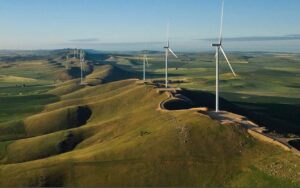
Now layer in electricity cost. Electricity is a major cost driver, and Fortescue has strong experience in building massive infrastructure including renewables and related electrical components in the Pilbara. They have the scale to import containers of Chinese solar panels and batteries, and the infrastructure and skill to deliver them and wind turbines to sites near the mine.
At $A62 per MWh, which is a mid-case for wind and solar plus modest storage in the Pilbara, per my scenario workup for this analysis, 3.2 MWh per tonne of crude steel implies $A198 per tonne of crude steel for the electrochemical route.
At $A40 per MWh it implies $A156. At $A90 per MWh it implies $A288. For hydrogen DRI at 3.6 MWh per tonne, electricity cost is $A217 at $A62 per MWh. At 4.6 MWh per tonne it is $A285.
If the electrochemical iron plant including balance of plant costs $A3,000 per annual tonne of iron capacity and operates at 85% utilisation, the annualised capital charge at a 10% recovery factor is about $A300 per tonne of iron output at full capacity. Adjust for 85% utilisation and it becomes about $A353 per tonne of iron. Add in the electricity cost and it comes out to about $A550 per tonne.
For hydrogen DRI, suppose electrolyser and hydrogen handling plus DRI shaft furnace together amount to $S3,500 per annual tonne of crude steel capacity, recognising that electrolyser sizing depends on utilisation and storage assumptions.
At a 10% recovery factor and 85% utilisation, the annualised capital charge is about $A412 per tonne of crude steel. Add electricity of $A248 per tonne at 4 MWh equivalent and total ironmaking is roughly $A660 per tonne of crude steel. If electrolyser capex is higher, or utilisation lower due to variable renewables, capital per tonne rises. This is before the ore upgrading required for hydrogen DRI to actually work with Pilbara iron ore.
The modelling I did for this assessment, using only publicly available data, and doing some simple scenarios for renewables and storage mix, suggests Fortescue’s electrochemical process, assuming it can be scaled, would be in the range of 20% cheaper than hydrogen DRI, consistent with my assessments of green iron economics along multiple pathways.
In Europe, the pig iron average price is around €350 euros, about $A580, after jumping to €500 during the energy crisis. With only delivery considered, Fortescue’s product would be in the running. However, the company is in the business to make profits.
For the fiscal year ending June 30, 2025, Fortescue reported average realised iron ore revenue of about $US85 per dry metric tonne of its core hematite product and C1 cash costs around $US18 -$19 per tonne, which are the straightforward operating costs before royalties and selling costs are added back in. Fortescue’s iron ore business today operates at very high gross margins, typically in the 60% to 80% range depending on how you define cost, per public reporting.
Clearly, if it’s exporting iron that costs $A550 per tonne to make, it’s going to make a lot more money. But would it be willing to forego the margins? Assuming that they would be willing to compromise gross margins for much higher overall profits, a 50% gross margin would put their green iron in the $A825 range, around €500, outside of the market. It would require a green premium in order to sell into the market, which is where CBAM comes in.
The blast furnace carbon liability at €73 per tonne of CO2 – today’s EU ETS price – times the 2.2 tons of CO2 emissions is €160, more than bridging the gap. All iron and steel manufacturers exporting to Europe and all iron and steel manufacturers in Europe are going to be paying, raising the price of iron on the market.
With actual green iron, Fortescue will be competitive because its $A825 will be cheaper than iron with an applied carbon price.
Of course, CBAM isn’t fully costed on imports at present. The transitional and definitive phase provisions in the regulation mean that only the portion of emissions not covered by free allocations in the EU ETS are subject to CBAM in the early years, with 100% coverage only arriving in 2034.
Analysis suggests that for iron, it would be around 2.5% of the quarterly average carbon price. Fortescue wouldn’t be in the money today if it were already in production.
With the targeted EU ETS value of €250 per ton CO2 in the mid-2030s, however, the CBAM charge would become €550 per tonne of high carbon iron, about $A915. Only green iron would be purchased from around the world or made in Europe, and the cost for it would be easily in the profitable zone for Fortescue.
Framing everything per tonne of iron and tying CBAM directly to the ETS price makes the comparison transparent. It is not the analytical guidance value that matters in law, it is the ETS allowance price that drives CBAM, and that price multiplied by 2.2 tonnes CO2 per tonne of crude steel defines the carbon headroom available to low emission routes.
At today’s scale, Fortescue ships roughly 198 million tonnes of iron ore per year. Using a simplified cash margin of about $US66 per tonne, which converts to roughly $A94 per tonne at recent exchange rates, that implies around $A18.6 billion in gross profit from ore at current volumes.
Under the green iron scenario modeled earlier, with an assumed selling price of $A825 per tonne and a production cost of $A550 per tonne, gross profit would be $A275 per ton. That is roughly $A180 per tonne more than the current ore cash margin.
If 5% of annual shipments were converted to green iron, about 10 million tonnes, total gross profit would rise by roughly $A1.8 billion. At 10% penetration the uplift would be about $A3.6 billion. At 20% it would approach $A7.2 billion.
At 50% penetration, gross profit could increase by nearly $A18 billion, relative to the all-ore baseline, assuming price and cost stability and ignoring additional capital, conversion yield, and market absorption constraints. These are simple gross margin comparisons, not return on capital calculations, but they illustrate the scale of the economic shift if green iron can command and sustain that price-cost spread.
The analysis has been against Europe, which has the most stringent carbon pricing regimen and the first operational CBAM. It’s not the biggest purchase of Australian iron ore, China is. But China had steel covered by its carbon price, even before the recent expansion of sectors covered to include all of heavy industry, petrochemicals, chemicals, flat glass, copper smelting, papermaking, and civil aviation.
China’s carbon price is much lower at present, but carbon prices are always expected to grow, and policy discussions do include mechanisms similar in effect to carbon border adjustments.
Establishing a green iron manufacturing industry in the Pilbara to serve the EU late this decade will likely lead to being able to expand it to sell to China in the late 2030s.
There are risks. Electrochemical iron must operate reliably at scale. Slurry handling, caustic management, impurity tolerance, and electrode durability must be proven. Capital intensity must fall with scale. Customers must accept a new form of iron unit. None of that is guaranteed. Boston Metal’s molten oxide electrolysis has been working through similar challenges. The path from pilot to multi million tonne per year plant is long.
Still, the policy signals are clear. Europe is embedding high carbon values into public finance and border policy. China is following. Maritime fuels will not remain cheap in a decarbonising shipping sector. Shipping gangue across oceans will become more expensive.
Hydrogen DRI adds infrastructure and energy steps beyond Fortescue’s approach which is expected to work against current Pilbara ore grades. Direct electrochemical iron aligns more naturally with a wind and solar system.
Fortescue’s green iron approach may not scale. But in a CBAM world with rising carbon prices, it sits closer to the economic center of gravity than hydrogen DRI in the Pilbara.
If primary steel is to be decarbonised at scale without pricing it out of reach, direct electrochemical routes are a plausible path to affordable green iron and the steel that follows.