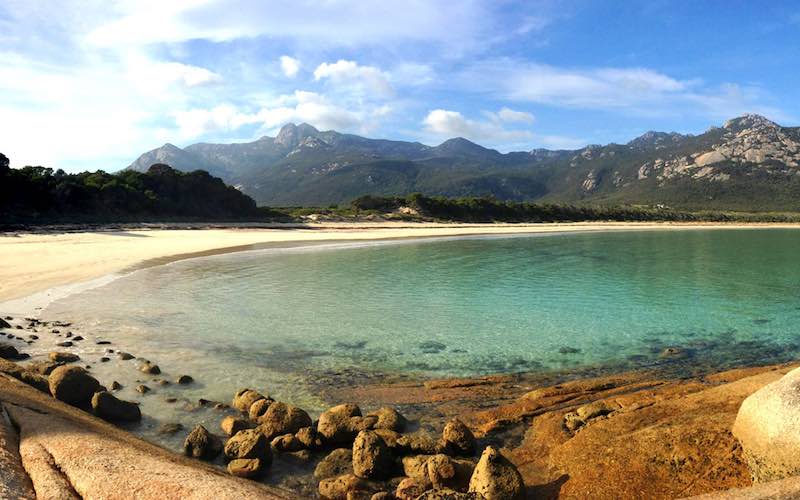
State-owned utility Hydro Tasmania will formally “switch on” its Flinders Island Hybrid Energy Hub in December, around two-and-a-half years after the project was first announced, with the aim of meeting at least 60 per cent the island’s 6.7 gigawatt-hours (GWh) of annual demand with renewables, and minimising the output of its 3MW diesel power station.
But the hub – which combines 900kW of wind (one turbine), 200kW solar, and a mix of “enabling technologies” including 300kWh of battery storage, a 850kVA flywheel, and a 1.5MW dynamic resistor – is already taking the Bass Strait island to levels of 80 per cent renewables, on occasion, and the team behind it are confident it will supply 100 per cent of demand before the year is out.
The $13.3 million Flinders Island project – which has been partially funded ($5.5m) by the Australian Renewable Energy Agency – follows up on Hydro Tasmania’s world-leading success with King Island (also funded by ARENA and the Tasmanian government), which used a similar mix of wind, solar and energy storage to achieve 60 per cent renewables between 2010-2014.
The $18.25 million King Island Renewable Energy Integration Project, or KIREIP, has since achieved multiple extended periods of 100 per cent renewable, including in November 2015, when it ran on 100 per cent renewables for 33 hours non-stop.
And in May 2014, the project won the Energy Supply Association Australia innovation award, for what judges described as a “world-leading approach to harnessing the full capacity of renewable energy… (and) the potential to be replicated in remote areas to reduce reliance on diesel and the cost of supply.”
Already, however, in the few years since King Island was switched on the technology has improved, and the project costs have come down, particularly due to the batteries and inverters and other “enabling technologies” being containerised, in specially designed units made in Tasmania.
“The technology mix is very much the same (at Flinders Island), but with a bit more solar, and the whole project has been easier, cheaper and quicker,” said David Brown, the implementation manager of hybrid energy solution at Hydro Tasmania.
This is good news for Hydro Tas, and the company’s plans to roll the energy hubs out at other locations in Australia, on other islands, and as temporary power solutions; for use in disaster relief and in the mining sector.
“We’re actively talking to people across the pacific… and making in-roads into the mining sector,” Brown told One step Off The Grid this week. “We’re also looking at (rolling the technology out) in embedded networks, in grid-connected projects, fringe of grid… A lot of this is fairly transferable.”
But it is even better news for the people of Flinders Island, who now have a more sustainable, more reliable, and much cheaper power supply.
And while the islanders’ power bills will not be any cheaper, not immediately, anyway, the new power mix shields them from future price rises and costs.
“Power prices on Flinders Island and King Island and most remote places are regulated,” Brown explains. “The (Flinders Island) tariff, set by the regulator, has covered about one-third of the cost of running a diesel power station, paying for employees, upkeep, buying diesel.
“The (Flinders Island Energy Hub) will reduce that level of subsidy,” he adds, thus reducing the island’s exposure to future tariff rises.
On top of that, the Hub has lower overall operational costs and, of course, a significantly reduced environmental impact. But Brown says one of the most pleasing outcomes achieved by the King Island system – and expected to be replicated on Flinders Island – has been the improved power quality.
“If we get a lightening strike or a tree branch falls, then previously that might trip a line,” Brown told One Step. “(Using the mix of solar, wind, energy storage) the electrical protection system works better. There’s more interim inertia in the system, with the fly-wheel.”
While demonstrated on a small scale, the finding is noteworthy, particularly considering the concerted campaign by Australia’s anti-renewables camp to associate high penetration of solar and wind with “the lights going out.”
“We can adequately demonstrate that intertia is good, but you don’t need baseload for it,” Brown said. In fact, you don’t need baseload at all.
“It’s a pretty well proven mix.”
For Flinders Island, this remains to be seen, but considering the Hub is already achieving levels around 80 per cent renewables, the HydroTas and the local government are both confident of getting it to 100 per cent in the not-too distant future.
“The beauty of the system that Hydro have put in is that when a wave tidal generation is developed more, this is a perfect location and the system will allow that to just plug in,” said deputy mayor, Marc Cobham.
“The waters around the Furneaux Islands have been identified internationally as some of the best resources as far as tidal energy.
“So hopefully that will happen in the next few years,” Cobham said.
This article was originally published on RenewEconomy’s sister site, One Step Off The Grid, which focuses on customer experience with distributed generation. To sign up to One Step’s free weekly newsletter, please click here.
Last week, the UK committed up to £1 billion to community and local energy, with…
The developer of a gigascale solar and batter project proposed for the NT says work…
Perhaps the most important feature of the latest monthly electricity data from the IEA is…
Australia's biggest publicly owned wind farm has been cleared for construction in Queensland coal country…
GridBeyond CEO Michael Phelan on how industrial loads and data centres are being orchestrated by…
Perth-based energy storage and off-grid energy system specialist secures a new private equity investor to…