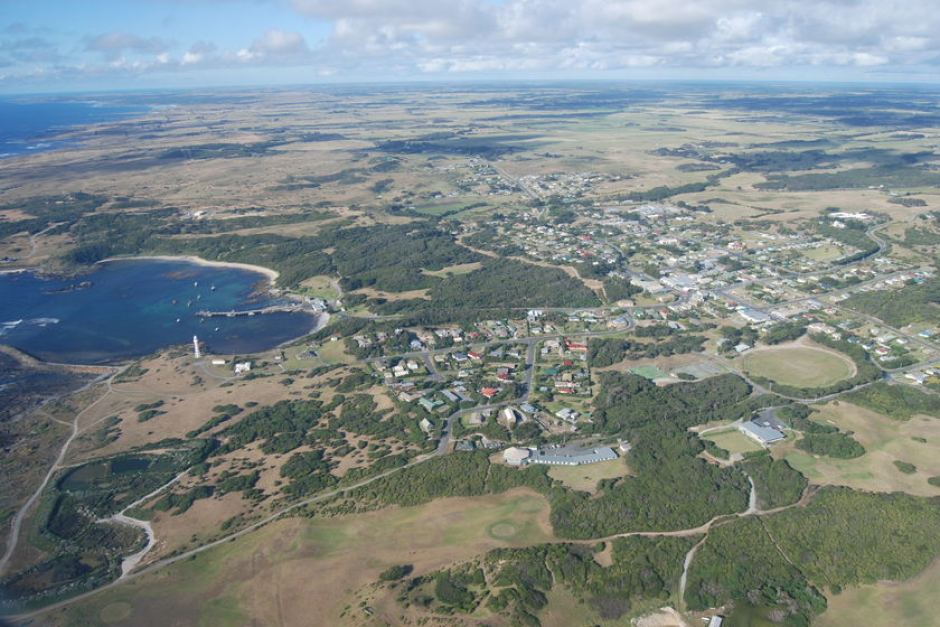
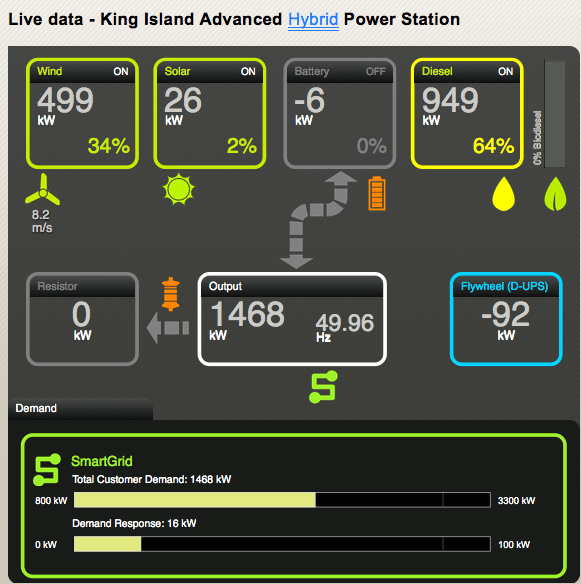
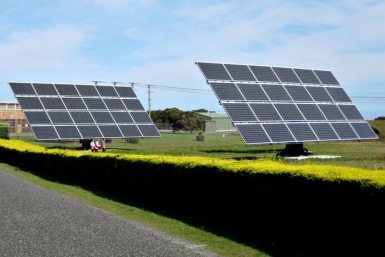
Tasmania’s King Island was powered by 100 per cent renewable energy for a period of 33 hours non-stop this month, chalking up another huge milestone for the renewable energy system established on the island as part of a world-leading project by Hydro Tasmania.
First announced in 2012, the King Island Renewable Energy Integration Project (KIREIP) – a $18.25 million prototype off-grid power plant combining solar panels, wind turbines and energy storage technology – aimed to reduce the Bass Strait island’s reliance on diesel fuel and cut its energy costs by $4.5 million a year by providing 65 per cent of its energy needs from renewables; perhaps 100 per cent on windy days.
According to Hydro Tasmania’s KIREIP wesbite, the now completed project has achieved just under two full days in recent weeks of zero diesel operation, with the diesel supply completely turned off and replaced by renewable energy – an unprecedented milestone.
“What makes this significant is that we’ve used renewable energy to support the needs of an entire community, which includes residential and industrial loads, for a full day,” said project director Simon Gamble.
“Our system has successfully managed the peaks in energy consumption that occur over the course of a full day, including early evening when demand is at its highest and there’s no solar contribution.
“It’s the first time anywhere that this has been achieved at a megawatt scale for such an extended period of time.”
Ivor Frischknecht, the CEO of the Australian Renewable Energy Agency – which provided $6 million in funding for KIREIP – said the milestone was a live example of how different renewable energy and enabling technologies can work
“Hydro Tasmania is using a unique combination of technologies to reduce King island’s reliance on expensive shipped in diesel and provide residents with a more secure and reliable energy source,” he said.
“This innovative energy solution could benefit off-grid communities on islands and in regional mainland Australia. I look forward to seeing Hydro Tasmania continue to refine and commercialise its approach in other locations.”
Indeed, the success of the project is being replicated by HydroTas through a similar project on Flinders Island, designed to prepare the solution for application internationally for remote and off-grid renewable energy supply.
“The aim of KIREIP is to reduce diesel consumption for power generation on King Island by more than 65 per cent on average every year, and provide for the ability to generate 100 per cent of the island’s power needs using renewable energy when conditions allow,” said Gamble.
“Achieving 100 per cent renewable energy penetration in large off-grid systems has remained elusive until now, and is very difficult to achieve given the need to maintain reliability and security of power supply under highly variable wind and solar conditions.”
To this end, HydroTas uses its own advanced automated control systems and dynamic load control technology coupled with energy storage and a standard flywheel uninterruptible power supply system, commonly used in hospitals and telephone exchanges.
This system enables all diesel generation to be switched off when there is sufficient wind and solar power to meet customer demand. The transition from diesel power station to 100 per cent renewables, and back again when and as required, is entirely automated and allows the station to achieve significant diesel savings while operating unstaffed.
“Although there are remote area power systems in some parts of the world that are capable of supplying the energy needs of single homes or small villages, this is the first remote system on this scale capable of supplying the power needs of an entire community, including industrial customers and an extensive distribution network, solely through wind and solar energy,” Gamble added.
Hydro Tasmania is currently commercialising its off-grid energy solutions and exporting these to customers in Australia, and in due course to the Pacific and the South East Asia region.
This story was first published on our sister site One Step Off the Grid. To sign up for the weekly newsletter, click here.
Australia's most powerful battery now free to trade its full capacity on market after its…
The site of one of Australia's very first wind farms now shows little evidence of…
The "35 by 35" electrification goal has an Australian origin that the government seems to…
If we fail to ensure data centres pay for new renewables and storage to cover…
Home batteries look like resetting the behaviour of households when it comes to responding to…
South Australia energy minister hints that the 100 pct net renewables target may not be…