The first large scale solar-battery hybrid power plant on Australia’s main grid has been energised, and is now ready to start sending solar power into the evening demand peaks.
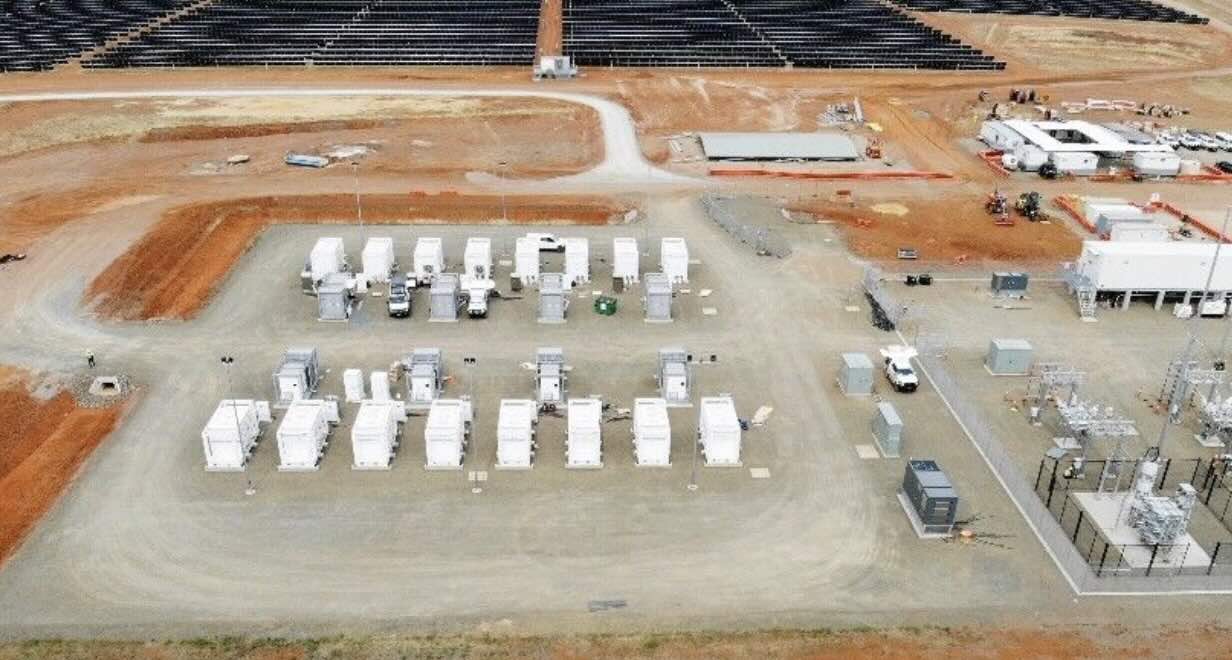
The Quorn Park facility – near Parkes in western NSW – combines an 80 megawatt (MW) solar farm and a 20 MW, 40 megawatt hour (MWh) battery behind the same connection point, allowing for solar to be stored rather than sent out into an oversupplied market, and fed into the grid in the more lucrative evening demand peak.
The larger Cunderdin facility (128 MWdc of solar and a 55 MW, 220 MWh of battery) has already been operating in Western Australia, feeding power regularly into that isolated grid in the evening peak, often up to midnight, and sometimes through the night.
See: The solar farm that winds down at dusk, charges up for dinner and is still generating at midnight
Although Quorn Park is the first solar-battery hybrid to be built on the National Electricity Market, it will soon be followed by a wave of other projects – many of them 10 times bigger in terms of combined solar capacity and storage.
Nearly 20 such projects have received underwriting agreements from state and federal schemes, such as the Capacity Investment Scheme, displacing wind projects which are struggling with higher costs.
Potentia Energy, the joint venture between Italy’s Enel Green Power and Japan’s Inpex, announced on Friday that the Quorn Park facility has been energised, following the recent approval of its generator performance standard – a landmark for the grid considering the complexity of such agreements and for what is to follow.
“We’re proud to announce the successful energisation and first synchronisation of the Quorn Park Solar Hybrid project,” Potentia Energy said in a statement on LinkedIn.
“The project demonstrates how renewable energy and battery storage can work together to deliver reliable, cost-effective support to the grid, meeting the evolving needs of NSW communities while accelerating the energy transition.”
Solar-battery hybrids have come to the four because of the falling cost of solar modules, the plunging cost of battery storage, the rising cost and difficulty of building wind energy, and the demand from industrial customers for dispatchable power, particularly in the evening peaks.
Stand-alone solar farms have also been heavily curtailed by the impact of negative wholesale electricity prices in the middle of the day – a result of a lot of rooftop PV and the desperation of many coal-fired generators to be dispatched (so they bid low to do so).
Many solar farms have batteries that have been built nearby, but until now they have had separate connection points and even different owners and off-takers. The emergence of solar-battery hybrids puts the whole package together.
Potentia Energy is also about to start construction on the Tallawang solar battery hybrid in the central west of NSW, which will combine 500 MW of solar with a 500 MW, 1,000 MWh battery. Other projects are looking to four and eight hour batteries to extend the solar output well into the evening peaks.
See also: Solar battery hybrids lead the charge as Chris Bowen names 20 winners of 6.5 gigawatt CIS tender
And: Why solar battery hybrids are the new go-to technology for the green energy transition
And Renew Economy’s Big Battery Storage Map of Australia for more information.
If you would like to join more than 28,000 others and get the latest clean energy news delivered straight to your inbox, for free, please click here to subscribe to our free daily newsletter.