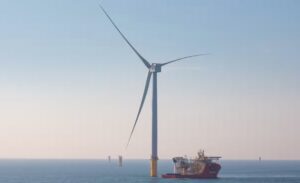
The United States’ Secretary of the Interior has declared the risk of a “swarm drone attack” as part of the reason for the Trump administration’s decision to halt construction on the 704-megawatt (MW) Revolution Wind offshore wind farm, which had already reached 80 per cent completion.
The Trump administration, citing supposed but unnamed “national security interests”, halted construction of the Revolution Wind offshore wind farm in late August.
Revolution Wind, which was fully permitted, having secured all necessary federal and state permits back in 2023, began construction in May 2024. Since then, according to the project’s developer, Danish government controlled Ørsted, all foundations and 45 of the 65 wind turbines had been completed at the time of the halt order.
In a letter sent to Ørsted by Matthew Giacona, the acting director of the Bureau of Ocean Energy Management (BOEM) and a former fossil fuel lobbyist, the company was told to “halt all ongoing activities related to the Revolution Wind Project on the outer continental shelf”.
According to Giacona, the reason for the construction halt was “to allow time for [the BOEM] to address concerns that have arisen” during the review of all offshore wind projects that Donald Trump ordered earlier this year. Among those supposed concerns were “the protection of national security interests.”
At the time, no hint was given as to what those possible national security interests could possibly be, nor why the Trump administration’s department of defence differed from the previous administration’s approval for the project, which included a Pentagon review in 2023.
Speaking to CNN’s Kaitlan Collins last week, however, US Interior Secretary Doug Burgum went some way to clarifying what those national security interests were – though, in turn, he only raised more questions than actual answers.
In response to Collins challenging him to detail the specific “national security impacts”, Bergum tentatively referenced “concerns about radar relative to undersea” and, in particular “undersea drones”.
“I mean, the war in Ukraine has shown that swarm attacks by drones, if you’re going to launch one into our most populous part of our country, the Pacific Northwest, the way a bad — you know, people with bad ulterior motives to the United States would launch a swarm drone attack through a wind farm, the radar gets very distorted around detecting, if you’re trying to have detect and avoid, if you’ve got drones coming,” said Bergum.
The comments were part of a larger discussion around the halt work order which also saw Bergum claim without evidence “that there’s evidence that not a full review was completed under the Biden administration” and that there are “people that are concerned about saving the whales, because of the record number of whale groundings that have occurred in the last couple of years near and around those wind farms.”
It is unclear exactly what Bergum could be referring to, considering that the United States has only three offshore wind farms – the 30 MW Block Island Wind Farm off the coast of Rhode Island, the 12 MW Coastal Virginia Offshore Wind pilot project off the coast of Virginia, and the 132 MW South Fork offshore wind farm off the coast of Massachusetts and Rhode Island.
In total, the three offshore wind farms consist of only 19 wind turbines in operation.
While there has been a recent uptick in whale deaths, in particular humpback whales, there is no evidence that the wind energy industry has anything to do with increased whale mortality.
The National Oceanic and Atmospheric Administration (NOAA) Fisheries department states on their website that “there is no scientific evidence that noise resulting from offshore wind site characterization surveys could potentially cause whale deaths”.
It also says there are no known links between large whale deaths and ongoing offshore wind activities. In fact, 40 per cent of dead whales examined over the past 9 and a half years died as a result of ship strikes and entanglement in fishing nets.
Similarly, a 2023 report from the Marine Mammal Commission stated that “, there is no evidence to link these strandings to offshore wind energy development.”
According to Bergum, other Trump administration cabinet ministers raised concerns such as a turbine’s “sustainability during high-speed storms”, unnamed concerns from US Defense Secretary Pete Hegseth, and Secretary of Health and Human Services supposedly “expressed 10 minutes of concern” in a recent cabinet meeting “because of what happened on Nantucket when one of the blades blew up.”
This appears to be a reference to damage caused to a 13 MW Haliade-X turbine in July of 2024 at the 800 MW Vineyard Wind project which is currently under construction. However, wind turbine blades cannot actually “blow up” and the project’s developers immediately secured the location to prevent any danger to locals or wildlife.
Before Collins ended the interview, Bergum landed one final baseless claim, suggesting that offshore wind farms are “massive, massive tax scheme,” adding that “60 to 70 per cent of the whole project is around the tax benefit, not around the electric generation.”
Good luck to anyone trying to decipher that one.