ASX-listed gas giant APA Group says it will opt out of the bidding to develop some of Australia’s biggest new electricity transmission projects, to focus instead on opportunities “complementary” to its current portfolio of assets.
APA is Australia’s biggest gas pipeline owner, but also owns a number of national electricity transmission assets, including Basslink, the 370 km undersea cables that runs between Loy Yang in Victoria and George Town in Tasmania.
In late 2023, APA signed a memorandum of understanding (MoU) with France’s EDF Group to “explore the pursuit of” electricity transmission projects being proposed as part of the energy transition, including for the New England Renewable Energy Zone and the Victoria to New South Wales Interconnector West (VNI West).
The companies said at the time the MoU would allow them to “capitalise on their respective experience and expertise owning and operating significant energy infrastructure assets, creating an attractive proposition when bidding for new transmission projects.”
But APA on Monday confirmed rumours it was no longer exploring this particular pursuit, and would focus its attention elsewhere, including the five-year East Coast Gas Grid (ECGG) Expansion Plan the company announced in February and new southern markets storage.
“APA has reviewed its electricity transmission strategy and made the decision to not participate in current tender processes underway for major, stand-alone electricity transmission projects on the east coast,” a company spokesperson said in an emailed statement on Monday.
“APA will continue to take a disciplined approach to its growth strategy focussed on the significant opportunities ahead in power generation, gas transmission and storage, gas-powered generation and complementary electricity transmission opportunities.”
The unravelling of the planned work with EdF comes as transmission costs soar, with the Australian Energy Market Operator recently citing a 50 per cent surge in costs as it flagged a potential review of its transmission plans. Numerous projects already under construction have suffered a blowout in costs.
Of particular concern, following APA’s change of heart, is progress on the VNI West project, a second high-voltage transmission link between Victoria and NSW that is considered critical to shoring up renewable energy and flow supply between the two states.
The multi-billion dollar, 800km project is one of the more hotly contested “priority projects” in the Australian Energy Market Operator’s 30-year planning blueprint, attracting criticism over visual and environmental impacts and over whether it offers best value for money and integration of renewables.
AEMO commenced the Invitation to Tender (ITT) phase for a development partner on the Victorian portion of VNI West in November of 2024, with construction expected to begin in 2026. At the time, AEMO said it had selected a “group of eligible organisations” to participate in the tender.
“While we are disappointed by APA’s decision to withdraw from major electricity transmission projects, we remain fully committed to supporting Australia’s energy transition,” an EDF spokesperson told Renew Economy on Tuesday.
“EDF Australia continues to work closely with AEMO, state and federal governments, and industry participants to help deliver the infrastructure required for a cleaner, more reliable, and secure energy future.”
APA, meanwhile, says it still intends to go ahead with its East Pilbara Network Project (EPN) – a “pit to port” common-use electricity transmission line connecting APA’s Port Hedland and Newman Power Stations, and the Burrup (Murujuga) Corridor.
This is part of a broader plan to unify the various power networks built by individual iron ore mining giants, as the region seeks a rapid switch from gas and diesel to renewables and storage. Fortescue, for instance, intends to reach “real zero” – burning no fossil fuels for transport or power – at its Pilbara mines by 2030.
“[EPN] is being designed as common-use infrastructure that can connect several large-scale renewable energy projects and align with major customer plans to accelerate decarbonisation efforts,” an APA group media statement said in December.
“The proposed route is near high-quality wind resources and offers opportunities to interconnect at port and to existing electricity networks inland.”
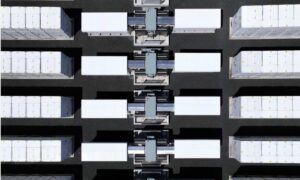
APA already operates the Port Hedland solar and battery project, a 45 MW PV array around 500m east of the Port Hedland Power Station and 14 km South of Port Hedland. The 35 MW battery (36.7MWh) is located at the gas power station, where it serves a spinning reserve function.
It also owns and operates the Newman gas fired power station and battery, and the 60 MW Chichester solar farm near Fortescue’s iron ore mines that were built by Alinta Energy. APA later bought the Alinta Pilbara business.