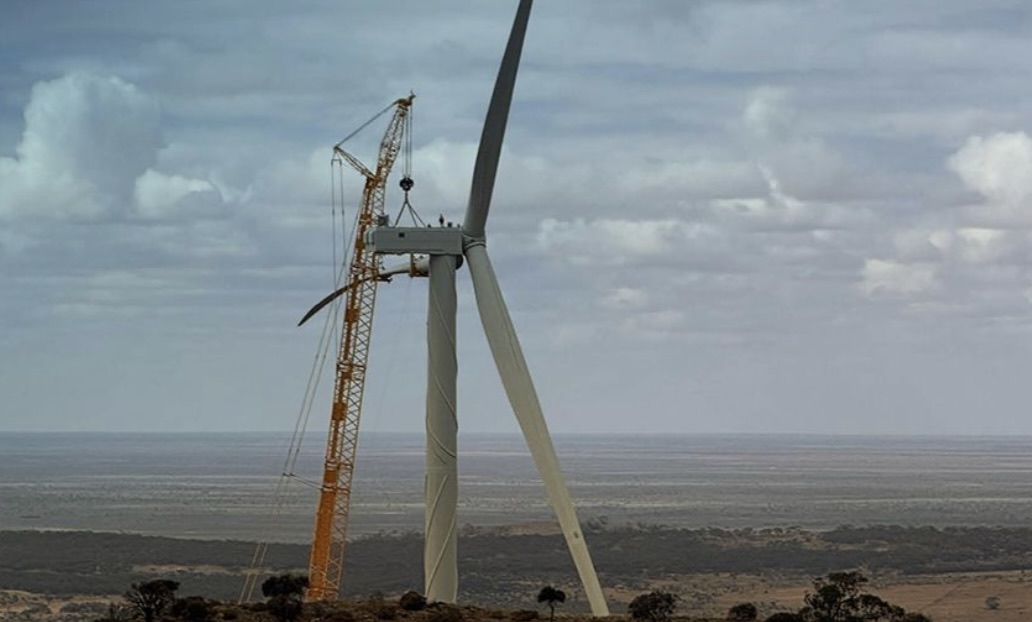

Government and industry must work with host landholders and local communities to develop leading practices around end-of-life renewables, a new report has warned, as more than 1 gigawatt (GW) of wind, solar and battery storage approaches retirement age over the coming decade.
The RE-Alliance report finds that at around 40 per cent renewables today, and headed to 82 per cent by 2030, Australia is at the “ideal juncture” in the energy transition to start planning strategically and sustainably for the first major round of renewables project retirement.
Put another way, there’s no time to lose; with the analysis finding that 12.5 GW of renewables across the country expected to be approaching the age of retirement by 2045.

Source: RE-Alliance
“There is appetite across industry, community and environment groups, civil society, and governments to start working together to get the right settings in place for retiring projects,” RE-Alliance national director Andrew Bray says in the report foreword.
“A collaborative approach is the best way to meet the needs of project owners, host landholders, local communities and the broader energy system.”
The first key point the report is keen to make is that “retirement” of a renewable energy project doesn’t always mean decommissioning – that is, a complete dismantling of the assets, removing equipment and rehabilitating the site, where needed.
End-of-life projects can also be refurbished, when components are upgraded to newer ones. But in particular, the RE-Alliance “Framework for action” identifies huge potential for repowering, which involves replacing old technology on the same site with newer, more efficient models and/or mixes of technology, often with boosted output.
“While this report began as a deep dive into decommissioning, it has extended into an emerging discussion on repowering,” the executive summary says.
The report notes that a mid-2024 study by energy industry consultants GHD estimated that 1.7 GW of Australia’s retiring wind generation projects could be repowered to supply 6 GW – with one-third of the number of turbines.
But this potential currently risks being overlooked, with a snapshot of existing landholder agreement clauses revealing no specific clauses for repowering (or refurbishment), the report says, and no identifiable detail on repowering in planning frameworks.
“There are significant financial, social and environmental opportunities in planning strategically and sustainably for retirement of renewable energy projects,” the report says.
“Government and industry must take the lead and, in consultation with host landholders and local communities, work together to nurture and develop leading practices around retiring renewables.”

Source: RE-Alliance
As well as grasping opportunities and filling in knowledge gaps, the report is also about boosting public confidence in decommissioning, with more and more communities being asked to host a range of large-scale renewable energy projects.
Questions and concerns about what will happen to these projects when they pass their use-by date are a recurring theme of community submissions to development applications and environmental impact statements.
In particular, landholders raise concerns that the huge costs of dismantling solar and wind farms could be left to them, or that promises made at a project’s outset could evaporate over the decades of its operational life.
Certainly, this was one of the issues addressed in a sobering presentation by farmer and tax lawyer, Claire Booth, at last week’s National Renewables in Agriculture Conference and Expo in Bendigo.
“Landowners should ensure that the [renewable energy development] company takes full responsibility for all operational risks … breaching of zoning or planning laws, and land rehabilitation at the end of the lease,” Booth told the conference.
“And I don’t trust any fucker. If you are saying to me that you are going to be rehabilitating my farm in 20 years, where is the money? Who holds it, and how do I know that it’s not been put in a term deposit and wasted away?”
Bridget Ryan, the lead author of the RE-Alliance report, says improving communication is really important and critically urgent – as the transition to renewables ramps up and social licence gets the speed wobbles.
“Some of the commentary that is out in public and on social media …[is] expressing concern and worry about the decommissioning of renewable energy,” says Bridget Ryan, a lead author of the report.
“There is a worry that things will be abandoned and left and … I think one of the things we want to do with this report and the toolkit as well is provide some clear information about what happens and what the requirements are.
“What landholders are actually putting in agreements to look after their own interests … is [also] something that the wider public doesn’t necessarily know much about. It’s also difficult to find information that’s accessible.”
The toolkit Ryan refers to is a comprehensive 27-page guide RE-Alliance has put together providing information for landholders, communities, and local councils on what happens when renewable energy projects reach their end-of-life.

It asks and answers questions including: who is responsible for moving equipment, how will the site be rehabilitated, what obligations and financial arrangements are in place, and how will your land be returned to use?
There is a section on financial safeguards for landholders hosting wind farms and a range of questions that landholders should ask about project retirement when negotiating an agreement.
But just as important as educating farmers and other landholders about their rights and risks in hosting renewables, Ryan says the report hopes to raise awareness about the opportunities and other positives.
“Renewable energy projects, unlike, you know, a coal-fired power station, or maybe even a gas fired power station or or an extractive industry – it’s very difficult to redo the same thing on the same site for those types of projects. Whereas with renewables, you can reuse and recycle that site as well as the assets themselves.”
Ryan says she was also pleasantly surprised, when undertaking the research for the report, by the capacity Australia already has to manage retirement of assets.
“I’ve looked into it and found that, well, we’ve done this at least eight times across the country and, in some parts of the country, a few times over. And there’s knowledge in those companies about how to do this; how to work with communities around retirement and refurbishment and repowering and decommissioning as well.

Source: RE-Alliance
“And I think, you know, the thing that surprised me a little bit, which I wasn’t really deeply aware of, was … the secondary market for wind turbines that [are] no longer okay for… providing power into the grid, but they could be reused in a different context.
“So an example of, you know, a wind turbine that was that was decommissioned off Kooragang Island and is now on a poultry farm in, I think, Tasmania somewhere.
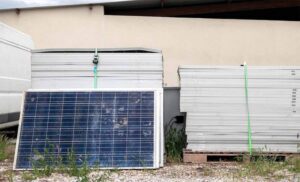
“And what I’m … hearing is that there is definitely interest in reuse of assets that, you know, even in the small scale, like solar panels that come off residential roofs, can be reused in different contexts.
“So, yeah, the sort of secondary market for use used assets was something that was a bit surprising.”
Ultimately, Ryan says, it’s about government working with industry and communities to identify what what the needs and the options are, particularly around things like refurbishment and repowering.
“And can we make [repowering] more common and more widely understood? Do we need to do anything in the planning regulations to assist and enable that for repowering? Is it possible for Australia to accelerate the path for repowered sites?”