
The cost of building community batteries is now lower than what it costs to install a home battery, according to one network operator, but figuring out how much lower is a work of joining the dots around subsidies.
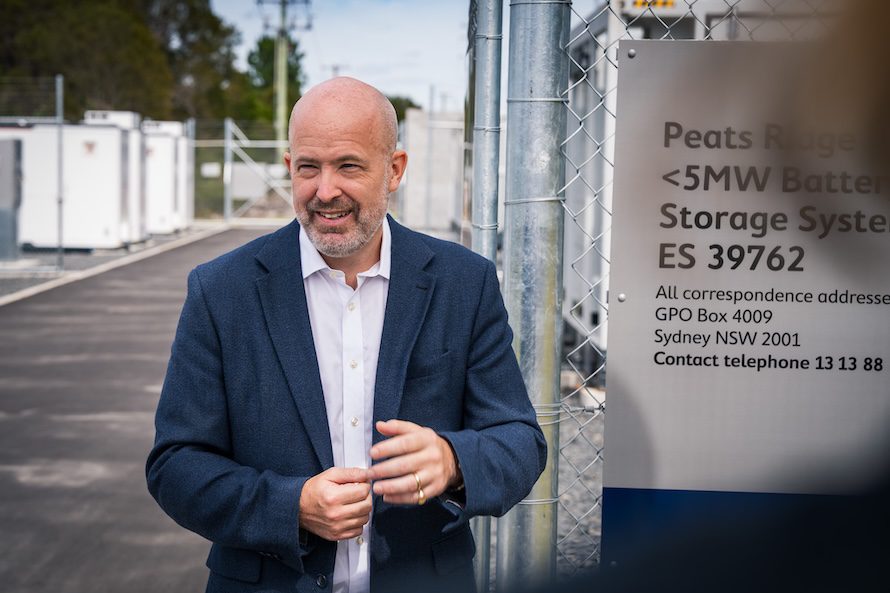
Ausgrid recently switched on its biggest community battery to date, the 10 megawatt (MW), 11 megawatt hour (MWh) Peats Ridge installation on the Central Coast of New South Wales (NSW).
At the time the distribution network service provider (DNSP) said it was “more cost effective compared to the average individual home battery”.
That’s a claim which wasn’t true a year ago but which stacks up today, says Ausgrid group executive distributed services Rob Amphlett Lewis, who confirmed the Ausgrid batteries are now cheaper than a home battery to install.
“We believe that these are cheaper than home batteries, and we think the evidence is very strong for that,” Amphlett Lewis told Renew Economy.
“The amount of subsidy to get a community battery up is lower than the home batteries subsidy per kilowatt hour (kWh), and lower now than [where] the home battery subsidy is forecast to be in 2030. So that’s the big picture of where we are at the moment.”
The Ausgrid executive would not say how much they’ve got the cost of installation down, citing commercial restrictions, but pointed to the size of per kWh subsidies as a proxy.
He says subsidies have fallen from above $1,300/kWh under the original federal DCCEEW program, to $180/kWh under the first round of Australian Renewable Energy Agency (ARENA) funding.
That compares to the Cheaper Home Battery subsidy rate of $372/kWh for home batteries, falling to $188/kWh in 2030.
“Ausgrid has received $12.5 million dollars of funding through the ARENA round one, and with that we’re building 500 megawatt hours of storage. So that means the subsidy per kilowatt hour for our storage is $25,” Amphlett Lewis says.
“Mind blowingly cheaper than the home batteries program.”
The Community Batteries for Household Solar program launched in 2022 to deploy 400 community-level solar batteries around the country, with $171 million of the kitty being administered by ARENA to deliver at least 342 of that number.
The idea of network operators being allowed to own these batteries was controversial from the start, when the energy regulator allowed them to access the subsidy in February 2023.
Since then, sceptical onlookers have repeatedly called for DNSPs to be forced to offer more benefits to communities in exchange for accessing the subsidy, and detailed the ways they either won’t deliver on “community empowerment” or deliver less value at a higher cost than home batteries.
The big selling point of community batteries – or neighbourhood or network batteries when owned by a DNSP – has been to allow everyone in a community to benefit from the surfeit of rooftop solar during the day.
But while that might sound like Australians should be getting lower bills for solar generated in the moment, for Ausgrid the batteries will reduce network investment over time, Amphlett Lewis says.
“We’re building these batteries to reduce future costs, and that will have a reductive effect on bills for everyone in the longer term,” he says.
“The way we encourage people to sign up to it is we say we’re going to give you a tariff that will harmonise, or replicate the sort of experience you have with the home battery.”
Ausgrid is promising a $200 a year bill rebate via its energy-storage-as-a-service offer through EnergyAustralia and Origin Energy.
If you would like to join more than 28,000 others and get the latest clean energy news delivered straight to your inbox, for free, please click here to subscribe to our free daily newsletter.