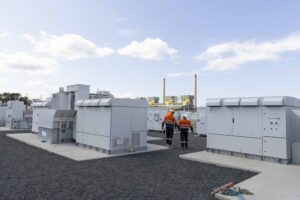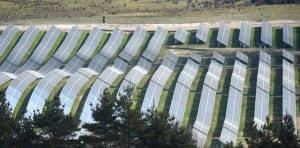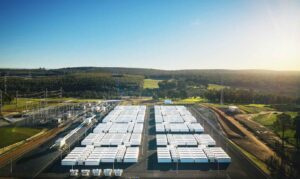
A 200 megawatt battery has been given the all-clear for construction alongside a 66 megawatt solar farm in Collie in Western Australia, paving the way for what will be the third big battery to be added to the coal town’s regional grid.
The $500 million project, which is being developed by Enpowered for its owner, property developer Hesperia, was given the nod by a state development assessment panel on Wednesday, after being recommended for approval by the Shire of Collie earlier this month.
The proposed 200 MW battery energy storage system (BESS) – the storage duration is yet to be specified – would sit just across the road from Neoen’s Collie BESS, the biggest battery in Australia, with dimensions of 560 MW and 2,240 megawatt-hours (MWh).
A bit further away to the south, another BESS is being built next to the Collie Power station by WA state-owned gentailer Synergy, in this case with a total capacity of 500 MW and 2,000 MWh.

The case for and against Hesperia’s solar and battery plans for Collie was heard by a five-member panel on Wednesday morning, including depositions from three adjacent property owners who oppose the development.
The objecting parties cited concerns of overdevelopment and incompatibility with rural amenity, adverse impact on views and rural landscape character and degradation of general amenity, including through noise pollution.
Other concerns raised in the objections from neighbouring properties included fire risk, impact on land values, pollution from heavy metals in the batteries, soil damage from solar panels, raised security risk during construction and “health issues from electromagnetic radiation.”
Ultimately, the panel voted in favour of approving the project, three votes to two. The two votes against came from the two Collie Shire Council members of the panel, Cr Ian Miffling and Cr Joe Italiano.
The project’s approval is subject to a list of 13 conditions, including a requirement of the developers to provide Collie Shire Council with a detailed landscaping plan setting out how the solar panels and BESS will be screened from neighbouring properties with a mix of earth bunds, bushes and trees.
A detailed Construction Management Plan must also be lodged with and approved by the Shire of Collie, to address matters including public safety, noise control and “vibration management,” traffic and access management and bushfire risk and emergency management measures.
The DAP determination also requires the developers to undertake a noise monitoring program for the first 12 months of the solar and battery plant’s operation to provide an acoustics report to demonstrate compliance with the Environmental Protection (Noise) Regulations.
A statement of reason signed off by the presiding member of the Regional DAP, Clayton Higham, said the panel acknowledged the concerns raised by the adjoining landowners – specifically that the solar and battery project would change the “character … and the current outlook from their properties.
But Higham also noted that the applicant had provided “strong justification” that solar and storage developments are suited to rural zones, including land availability, access to sunlight and the ability to co-locate with agricultural uses.
On bushfire risk, Higham said most panel members were satisfied these concerns had adequately addressed.
“The Bushfire Management Plan outlines several strategies to manage risks from both external bushfires and potential internal ignition, and the panel noted that the plan has been designed to cater for worst-case scenarios,” he said.
Renew Economy is seeking further comment from Hesperia and Enpowered on their plans for the Collie solar and battery project, and any further aspirations for large-scale renewable energy development.