The Calala battery project. Image: Equis Australia.
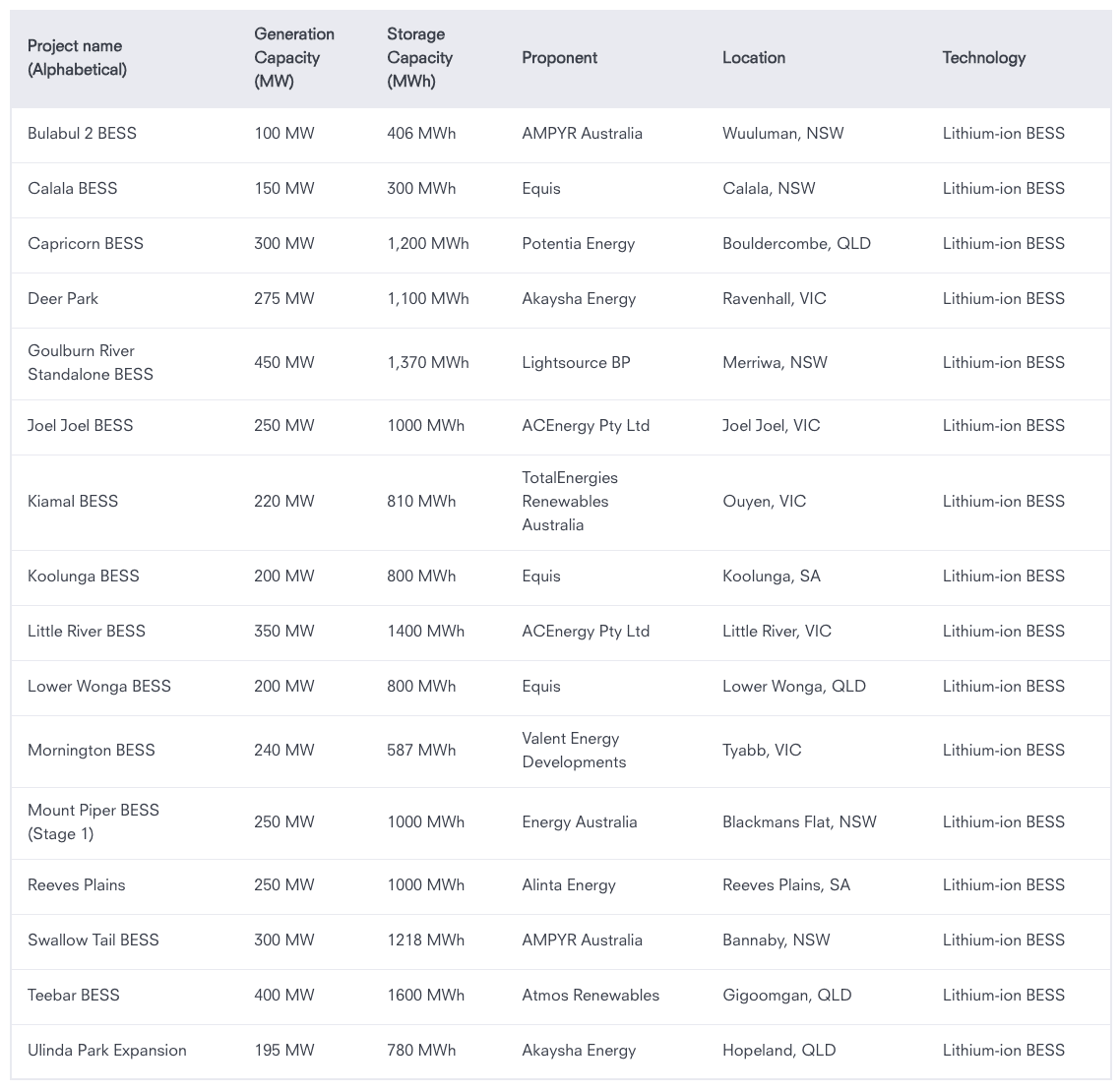
The race is on for the owners of 16 big battery storage projects to get their facilities financed and built after they emerged as winners of the largest auction of its type in Australia, under the auspices of the federal government’s Capacity Investment Scheme.
As Renew Economy revealed on Tuesday, the 16 battery storage projects total more than 4 GW and nearly 16 GWh of storage capacity. And while many large scale wind and solar projects that landed underwriting deals in last year’s generation tender have struggled to secure finance, it shouldn’t be too difficult for the big battery projects.
Big batteries have proved the success story of the green energy transition in Australia in the last few years, and it means that more than 14 GW of battery capacity – with varying but steadily increasing levels of storage – are now committed or under construction.
The CIS itself is aiming to underwrite a total of 13 GW and 52 GWh of battery projects to provide the grid reliability and security backup to support its target of reaching 82 per cent renewables by 2030. The CIS also seeks a total of 25 GW of new wind and solar, and the main grids will likely require more to meet the target.
The challenge for the battery project owners is narrowing down exactly what role they will perform – some are proposed primarily as grid shock absorbers, others for arbitrage, and some are destined for tolling arrangements. Others will seek to “stack” the various revenue options into an enticing packaging for investors and bankers.
One project that won’t have a problem with finance is the Mornington battery being built in Victoria by Valent Energy – a joint venture between BW ESS and Gaw Capital, and which is chaired by former CEFC boss and one time political candidate Oliver Yates.
That is because it is already largely built, and about to move through its commissioning process and should be complete in early 2026.
Not all the other projects are going to move quickly. EnergyAustralia, a winner for the first 250 MW, 1,000 MWh hour stage of the Mt Piper battery, significant because it will be built next to the coal fired power generator likely to close in the next decade, says it is likely to be late next year until it reaches financial close.
EA has been busy with big batteries, but has readily sought outside finance for the projects despite being one of the big three energy retailers in the country.
It sold a 50 per cent stake earlier this year in its 350 MW, 1400 MWh Woreen battery in the Latrobe Valley, which is now under construction and which was a winner of an earlier CIS auction focused on Victoria and South Australia, as was its proposed Hallett battery.
“As more renewable energy enters the system and traditional baseload generation retires, large-scale batteries are becoming essential to maintaining reliability,” said EA’s head of trading and transition Dan Nugest. “The location of the Mt Piper BESS project alongside traditional generation shows the emergence of the new energy future.”
For others, things are also already moving. Equis Australia won underwriting deals for three of its battery storage projects, but the first stage of one winner – the 250 MW, 500 MWh Calala project near Tamworth in NSW (pictured above) – is already under construction.
Earlier this year it signed a “tolling agreement” with Smartest Energy for a 100 MW, 200 MWh portion of the battery and landed $260 million of finance in what it then described as the first merchant deal for a battery in NSW. The CIS underwriting relates to the 150 MW, 300 MWh portion of the project.
The other Equis projects include the 200 MW, 800 MWh Koolunga battery in South Australia, and the Lower Wonga battery in Queensland. “The team are proud to have been awarded 14% percent of the total 4GW allocation for Round 3,” the company said in a statement on LinkedIn.
Two other winners are also effectively second stages of projects that are already under construction, financed, or working through the commissioning process – such as Akaysha Energy’s Ulinda Park battery in Queensland and Ampyr Energy’s Bulabul battery near Wellington in NSW.
That will reduce the complexity of such financing arrangements, given the infrastructure already in place and, in the case of Ampyr, will give an opportunity to extend the first of its kind equity deal with local First Nations peoples to the second stage.
Both Akaysha and Ampyr have other projects wins – Deer Park in Victoria for Akaysha and Swallow Tail in NSW for Ampyr.
In a LinkedIn post, Akaysha managing director Paul Curnow said the CIS agreements provide flexibility to move into bilateral offtake agreements, which strengthens the investment case.
“These awards don’t just underline the critical role of big batteries in Australia’s energy future, they enhance revenue certainty, unlock investment, and enable us to deliver faster,” Curnow said.
Another project that could be able to piggy back off existing infrastructure is Lightsource bp’s 450 MW, 1370 MWh Goulburn River project near Merriwa in NSW, which is being built next to a smaller solar-battery hybrid – including an eight-hour battery – that won a NSW tender for long duration storage.
Alinta Energy is also already moving on its Reeves Plains battery in South Australia, where early works have started and contractors appointed. It will finance the project off its balance sheet, so no problems there.
Its underwriting deal under the CIS is for 250 MW and 1,000 MWh, although Alinta has flagged that the project may grow to 500 MW and 2,000 MWh, making it the biggest in the state that leads on renewables.
Indeed, South Australia, which is already at 75 per cent renewables and is aiming for “net” 100 per cent renewables by the end of 2027, has at least eight big batteries under construction, including five – Reeves Plains, Hallett, Limestone Coast, Clements Gap and Solar River – that have won contracts through the CIS.
Victoria, the next most ambitious state with a target of reaching 95 per cent renewables by 2035 – if it can get its offshore wind projects built – now has seven winning projects – Woreen, Deer Park, Kiamal, Springvale, Joel Joel, Little River and Mornington.
The biggest winner of all is the 400 MW, 1,600 MWh Teebar battery in Queensland being developed by Atmos Renewables, which also won the W.A. tender for the 100 MW, 400 MWh Merredin battery now under construction.
Atmos is aiming for financial close in mid-2026, and for project completion in early 2028. “This support provides a clear pathway for the construction and delivery of the Teebar BESS project in Queensland,” it said in a statement posted on LinkedIn.
Another aiming for financial close in 2026 is Potentia Energy, for its 300 MW, 1,200 MWh Capricorn BESS in Queensland, which it says is designed to deliver critical storage capacity, strengthen grid reliability, and “support Queensland’s transition to renewable energy, as well as creating local jobs and community benefits.”
ACEnergy, which won for both its Joel Joel and its Little River batteries in Victoria, says it expects to move quickly on both projects.
“With the CIS now confirmed, our equity and financing process can move ahead with speed and certainty, paving the way for construction to begin in early 2026 and operations by mid 2028,” ACEnergy head of development Danny Wilkinson said in an emailed statement.
“These batteries will deliver reliable clean energy when it is needed most, while also creating jobs, supporting local procurement, and contributing to community benefit programs in the regions where they are located.”
Renew Economy is seeking comment and updates from another tender winner TotalEnergies, for its Kiamal battery project.
See also: Big Battery Storage Map of Australia
A major solar project with a now supersized battery component has sailed through EPBC but…
A South Australia-based pilot project backed by iron ore billionaire Andrew Forrest demonstrates its potential…
A new interactive map designed to chart Australia’s energy market transformation has been launched by…
Big battery projects seeking to be built in the Sunshine State will now have to…
Spanish energy giant bags another key transmission project in Australia, winning the rights to build…
A new boss for Horizon Power, Woodside boss to head BP, and big changes at…