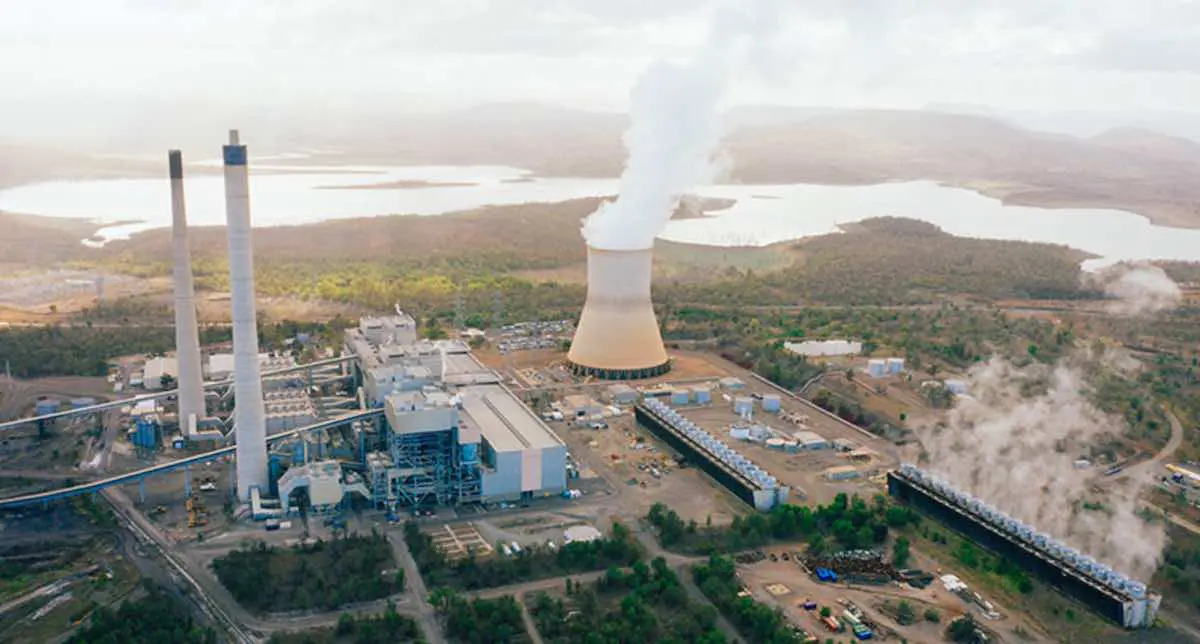
I doubt many people are too surprised at the Queensland state government’s decision to pour cash into putting the ancient Callide B coal-fired power station on life-support.
The state government is putting fossil fuels at the centre of its future energy plan, but can’t pretend to want to build nuclear like the Federal Liberal-National Coalition. That means they just have to be honest: they’ll go to extreme lengths to prop-up the oldest, most polluting coal-fired power stations.
To put this really simply: the dates at which Australia’s coal-fired power stations stop operating are the key numbers on which Australia’s entire economy-wide emissions turn.
Australia has a uniquely concentrated coal-fired power fleet, made up of a few massive power stations. Eraring, Australia’s second most harmful power station by amount of climate damage, was recently extended by the NSW Labor government. Yallourn, the fifth-worst, was wrongly reported as having been extended by News Corp – it turned out that seems to have been a weird fabrication.
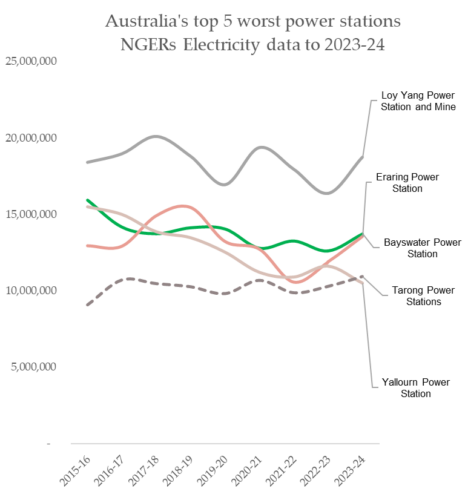

Data via NGERS
As I noted with Eraring’s closure, it is rationalised by policymakers and politicians who insist that even though the plants pump out eye-watering amounts of greenhouse gas emissions, point-in-time climate targets are still met.
This is something I call the tap-turning-fallacy. The damage we suffer from climate change occurs based on the total amount of greenhouse gases in the atmosphere, filling up like a bathtub.
When a bathtub is overflowing, we turn the tap off ASAP – we don’t set a target 3 hours in the future, and only worry about ensuring it’s turned off by then. As I illustrated visually using some dummy data – the slower you go, the worse you suffer:


What is no surprise is that Queensland’s government is insisting exactly the same fallacy, in extending Callide B.
WWF Australia’s CEO Dermot O’Gorman said: ““It means more climate-related disasters—floods, heatwaves, bushfires—will hit Queenslanders harder. Climate change raises the cost of living. Insurance premiums will go up, food production will suffer, and disaster recovery costs will soar. Keeping coal is bad economics. Queensland deserves better”.
Calculating the climate impact of Callide B’s extension is tricky without complex modelling tools. OpenNEM shows that the plan has actually been operating at falling capacity factors in recent years, meaning it probably isn’t fair to assume it’ll be running at full pelt in its final years:

Despite the Queensland Liberal party having voted for the previous government’s climate targets, it’s very likely they’ll be scrapped.
I had plenty of questions about those targets (namely the effect of problematically including land-use emissions). But they were far better than nothing at all, which is what the Queensland government seems to be heading towards.
The cost, reliability and climate impacts of extending coal remain badly under-recognised. Short-term political games are currently more important than those three things.
And the Queensland government are demonstrating life under a Dutton government, where active effort and consciosuly bad decisions are used to try and stifle the growth of clean energy in Australia, and the achievements of climate goals through rapid limits to pollution.