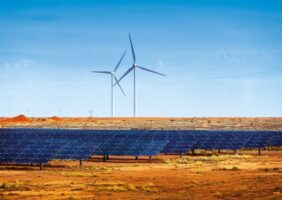
Abandoned coal mines could host up to 52 gigawatts (GW) of solar in Queensland alone, and up to 14GW in New South Wales (NSW), according to a Global Energy Monitor study.
Australia, as one of the top four coal producers globally, has some of the best sites for coal-mine conversions, with 1,470 km² of mine sites potentially supporting some 73 GW of solar in total — and some 2.7GW of coal-to-solar conversions have been announced.
These numbers came out of an analysis of Global Energy Monitor’s coal mine tracker, and suggest globally mines that have been abandoned in the last five years and which could be abandoned in the next five years could host up to 300GW of solar.
There are 312 open cast mines that closed in the last five years, covering territory of 2,089 square kilometres. Another 143 mines covering 3,731 square kilometres may be abandoned by the end of 2030.
Nearly three quarters of these sites are in those top-four coal producing countries of Australia, the US, Indonesia and India, and nearly all of which are near electricity infrastructure such as substations and transmission lines.

China is the biggest player in this space, with 90 operational coal mine-to-solar conversions now delivering 14GW or power, and 46 projects in planning worth 9GW.
“Acquiring land for global renewable energy targets has been rife with conflicts among stakeholders and decision-makers, so repurposing degraded lands could provide salient new benefits to former coal communities across the planet,” said Global Energy Monitor researcher Hailey Deres in a statement.
But repurposing open cut coal mines is not as easy as just making the decision, as French energy company Engie has found with its Hazelwood coal mine.
Plans to rehabilitate the 135 metre-deep mine next to Morwell in Gippsland as a lake stalled years ago, held up within the Victorian government bureaucracy.
Engie wants to cover the fly ash dump at the north of the void with a cap of either clay, a geomembrane, or both, and flood the whole with water sourced from aquifers, surface flood waters, and “other” sources. The bottom of the pit, which is below the water table, is already partially filled with water from these sources.
This may be the only realistic option. The bottom of the pit is below the water table, meaning it must be filled in with something to prevent ‘heave’, a situation where groundwater presses on the floor and sides and forces them upwards, causing these to become unstable and slip, undermining the town of Morwell.
In the Latrobe valley, three mines sit below the water table: Hazelwood, Yallourn and the Loy Yang mine.
A lot to work with in NSW, Queensland
Three years ago, Consultancy EY found that 17 mines will close in NSW’s Hunter Valley during the next two decades. There are at least 45 abandoned mines in the state today.
In 2020, Australia Institute researchers found that filling in all of NSW’s coal voids would cost $12-25 billion.
It’s this kind of legacy that Global Energy Monitor’s Cheng Cheng Wu says is written into the land, but doesn’t have to define the future.
“Repurposing mines for solar development offers a rare chance to bring together land restoration, local job creation, and clean energy deployment in a single strategy,” she said.
“With the right choices, the same ground that powered the industrial era can help power the climate solutions we now urgently need.”
Mines for storage
The Global Energy Monitor report didn’t name the Australian mines it thinks could host solar, but to date, the focus for mines and renewables has been for energy storage.
Green Gravity is testing using mine shafts for gravity based energy storage, and last year secured another $9 million to continue that.
Also last year Australian National University researchers found 37 sites they believe could host pumped hydro.
The former gold mine site at Kidston in far north Queensland is already being turned into a pumped hydro project supported by wind and solar power.
AGL is proposing to do the same with the Muswellbrook coal mine, which won Critical State Significant Infrastructure status in NSW last year.
But other options the ANU researchers suggested could be on the table include the Coppabella mine, coal mining pits near the old Liddell power station, mines at Mount Isa in Queensland and the Cadia Hill gold mine near Orange in NSW.
In South Australia, the old Leigh Creek coal mine in the Flinders Ranges and the operating Prominent Hill mine northwest of Adelaide are also potential candidates.