A new report by the Australian Energy Market Operator has warned that up to one third of the output from wind farms in South Australia and Victoria may need to be curtailed in the future, unless changes are made to the operations of the Australian grid it manages.
The prediction comes in a new technical report issued by AEMO on anticipated development in the wind industry. The report is notable for several predictions – including an extra 8,800MW of wind capacity by 2020 – with nearly half of this being built in Victoria.
This would take total wind capacity in Australia to around 11,500MW. The modelling it uses is based on 1,000MW of utility scale solar PV being built in Australia by 2020, and for 3000MW of coal-fired generation being retired.
AEMO warns that the level of new wind generation will present challenges in operating the power system and the electricity market – and expects the issues to be felt first in South Australia and Tasmania, where forecast levels of wind generation are highest compared to demand, and in Victoria, which will have most new generation.
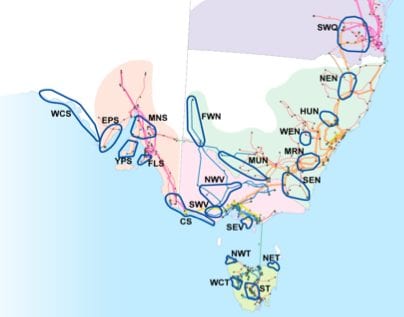
 Its modelling is based around the concept of “wind bubbles” – which are regions where it anticipates wind energy to be deployed. (see graph to the right).
For instance, South Australia already sources 27 per cent of its electricity from wind energy and is forecast by AEMO to double its capacity hy 2020. Tasmania is forecast to increase its capacity more than three-fold by 2020.
AEMO says further challenges to the grid are also expected to arise from what it calls “technological innovations”, including increased distributed generation such as rooftop PV; and from changing consumer behaviour contributing to a trend of declining electricity consumption from the power system.
On the matter of wind, AEMO says it has not yet costed the investment needed, or indeed the benefits, of addressing the wind issue.
However, it warns that without action, particularly on interconnector limits, up to 5,750 GWh and 1,260 GWh of the maximum potential wind generation energy in Victoria and South Australia could be curtailed due to network limitations. It says this represents around 35 per cent and 15 per cent respectively of the energy potentially available from in these regions.
AEMO says other impacts from the anticipated growth of wind energy could be the reduction in “power system inertia”, caused by the withdrawal of thermal generation. This affects power system frequency. It says changes need to be made in South Australia and Tasmania to address this.
It also notes that increasing levels of wind generation will reduce power system fault levels at some locations, which may lead to further limitations on the operation of wind generation and high voltage direct current (HVDC) links.
Frequency is also an issue, which means that the accuracy of forecasting wind output is also critical. It notes that this is made easier by greater geographis spread. It says because of the high standard of forecasting, ”
the impact of 2020 levels of wind generation on NEM frequency regulation is likely to remain manageable within the existing frequency regulation arrangements.”
AEMO says it could potentially manage these power system impacts with existing processes and systems – either by using constraints to limit wind generation, or as a last resort by market intervention by directing other generators to ensure sufficient levels of power system inertia are maintained.
AEMO says it is yet to investigate the likely costs and potential benefits of various options to address the issues.
,