Offshore wind project developer Star of the South has taken the unusual route of buying a patch of farmland to secure the onshore landing point for underground cables linking its proposed 2.2 gigawatt (GW) project with the grid.
While VicGrid is managing the onshore transmission routes, setting out a preferred onshore route that starts at Giffard in October, it’s up to the Gippsland offshore wind projects to figure out how to get their electricity ashore.
Star of the South’s new acquisition is a 120 hectare block near Reeves beach to the south of Giffard.
“Securing the shore crossing site locks in a critical piece of the project’s infrastructure,” Star of the South CEO Charles Rattray said in a statement.
“This is a huge step forward, recognising the positive relationships we’ve built with landholders over time.”
The $8.7 billion project, developed by Southerly Ten, is on track to be Australia’s first offshore wind farm, with support from both the Victorian government and federal Labor.
It’s just submitted the environmental impact statement (EIS) to the federal EPBC process, which it calls the most comprehensive ever taken for an energy project in Australia.
“This environmental assessment reflects seven years of rigorous science and consultation to understand the local environment and how to protect it,” Rattray said.
“We’ve done the work, and then some, to ensure government and the community can have confidence that the project will be delivered responsibly.”

Stakeholders conducting BIOSIS bird surveys for the Marine Ecology Survey Program. Image: Star of the South
The EIS uses 26 technical studies looking at environmental, cultural, social and economic values, building on work that’s been underway since 2019 when the project was awarded an exploration licence.
Geophysical seabed surveys were done in 2020, geotechnical seabed surveys in 2023 and marine and land-based environment and cultural heritage surveys between 2020 and 2024.
Star of the South has also signed an engagement agreement with the Gunaikurnai Land and Waters Aboriginal Corporation (GLaWAC), and renewed its federal Major Project Status in November.
Only two offshore wind projects in Australia have Major Project Status, the other being Jera Nex’s 1 GW Blue Mackerel project which landed the coveted status last week, which amounts to tailored regulatory “facilitation” to help avoid unnecessary delays.
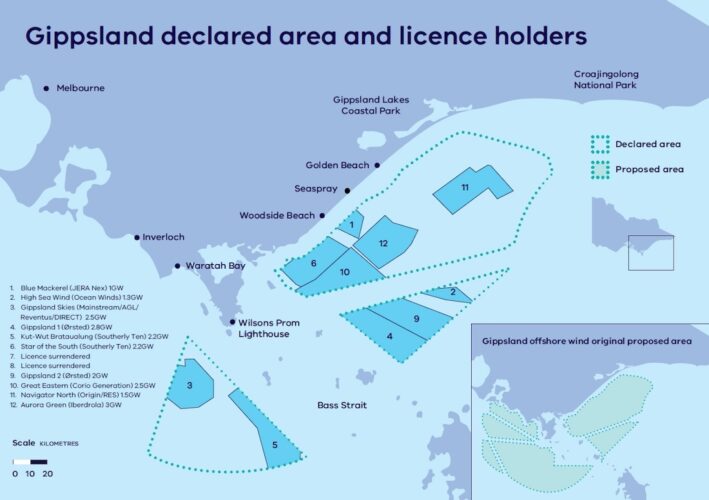
October 2025 map of Gippsland offshore wind feasibility licences. Image: Victoria Department of Energy, Environment and Climate Change
Provided it can pass all regulatory wayposts on time, construction on Star of the South could start towards the end of the 2020s.
The project has changed significantly since work first started in 2017 as information and technological advancements have prompted alterations.
The original 400 turbines have shrunk to 150, but they’re also much, much bigger: those numbers suggest they will need to be at least 15 megawatt (MW) standing up to 350 metres tall.
Victoria has a target of 2 GW of wind power by 2032, 4 GW by 2035 and 9 GW by 2040 to replace the last of its last brown coal generators that will retire over the coming decade. Star of the South has largely avoided the pushback from local communities that have dogged other offshore wind projects around the country.
Of the 12 awarded feasibility licences in 2024, nine projects remain with a total capacity of 16.3 GW.
That is almost double Victoria’s target for 2040 and with the country’s first offshore wind tender still on hold due to uncertainty around federal funding, more are likely to fall away.
This month AGL pulled its 2.5 GW Gippsland Skies proposal from the mix as it focuses on batteries.
In July, Spanish company Bluefloat Energy dumped the 2.5 GW Gippsland Dawn proposal, and there is uncertainty around Origin Energy’s and RES Australia’s 1.5 GW Navigator North proposal after key staff being laid off in September.