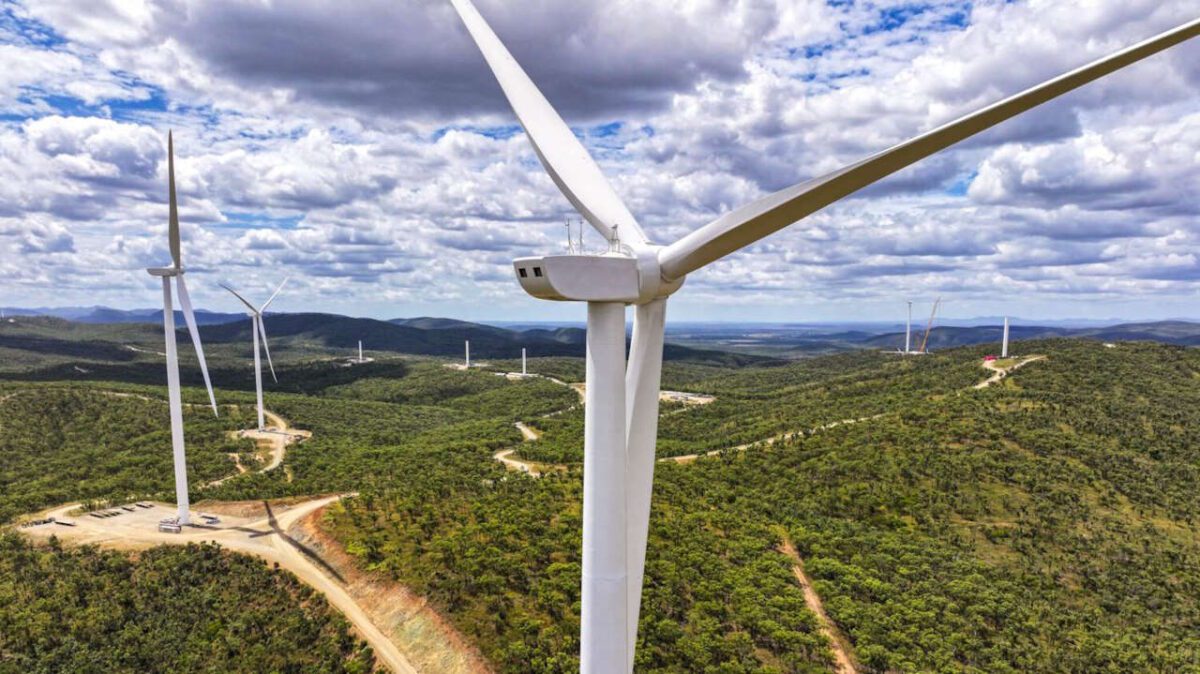
Australian utility Alinta Energy is seeking federal environmental approval for a new wind and battery project proposed near a shuttered coal fired power station, and which could feature the most powerful turbines in the country.
The Mount Lambie wind project could host up to 20 turbines with a capacity of up to 200 megawatts (MW), and a 100 MW, 600 MWh battery energy storage system.
It is one of a number of renewable and storage projects proposed for the area near the shuttered Wallerang coal generator and the still generating Mount Piper facility and is pitched by Alinta as “the next chapter in Lithgow’s energy story.”
The dimensions of the wind project indicate wind turbines sized at 10 megawatts each, which would make them the most powerful proposed for Australia, along with the 10 MW “self lifting” turbines propped by Andrew Forrest’s Fortescue for a major wind project in the Pilbara.
Currently, the biggest turbines in Australia are 6.2 MW machines, although some projects have also proposed turbines of up to 8 MW.
Alinta inherited the Mount Lambie project through its purchase of Tetris Energy, which had been consulting local communities since 2021. The company hopes to have the project in operation in 2029 or 2030, and predicts a project life span of 35 years.
Mount Lambie would be built on land mostly used for grazing, and construction would necessitate “one or two” substation and transmission connection points, according to the referral document, approximately 27 kilometres of access tracks throughout the project area, and various other localised infrastructure necessities.
Preliminary ecological investigations have concluded there is potential for construction and operation of the project to affect eleven threatened fauna species and four threatened flora species.
Alinta says the project would require infrastructure components to be transported to the site, from Port of Newcastle, Port Botany and/or Port of Geelong.
It says investigations into whether road upgrades would be required for the delivery of WTG components, including swept path analyses, would be carried out during the EIS phase.