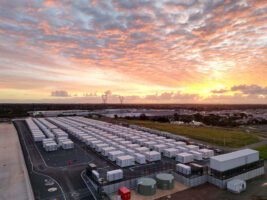
The NSW state government has formally opened a new tender for 500 megawatts (MW) of firm capacity – essentially battery storage and demand response – to help fill the gap created by the expected closure of the country’s biggest coal generator in two years time.
The tender, flagged in late July, is focused on providing additional storage, firming and demand response capacity in the major load centres of Sydney, Wollongong and Newcastle, and must be in place by November, 2027.
The tender is also open to gas generators, although given the timeline and the difficulties obtaining gas equipment because of the global supply crunch, it is hard to see such projects meeting the deadline.
It is also open to hybrid facilities (such as solar and batteries), with a minimum size of 5 MW, and is also open to aggregated facilities. The tender offers longer contracts of 15 years rather than 10 years.
The tender is the seventh for generation and storage capacity to be held by state government under its infrastructure roadmap, and also follows a recent federal Capacity Investment Scheme tender that saw five NSW batteries totalling 1,250 MW and 4.3 GWh of capacity awarded underwriting agreements.
NSW expects all of its remaining four coal fired generators will close over the coming decade, with the biggest – the 2.88 GW Eraring facility – the first to go in August, 2027.
Eraring was due to close in August this year, but the state government agreed to underwrite a minimum two year extension because of fears of supply shortfalls and soaring prices. There is speculation one or two units could stay open for even longer, until early 2029.
The new tender requires interested parties to register by the end of the month, lodge their bids by the end of November, with the winners to be announced in April or May next year, giving them just 18 months to deliver their projects.
The winning bidders will be required to be able to deliver at least two hours of storage and preference will be given to projects within the major load centres. It is open to aggregations of demand response (where industrial facilities can dial back their power needs at specific times) and small batteries.
The winning bids will be awarded a long term energy service agreement (LTESA). ASL is conducting the tender in its capacity as the NSW Consumer Trustee.
“We’ve made key changes to the firming LTESA which includes increasing the maximum contract term to 15 years and making it easier for aggregations of smaller energy storage systems to participate,” ASL CEO Nevenka Codevelle said in a statement.
“This is a standalone opportunity for project proponents to secure a firming or demand response LTESA that can be used to accelerate delivery and support revenues when in operation.”
State energy and climate minister Penny Sharpe says 36 per cent of the state’s electricity supply currently come from renewable sources, and projects already contracted and in construction will take the state more than two thirds of they way to its 2030 targets.
These include the creation of five renewable energy zones, with work already commissioned for the south-west, Central West Orana and Hunter zones.
The world’s most powerful battery, the 850 MW, 1680 MWh Waratah facility on the central coast is now partially commissioned and delivering services as a giant “shock absorber”, and the new 500 MW, 1,000 MWh Liddell battery is also now registered and about to embark on its commissioning process.
“As we continue to transform our energy system, we know there will be challenges, which is why we’re taking decisive steps now to keep the lights on and prevent price spikes down the track,” Sharpe said in a statement. “That’s what this is about.”