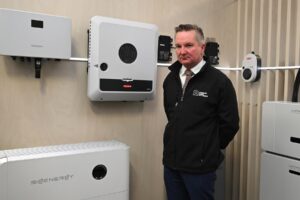
Saul Griffith wants to build an army. Not of soldiers, but of ordinary Australians – householders, tradies, and communities – who can demand more from the energy industry and government.
Griffith is an engineer, inventor and author who has spent decades tackling climate change, advising policymakers around the world, helping shape the US Inflation Reduction Act, and founding Rewiring America and Rewiring Australia to drive electrification from households up.
He’s currently on his ‘Faster and Fairer’ tour to promote his new book, Plug In, an electrification handbook for householders and tradies who are on the front line of Australia’s energy transition.
At a recent live event on the Gold Coast, hosted by Electrify Gold Coast and Rewiring Australia, he told the audience he’d like “to build the army, to build enough political pressure to get the government to actually go at the speed and pace required and help make this a fairer, easier project for as many Australians as possible.”
Households are carrying some of the heaviest investment load in the energy system through rooftop solar, home batteries, and EVs, and Griffith wants Australians to realise the power they already hold.
“We are making more substantial infrastructure investments than the corporations. They’re getting guaranteed 10% returns. I haven’t seen anyone guarantee your 10% returns,” he told the live audience.
Griffith says consumers are still missing out on influence. “We’re not getting a super deal yet, and we don’t even have representation at board level, or voting, in any sense, on the governance of our electricity market,” argues Griffith. “And that’s slowing the transition down, and it’s not giving us the cheapest energy system.”
For Griffith the cheapest solution for the energy transition is simple: to generate electricity close to where it is used.
“The cheapest energy system in Australia comes about when you maximize rooftop solar, then you generate as much electricity as you can in your local community. So that means on the roof of Bunnings, on the church, on the surf club, over car parks on the school. Because you’re avoiding all of the big network costs.”
Electricity networks, he warns, are often more interested in guaranteed returns than in empowering consumers. “They’re not necessarily on board with all you owning all the batteries,” he told the audience. “They’d like to own the batteries so they get guaranteed 10% returns.”
Meanwhile, households are already paying for a large portion of the system: “About 40% of the price of electricity you buy from the grid is for the local poles and wires, and 10% of it is for the people who do the accounting and the billing and reading the meter.”
Which is why Griffith celebrates the “rooftop revolution”: “You generate right there behind the meter. You don’t need to pay for the poles and the wires or the transmission or the generators or anything.”
Griffith is particularly critical of how electricity is priced. “When I sell my electricity to my retailer for one cent or two cents a kilowatt hour, we pretend that it goes all the way back to Melbourne, where AGL HQ is, and then we pretend that that electricity comes all the way back to you, so they can charge you 28 cents for it.”
Physics, he points out, tells a different story. “I’m a physics nerd, and there’s a wonderful thing called Kirchhoff’s law.”
“Electrons are lazy,” he explains. “They want to go to the closest load. So what actually happens is, my solar goes to [my neighbour’s] house.
“I’m willing to pay the poles and wires companies some money to get there, but not the full stack and all the bureaucracy that comes with the whole system.”
While Griffith acknowledges that virtual power plants (VPPs) can help manage distributed energy, he warns against granting new monopolies. “A VPP is giving a monopoly the control of your electricity to somebody who can aggregate it in software.
“But …. there are software platforms that exist that could reconcile this at every individual household. And you don’t need the VPP. You can just solve this by having rational, simple rules of the electricity market.”
Vehicle-to-grid technology, he says, will be transformative. “That is going to be the biggest battery in Australia no matter what we do with VPPs. I can’t emphasize how important that is. That is enough to guarantee that our mix of solar and wind is 100% renewable as possible.”
But behavioural change will be key to making that happen so Griffith is calling for incentives that reward daytime charging at work or weekend charging.
“If we all don’t play nicely, and we all get home at six o’clock, crack the beer, turn the air conditioning on and charge the car at six o’clock, then the grid is not going to work.”
Despite the challenges, Griffith is encouraged by grassroots momentum.
“I think the economics is driving that,” he says. “10 years ago, can you imagine a bearded hippie filling sold out audiences six nights running of a few hundred people to talk about energy policy and electrification? No way.”
Griffith’s message is clear: households already hold the tools to transform the system, and they need to use them to exert influence.
“Why am I on this tour? To make you angry about that so we can push the government to take one or two years to fix this, whereas we’re about 15 years deep in reviews.”
Griffith admits it won’t be easy: “It’s gonna be hard to create a social movement around respect for Kirchhoff’s law.”
But he believes that with technology, smarter behaviour, and political pressure, Australians can get a fairer, faster, and more efficient energy transition, and that ordinary consumers can be the real power behind the change.
You can hear the full interview with Saul Griffith on the SwitchedOn podcast.