The biggest wind farm to be built so far in New South Wales has been officially opened, on the edge of the Southern Tablelands, although it will soon enough be dwarfed by projects nearly four times its size.
The 396 megawatt (MW) Rye Park wind farm, owned by Tilt Renewables, was officially opened on Friday by state energy and climate minister Penny Sharpe (pictured above).
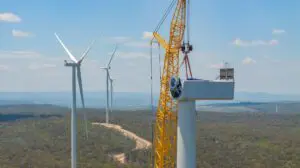
The project features some of the biggest turbines in the state. It actually started generating in July 2023, and the last of the Vestas 6 MW turbines was installed in April last year.
About 55 per cent of energy production from the Rye Park wind farm – located north of Yass – is contracted to mining company Newcrest Mining under a 15-year power purchase agreement that will supply the Cadia gold mine in NSW.
The remainder of the output is going to Tilt part owner AGL Energy, which signed a 15-year power purchase agreement over the other 45 per cent and for the associated large-scale generation certificates (LGCs), which it’s on-selling to Microsoft.
While Rye Park is the biggest wind project to date it will soon be overtaken by the 414 MW Uungula project being built near Wellington in the central west of the state by Andrew Forres’t Squadron Energy.
Bigger projects are also in the pipeline, including Origin Energy’s 1.46 GW Yanco Delta wind project that has been granted grid access rights in the state’s south-west renewable energy zone.
Sharpe said in a statement that the Rye Park project highlighted the progress being made in building new wind and solar project to replace the state’s ageing coal fleet.
“With three out of four of the state’s remaining coal-fired power stations due to close in the next decade, Rye Park plays a vital role in keeping the lights on,” she said in a statement.
The focus of the state government’s renewable development plans has been on the five renewable energy zones that it is creating across the state, including in the Central West Orana, the south west, New England, Hunter Valley and Illawarra.
These plans are focused on existing and new high voltage transmission networks, but the owners of three distributed networks are pushing for more projects on their poles and wires, which they insist have the capacity to add multiple gigawatts of new capacity at a fraction of the price.
Last week, Essential Energy, the biggest of the three local network owners in terms of geography, celebrated the offical opening of the biggest wind project so far on its network, the 148 MW Flyers Creek wind project near Bathurst.
Darrin Edwards, the major network connections manager for Essential Energy, said wind farms such as Flyers Creek can strengthen the local network because they can generate power at different times to solar farms, ensuring a more balanced and resilient renewable energy supply.
“The benefit of connecting wind farms in Essential Energy’s network is that we already have a considerable amount of solar… so we need more wind-based technology,” Darrin said in a statement.
He noted that the Flyers Creek online was a complex task, requiring extensive coordination to integrate it into the network. Securing outages for such a significant connection was challenging, and the project faced challenges from weather disruptions to unexpected technical hurdles.
“There was a lot of negotiations around when we could have outages in the network to be able to connect this piece of kit,” Edwards said. “At the end of the day, we got it connected, and that was extremely pleasing to see.”
Flyers Creek took more than a decade to be realised. First proposed in 2014, but was stalled by planning delays until it was picked up by Spanish utility giant Iberdrola in 2021, with construction beginning in 2022.
In 2015, three local landowners withdrew from the project, forcing the project’s then-owner, Infigen Energy, to drop five turbines from the plan.
Meanwhile, Tilt CEO Anthony Fowler said his compan would contribute more than $230,000 every year to community groups around Rye Park through Community Enhancement Funds, administered in partnership with the Hilltops Council, Yass Valley Council and Upper Lachlan Shire.
During construction, Tilt Renewables invested $250,000 in local benefit sharing initiatives, supporting initiatives including school mental wellbeing programs, the Country Education Foundation and the Rye Park Recreation Ground’s food truck.