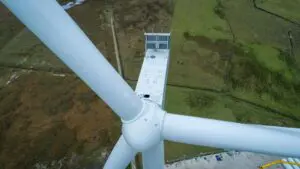
Earlier this week, an eagle-eyed local spotted two turbines at the Dundonnell wind farm in western Victoria missing a blade each, but owner Tilt Renewables insists it’s all part of the company’s maintenance plan.
Four of the 80 turbines at the five year old wind farm are having their pitch bearings changed as part of what a Tilt spokesperson says is routine maintenance to proactively replace components.
“We are undertaking a bearing replacement as part of our maintenance. Eventually, all 80 turbines will have upgraded blade bearings,” the spokesperson told Renew Economy.
“The upgraded bearings will have a significantly longer operational life than the current ones.”
Wind turbine supplier Vestas is in charge of the maintenance program, which takes each turbine offline for 12 days to take each blade off to replace what’s called a pitch bearing, which connects the bottom of the blade to the motor.
The work on the four turbines should be finished by May, the spokesperson says.
“Bearing upgrades for other turbines are being programmed into our future maintenance program,” the spokesperson said.
“Dundonnell Wind Farm continues to operate well…We are not expecting this program to significantly impact generation. Our operational program allows for a proportion of turbines to be removed from service at specific intervals for planned maintenance.”
There have been problems in the past at the 336 megawatt (MW) Dundonnell wind farm, which began producing power in 2020.
In October 2020, a 73 metre, 70 tonne blade fell off one of the newly installed Vestas turbines when bolts holding it to the hub became loose.
A month later, however, the wind farm was operational again and moving through the Australian Energy Market Operator’s staged commissioning process.
Long-standing problem
Bearings should last the life of a turbine, but until a decade ago turbine owners were having a real problem getting pitch bearings to last, says wind turbine consultant Rosie Barnes.
“When they started adding pitch bearings to blades it took them a while to design for this really unique operating environment [within the turbine structure]. I would say we’re past that time. It’s more common that a main bearing would fail now,” she told Renew Economy.
Pitch bearings allow the blade to be angled to best capture winds, and move only to shift the blade in or out of the wind — not when it’s spinning.
But Barnes says these components work under unusual conditions for a bearing, operating under the heavy load created by the blade at the point where the forces on it are highest.
Three months ago Barnes pointed out on Linkedin, via her consultancy, that this is still a common problem for wind farms.
“At least one Australian wind farm has recently had over half of its turbines out of action due to pitch bearing failures, with components having to be transported offsite for repair after only six years,” she wrote.
“It’s a stark reminder that keeping turbines spinning isn’t just about building them – it’s about maintaining them too.”
Problems include microscopic cracks beneath the bearing surface caused by high loads, static oscillating movements creating flat spots, and a lack of lubrication caused by slow rotational speeds and high loads, and not enough lubrication moving around the metal parts due to the slow speeds at which they move.