I get a bit tired of repeated, breathless articles “exposing” how almost every action that helps our transformation towards a low-carbon, advanced global economy is actually a problem. Nothing is perfect, but a lot of changes are positive – if they are well-managed.
For example, I often hear expressions of concern about the carbon (and broader) environmental impacts of digitalisation.
The International Energy Agency has looked at this issue and found that, overall, the net benefits of digitalisation (through energy savings and productivity improvements) usually far outweigh the impacts.
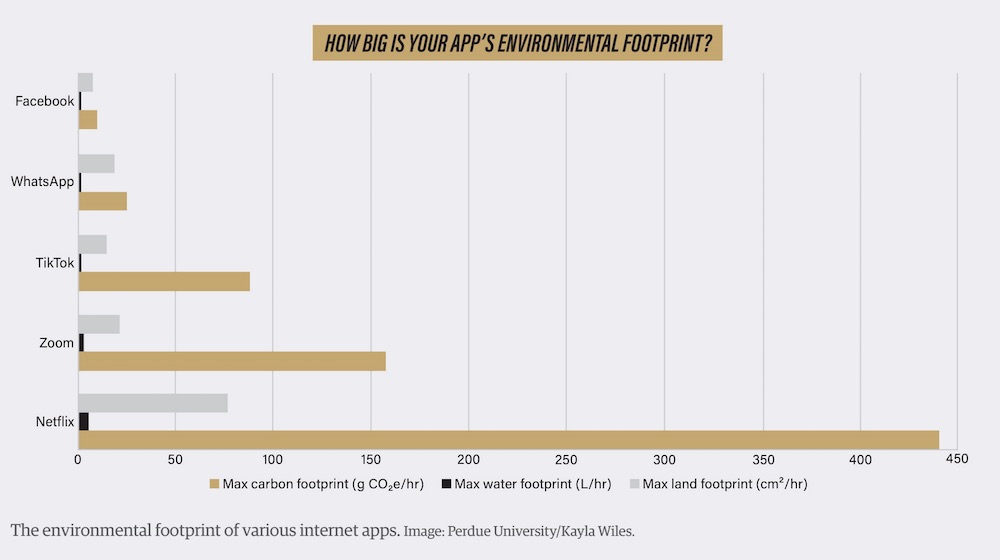
The graph here provides insights into the worst-case environmental impacts of some internet apps, but it doesn’t put them into context. For example, an hour spent on Zoom generates less CO2 than driving a car a kilometre. Avoiding a five-kilometre car trip cuts emissions by more than a two-hour, “worst case” Netflix video.
According to the International Civil Aviation Organization flight calculator, a return flight between Melbourne and Sydney generates 141kg of CO2. Add another 25kg for 100km of taxi travel to and from airports; the result is equivalent to over 1000 hours of Zoom.
Scientists estimate that the indirect climate impacts of air travel, including release of water vapour and pollutants at high altitude and contrails, can double or triple the overall impact relative to the CO2 emissions. So the gap between flying and Zooming is actually much bigger.
Of course, it’s much more complex than this. On one hand, many digital businesses are investing heavily in energy efficiency and renewable energy, so impacts of internet apps are declining below the worst case shown in the graph.
On the other hand, we may spend more time watching movies. But we need to compare our energy use while watching movies at home against what else we might have done in that time!
Our ability to maintain long-distance internet relationships may encourage us to take extra flights. Then there is the obsolescence and resource waste driven by frequent equipment replacement without effective recovery and recycling.
How we use the internet also matters: a tablet computer uses about 4W, while a 4-Star big screen “smart” TV may use 180W (but then, a 7-Star model only uses half of that).
There are some digital endeavours that are unambiguously terrible from an emissions perspective: cryptocurrency mining, for example. The Bitcoin network alone has recently been estimated to be consuming 129TWh per year, which would rank it 29th amongst entire countries worldwide.
It’s a complicated world!
Alan Pears, AM, is one of Australia’s best-regarded sustainability experts. He is a senior industry fellow at RMIT University, advises a number of industry and community organisations and works as a consultant.
This article was originally published in Renew magazine. Republished here with permission.
Construction of the "hydroelectric station the size of the Sydney Opera House" has started laying…
Leading solar expert says cost of recycling scheme should be paid by end-users, including solar…
A new report finds that monitoring of methane emissions can be significantly improved, particularly for…
Germany's cabinet approves roadmap to phase out oil, coal and gas across energy, industry, buildings and…
Eastern Australia is not yet in the grip of a terrible 2019-20-like drought but early…
Queensland has ripped up its renewables target and cancelled projects, but it remains a hot…