Liddell coal generator. Image: AGL
AGL Energy, the country’s biggest coal generator – and the biggest polluter because of it – has declared that the “world is changing” as it prepared to shut the last of its units at the ageing Liddell coal generator on Friday, and replace it with new, clean technologies.
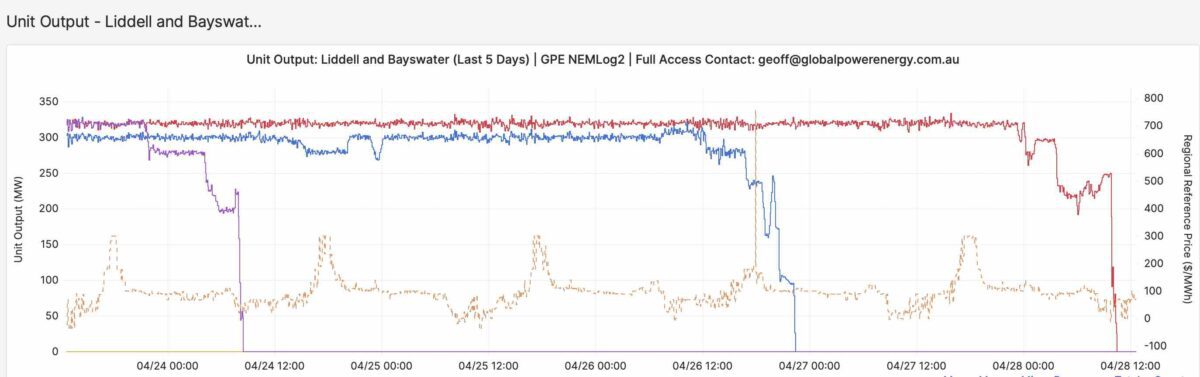
AGL has been steadily closing the four units at the 51-year-old plant – the first last April, the second on Monday and the third on Wednesday – and the last was closed just before 10.30am on Friday.
“The world is changing and so is AGL,” AGL CEO Damien Nicks said in prepared remarks released ahead of the closure event.
“Today marks the end of one chapter for the site, but also the beginning of another with our plans to transform the site into the Hunter Energy Hub.
“We already have plans underway to build a 500 MW grid-scale battery on the site, a feasibility study into a hydrogen facility is underway, and we are also exploring options with potential partners in industries such as solar, wind, and waste-to-energy.”
It’s been nearly a decade since AGL bought Liddell as part of the purchase of Macquarie generation from the NSW government, and seven years since it gave notice that it would close Liddell down.
It’s only recently though, that AGL has fully engaged with the idea of the green energy transition – at least in a way that might be broadly compatible with acceptable climate targets – and part of this is because of the influence of shareholder and green activist Mike Cannon-Brookes and a changing of the guard at executive and board level.
AGL now has plans to transform all its fossil fuel centres – in the Hunter Valley where Liddell and Bayswater are based, in South Australia where the Torrens Island gas hub is based, and in Victoria with the highly polluting Loy Yang A – into new green energy and industrial hubs.
This week AGL switched on the 250MW/250MWh Torrens Island battery for the first time, and it intends to do the same at both Liddell and Loy Yang, and add other green energy technologies and industrial centres too.
“The closure of Liddell and the repurposing of the site as an industrial renewable energy hub is an example of AGL’s climate transition plan in action,” Nicks said in his statement.
“It will reduce AGL’s emissions by around 8 million tonnes per year – the equivalent to approximately 5 per cent of emissions from Australia’s electricity sector in 2021.”
But it will not mean any change in Australia”s climate pollution rankings. AGL’s scope 1 emissions, according to the Clean Energy Regulator, were more than double the next highest in 2021/22.
It would need to close either Bayswater or the Loy Yang A coal generators to lose the title of Australia’s biggest carbon polluter, but currently intends to close neither in the next decade.
The actual demolition process at Liddell will take around two years to complete, with the two giant chimneys to be brought down in 2024, along with a vow to recycle more than 90 per cent of the materials in the power station, including 70,000 tonnes of steel.
The critical infrastructure such as transmission connections to the grid will be retained for use by the proposed big battery and other generation and storage projects. The site will eventually be known as the Hunter Energy Hub,
More than half of our Liddell employees will transfer to the neighbouring Bayswater coal fired power station, which is expected to run for another decade. The rest have either decided to retire or sought opportunities elsewhere.
Australian BEV sales pass the 20% mark for the second month in a row as…
EnergyAustralia looks to options for its Yallourn coal site as it reports big customer losses,…
Project to add solar and storage to an off-grid power system is the latest in…
Industry insiders reject a persistent anecdote that 10% of solar panels arrive at major projects…
Bowen strict rules on data centres will likely help the country meet its renewables target,…
China makes the most solar panels, most of the batteries and many of the wind…