AGL Energy has commenced decommissioning of the Liddell power station, closing its first unit. (Photo credit: AGL Energy)
AGL Energy is juggling the expected closure dates of its last three remaining units at the ageing Liddell coal generator, but insists that the last unit will be shut down on Friday, April 28, as planned.
The juggling of the schedule has seen the advertised timing of the shut-down of the first of the last three units shifted in the last 24 hours from Wednesday, April 19, to Friday, April 22, and now to Monday, April 22.
The second unit is now due to close on Wednesday, April 26, and the last unit on Friday, April 28. However, a spokesman for AGL said the closure times of the first two units could still be subject to change.
The closure of Liddell – once the biggest coal generator in the country when switched on in the early 1970s – is a landmark event for Australia and its green energy transition.
Its significance is not so much in the loss of the plant itself – the ageing facility has been massively de-rated and has become increasingly unreliable – but in the way it has galvanised debate about Australia’s renewable transition since its closure was first flagged in 2015.
Arguably, the debate around the Liddell closure and what follows it has cost the jobs of at least three AGL CEOs, and two prime ministers. The closure of the remaining 21GW of coal power in Australia is inevitable, but is now just a question of when, and how to ensure enough replacement capacity is built.
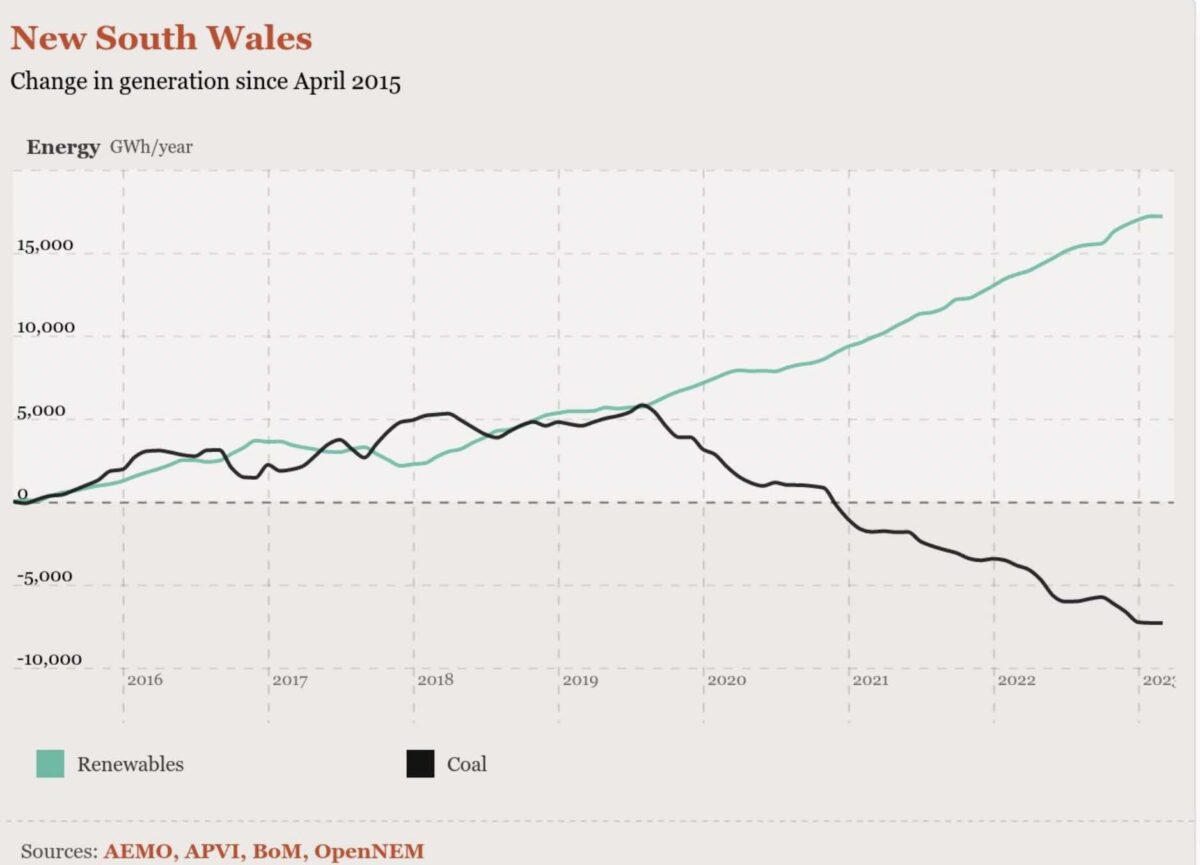
Several media articles have questioned whether enough new wind, solar and storage has been built to replace the lost Liddell capacity, but as UNSW energy analyst Dylan McConnell tweeted, renewable energy generation in NSW has grown much more than Liddell annual output ever was since 2015.
The new NSW Labor government has been openly questioning the wisdom of announcing an August, 2025, closure date for the biggest coal generator in the country, the 2.8GW Eraring facility, and has suggested it might buy back the plant to keep it running longer.
But in a statement issued on Tuesday, the NSW energy minister Penny Sharpe thanking AGL and the Liddell workforce for the orderly way in which the transition has been managed.
“Liddell has served NSW well for more than 50 years. But it’s not our energy future. NSW is already transitioning to a renewable energy future and that will continue,” Sharpe said.
The minister noted that Liddell had already been derated to 1260MW in 2022 (thanks to the closure of one unit and the derating of the remaining three), and new renewable projects constructed in NSW since mid-2019 can produce the same or more electricity each year.
This included some 2060MW of large-scale solar and 840MW of wind.
“NSW’s energy future is mostly renewable power. Renewables are the cheapest power for families and businesses, and they bring us towards a net zero future,” she said.
“The government is focused on ensuring that more projects are coming through the pipeline – coupled with transmission, firming, and large-scale batteries to maintain reliability of supply.” The statement made no mention of Eraring.
The closure of the 50-year Liddell comes at a pivotal time for the country, with a group of Australia’s biggest clean energy investors on Monday calling for the closure of Australia’s remaining coal fired power stations within a decade to ensure an energy transition in line with 1.5°C targets.
The Clean Energy Investor Group said the target was achievable but needed clear government support, and targets. And it needed those targets to be accelerated, particularly in Victoria, NSW and Queensland.
Amandine Denis-Ryan from IEEFA on what can be done about Australia's unique and unhealthy dependence…
A Melbourne project to assess apartment buildings' electrification potential suggests that technically it's doable but…
The former Nationals leader has come out swinging on social media against a global wind…
The only wind farm under construction in NSW has entered the grid management system, the…
Large-scale solar generation hit record highs in three states across Australia's main grid in September,…
High Court reverses NSW approval for an extension of one of the country's biggest coal…